
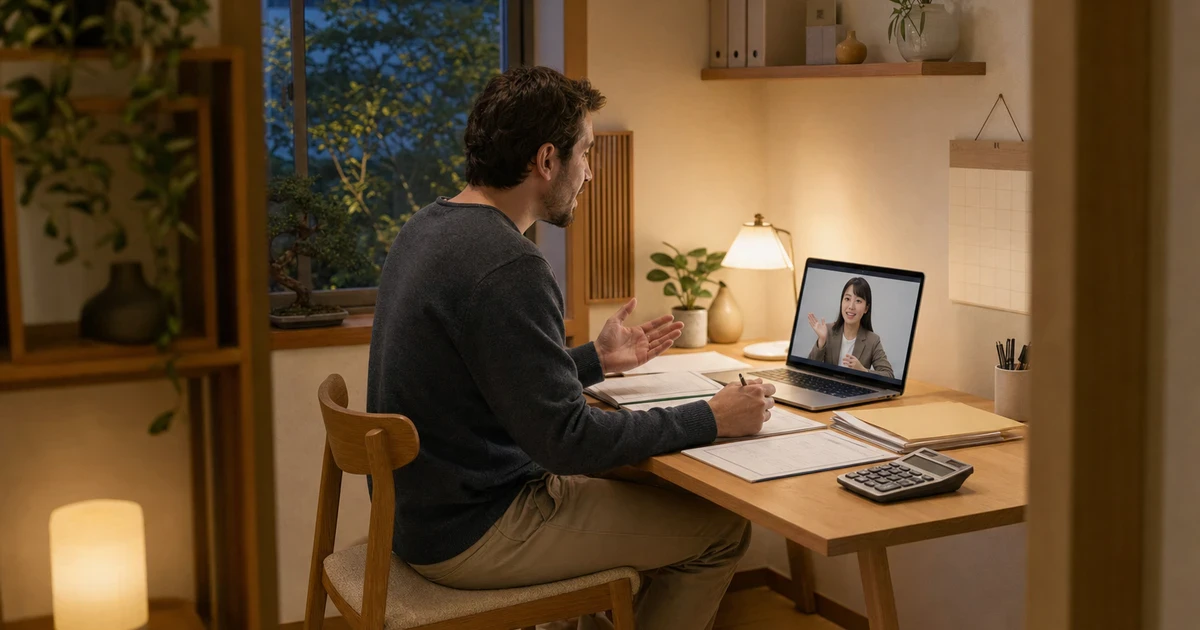
Online Japanese lessons for accountants work best when they focus on the language you actually need: documents, deadlines, numbers, client clarification, and polite correction. You do not need random textbook dialogues about travel if your real problem is explaining that an invoice is missing information or asking when a report is due.
For accountants outside Japan, the useful goal is not “perfect business Japanese.” It is being able to handle realistic accounting conversations with a live teacher: checking details, confirming documents, asking careful questions, and sounding professional without becoming overly stiff.
Kind Japanese offers one-on-one online Japanese lessons over LINE. Standard one-on-one lessons are 25 minutes, which is enough time to practise one narrow accounting situation, receive teacher feedback, and repeat the conversation more naturally.
What Accountants Should Practise First
Accountants should begin with clarification language before advanced technical vocabulary. If you cannot ask “Which document do you mean?” or “When is this needed?” smoothly, more specialised words will not help much in a live client conversation.
Useful practice areas include:
- Asking for missing documents
- Confirming invoice details
- Checking deadlines
- Explaining that information is incomplete
- Asking a client to clarify a number, date, or file
- Politely correcting a misunderstanding
- Summarising the next step
From a teacher’s perspective, learners often know individual accounting words but hesitate when they need to connect them politely in real time. A one-on-one tutor can slow the exchange down, let you try the sentence first, then give feedback on grammar, politeness, and natural phrasing.
A short cultural note: in Japanese business communication, directness is often softened. Instead of saying “This is wrong,” you may need language closer to “Could you please check this part?” The goal is not to be vague; it is to protect the working relationship while still getting accurate information.
If you are deciding whether private lessons are worth it for this kind of professional goal, Kind’s article Is It Worth Paying for Japanese Lessons? can help you think through the value of guided feedback.
Core Phrases for Documents and Deadlines
The phrases below are not a full accounting glossary. They are a practical starter set for role-play, teacher correction, and client clarification practice.
Japanese | Romaji | English Meaning |
|---|---|---|
書類 | shorui | document / paperwork |
請求書 | seikyūsho | invoice |
領収書 | ryōshūsho | receipt |
締め切り | shimekiri | deadline |
確認させてください | kakunin sasete kudasai | Please let me confirm |
いつまでに必要ですか | itsu made ni hitsuyō desu ka | When do you need it by? |
もう一度ご確認いただけますか | mō ichido go-kakunin itadakemasu ka | Could you please check once more? |
不足しています | fusoku shite imasu | It is missing / insufficient |
追加で必要です | tsuika de hitsuyō desu | It is additionally required |
ご連絡いたします | go-renraku itashimasu | I will contact you / follow up politely |
These phrases become more useful when you practise them in full turns, not as isolated flashcards. For example, a teacher might ask you to explain what is missing from a file, then adjust your sentence so it sounds polite enough for a client but still clear.
Example Sentences in Context
書類を確認させてください。 shorui o kakunin sasete kudasai. Please let me check the documents.
この請求書の日付をもう一度ご確認いただけますか。 kono seikyūsho no hizuke o mō ichido go-kakunin itadakemasu ka. Could you please check the date on this invoice once more?
領収書が一枚不足しています。 ryōshūsho ga ichi-mai fusoku shite imasu. One receipt is missing.
締め切りはいつまでですか。 shimekiri wa itsu made desu ka. When is the deadline?
確認後、こちらからご連絡いたします。 kakunin-go, kochira kara go-renraku itashimasu. After checking, I will contact you from our side.
Role-Play That Matches Real Accounting Work
Role-play is especially useful for accountants because the pressure is rarely the vocabulary alone. The hard part is responding politely when something is missing, unclear, urgent, or inconsistent.
A focused LINE lesson can use situations like these:
- A client sends an invoice without a date.
- A receipt total does not match the reported amount.
- A deadline is unclear.
- A document name is unfamiliar.
- A client asks whether a file is enough, but you need one more item.
- A colleague wants a quick summary of what is still missing.
A simple role-play might have two sides:
Client side: “I sent the invoice yesterday. Is that enough?”
Accountant side: “Thank you. I have confirmed the invoice, but the receipt is still missing. Could you please send it by Friday?”
Teacher feedback can then focus on whether your Japanese was too direct, too casual, too vague, or too long. The most helpful loop is usually:
- Say the sentence naturally, even if imperfect.
- Receive one or two corrections.
- Repeat the corrected version.
- Try the same function with a slightly different document or deadline.
This speak-correct-repeat pattern helps you build usable professional Japanese, not just recognition knowledge.
A 25-Minute LINE Lesson Flow
A standard Kind Japanese one-on-one lesson is 25 minutes, so the best accounting lesson has a narrow target. One lesson should not try to cover tax vocabulary, keigo, invoice checking, and presentation skills all at once.
A practical 25-minute LINE lesson flow could look like this:
- Warm-up: briefly explain your accounting role and the type of Japanese you need.
- Target phrase check: practise two or three phrases for documents, deadlines, or client clarification.
- Speaking task: role-play one realistic client exchange.
- Correction: receive teacher feedback on grammar, politeness, and clarity.
- Repeat: say the improved version again until it feels easier.
- Next question: note one phrase or situation you want to ask about in a future lesson.
For time-zone planning, prepare lesson-window suggestions in your own local time and keep them concrete. For example, you can say that evenings in your country are easier, or that you want to avoid work deadlines at month-end. Do not worry about saying this perfectly at first; it can become part of your lesson practice.
If you are preparing for a first lesson, Japanese Free Trial Lesson Questions to Ask gives useful ideas for turning your goals into clear questions.
Common Mistakes
Learners often sound too direct when asking for missing documents. “Send the receipt” may be grammatically understandable, but a client-facing sentence usually needs a softer request. Practise asking clearly without sounding blunt.
Learners often overuse dictionary-style accounting words without practising the sentence around them. Knowing the word for invoice is useful, but you also need to say who sent it, what is missing, and when it is needed.
Learners often confuse katakana in document names or file labels. In our one-on-one lessons, our teachers have seen learners mix up characters such as ツ (tsu, katakana “tsu”) and シ (shi, katakana “shi”), or ソ (so, katakana “so”) and ン (n, katakana “n”). For accountants, that matters because a small reading mistake can affect names, file titles, or imported terms.
Learners sometimes borrow casual Japanese from anime or online media. Words such as 君 (kimi, casual “you”) or あんた (anta, rough “you”) can sound unsuitable in client communication. Accounting Japanese should usually be neutral, polite, and boring in the best possible way.
Learners often translate English business habits too literally. In Japanese, a softer phrase may still carry a clear meaning. The key is to practise with teacher feedback so you know when a phrase is polite enough and when it becomes unclear.
FAQ
Do accountants need business Japanese or accounting Japanese first?
Most accountants need practical business Japanese first, then accounting vocabulary. Start with confirming documents, asking about deadlines, and requesting clarification. Once those sentence patterns are stable, specialised accounting terms become much easier to use in real client conversations, emails, and LINE lesson role-plays.
Can online Japanese lessons help with client clarification?
Yes, online Japanese lessons can help if you practise realistic clarification tasks. A one-on-one tutor can play the client, listen to your wording, and give teacher feedback on whether your question is clear, polite, and specific. This is more useful than memorising phrases without using them.
Should I bring real accounting documents to a lesson?
You can bring sample situations or anonymised examples, but avoid sharing confidential client information. A safer approach is to describe the problem in general terms: a missing receipt, unclear invoice date, or deadline question. The lesson can focus on language practice, not document handling or professional advice.
Is a LINE lesson suitable for professional Japanese practice?
A LINE lesson can work well for focused speaking practice because it keeps the lesson direct and conversational. For accountants, that means you can practise short client exchanges, deadline questions, and polite correction in a compact format. The important part is choosing one clear speaking goal per lesson.
Book a Free Trial Lesson with Kind Japanese and practise the accounting Japanese you actually need over LINE.

