
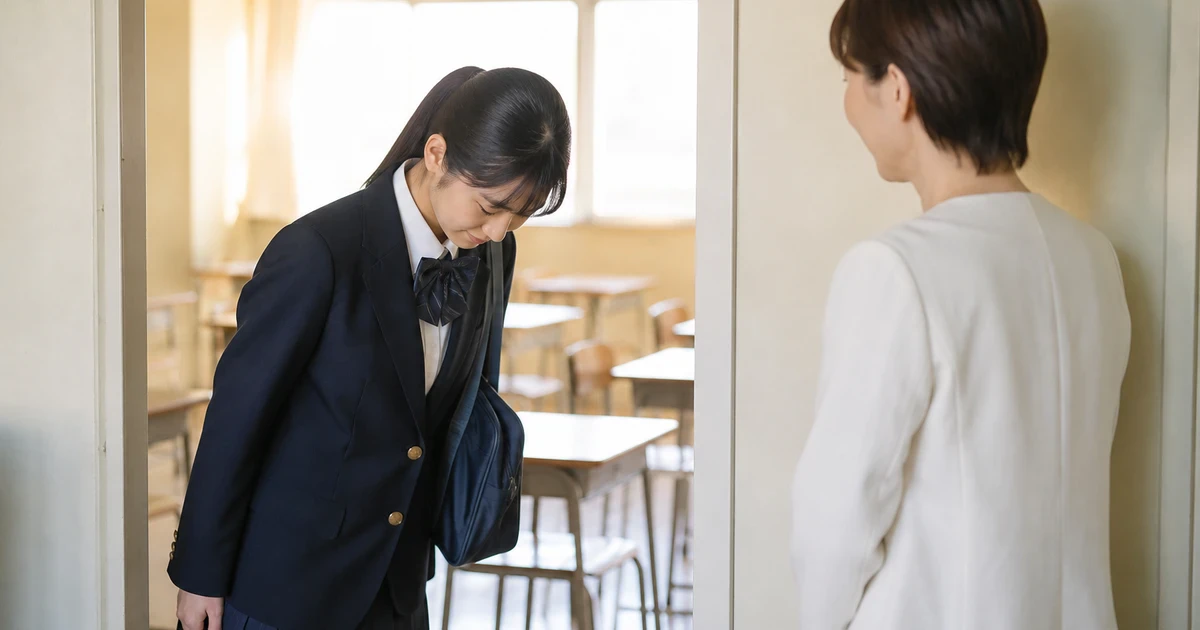
Japanese students usually greet the teacher politely before class, check materials, talk quietly with classmates, and use set classroom phrases when the lesson begins. The exact routine changes by school, age, teacher, and formality, but the most useful phrases are simple: greetings, apologies, readiness phrases, and short questions.
If you are learning school Japanese, the goal is not to copy every classroom ritual perfectly. It is to understand what students are likely to say, how polite it sounds, and when each phrase is natural.
What Students Usually Say Before Class
Before class, students often use short, polite greetings rather than long conversations. In many Japanese schools, students greet the teacher when they enter the room, when the teacher arrives, or when the formal start-of-class greeting happens.
Common situations include:
- Greeting the teacher in the hallway or classroom
- Saying good morning before a morning class
- Telling the teacher you forgot something
- Asking a classmate whether there is homework
- Preparing textbooks and notebooks
- Joining the formal class opening, if the school uses one
A typical student might say おはようございます (ohayō gozaimasu, good morning) to a teacher in the morning. To classmates, students may use the shorter おはよう (ohayō, morning), depending on closeness and school atmosphere.
A cultural note: in some Japanese classrooms, a student leader may call out formal commands such as 起立 (kiritsu, stand up), 礼 (rei, bow), and 着席 (chakuseki, sit down). Not every school, grade, or class uses the same routine, so treat this as a common pattern, not a universal rule.
Essential Classroom Phrases
These classroom phrases are useful for understanding what students say before class and at the very beginning of a lesson. Some are for teachers, some are for classmates, and some are part of the class routine.
Japanese | Romaji | English Meaning |
|---|---|---|
おはようございます | Ohayō gozaimasu | Good morning |
こんにちは | Konnichiwa | Hello / good afternoon |
先生、おはようございます | Sensei, ohayō gozaimasu | Good morning, teacher |
よろしくお願いします | Yoroshiku onegai shimasu | Please treat me favorably / I look forward to the lesson |
授業を始めましょう | Jugyō o hajimemashō | Let’s start class |
宿題を出します | Shukudai o dashimasu | I will hand in my homework |
宿題を忘れました | Shukudai o wasuremashita | I forgot my homework |
教科書を忘れました | Kyōkasho o wasuremashita | I forgot my textbook |
遅れてすみません | Okurete sumimasen | I’m sorry I’m late |
質問があります | Shitsumon ga arimasu | I have a question |
もう一度お願いします | Mō ichido onegai shimasu | One more time, please |
分かりました | Wakarimashita | I understand |
まだ分かりません | Mada wakarimasen | I still don’t understand |
今日はテストがありますか | Kyō wa tesuto ga arimasu ka | Is there a test today? |
The phrase よろしくお願いします (yoroshiku onegai shimasu, I look forward to your help / please treat me well) is especially important in school Japanese. It can sound strange if translated literally, but it is a very normal polite phrase before a lesson, club activity, meeting, or practice session.
Realistic Before-Class Examples
These examples show natural student language in context. They are simple enough for beginners but still sound like real Japanese classroom speech.
先生、おはようございます。 Sensei, ohayō gozaimasu. Good morning, teacher.
宿題を忘れました。すみません。 Shukudai o wasuremashita. Sumimasen. I forgot my homework. I’m sorry.
今日はテストがありますか。 Kyō wa tesuto ga arimasu ka. Is there a test today?
教科書を忘れたから、見せてくれる? Kyōkasho o wasureta kara, misete kureru? I forgot my textbook, so could you show me yours?
The last sentence is casual and is for a classmate, not a teacher. With a teacher, the learner should use a more polite version such as 教科書を忘れました (kyōkasho o wasuremashita, I forgot my textbook) and then explain the situation politely.
How Formal Should Students Be?
Students usually speak more politely to teachers than to classmates. This is one of the biggest differences learners need to notice before class.
To a teacher, use polite endings such as です (desu, to be) and ます (masu, polite verb ending). To classmates, casual speech may be natural if you are friends or the classroom culture allows it.
For example:
- To a teacher: “I’m sorry I’m late.”
- To a classmate: “Sorry, I’m late.”
In Japanese, that difference often changes the whole sentence ending. A teacher can help you hear whether your sentence sounds too casual, too stiff, or just right for the situation. This is one reason human correction matters; AI can generate phrases, but live feedback helps you adjust tone in real time. For a broader comparison, see AI Japanese Tutor vs Human Teacher: What Works Best.
From a teacher’s perspective, learners often know the vocabulary for school items but need feedback on register: who they are speaking to, how formal the moment is, and whether the sentence ending matches the relationship.
Common Mistakes
Learners often translate classroom phrases word by word, which can make otherwise correct Japanese sound unnatural. The main issue is usually not vocabulary; it is timing, politeness, and context.
Using casual greetings with teachers too quickly.
おはよう (ohayō, morning) is common among friends, but おはようございます (ohayō gozaimasu, good morning) is safer for teachers, school staff, and adults you do not know well.
Overusing “you” when speaking to the teacher.
Japanese often avoids direct “you” words. Instead of trying to say “teacher, can you explain this?”, learners can often use 先生 (sensei, teacher) or simply make the request politely.
Forgetting apology language before explanations.
If you are late or forgot homework, start with すみません (sumimasen, I’m sorry / excuse me). The explanation alone can sound abrupt.
Using one phrase for every classroom situation.
よろしくお願いします is useful, but it does not replace every greeting. Before class, students may greet, apologize, ask a practical question, or respond to the teacher. Each situation needs its own phrase.
Sounding too textbook-like with classmates.
Very formal Japanese with close classmates can sound distant. Learners need both polite school Japanese for teachers and natural, simpler phrases for students.
Practicing School Japanese Online
A focused one-on-one lesson is a practical way to turn memorized classroom phrases into real speech. Kind Japanese offers 25-minute one-on-one lessons over LINE, which fits this topic well because school Japanese depends on quick correction: greeting, responding, asking again, and adjusting politeness.
A simple lesson flow might look like this:
- Warm up with basic greetings for teachers and students.
- Practise one before-class situation, such as being late or forgetting homework.
- Receive correction on word choice, particles, and sentence endings.
- Repeat the same situation more naturally.
- Keep one or two follow-up questions in LINE for your next lesson preparation.
If you are comparing whether lessons are worth paying for, Is It Worth Paying for Japanese Lessons? can help you think through what a tutor adds beyond self-study.
To practise these phrases with one-on-one feedback, book a Free Trial lesson with Kind Japanese and bring one school or classroom situation you want to handle naturally.
FAQ
Do Japanese students always bow before class?
Many Japanese schools use some kind of greeting routine, and bowing may be part of it, especially in elementary, junior high, and high school settings. Still, routines vary by school, teacher, age group, and class style. It is better to learn the common pattern while staying flexible.
What is the most common greeting before class?
In the morning, おはようございます (ohayō gozaimasu, good morning) is one of the safest greetings for a teacher. Later in the day, こんにちは (konnichiwa, hello / good afternoon) may be used. With classmates, shorter and more casual greetings are common if the relationship is friendly.
Can I use these phrases in a Japanese language school?
Yes, many of these phrases are useful in Japanese language schools, especially greetings, apology phrases, and questions about homework or tests. Adult classrooms may feel less formal than Japanese school homerooms, but polite Japanese is still a safe starting point with teachers.
What should I learn after basic classroom phrases?
After basic greetings, learn how to ask for repetition, say what you do not understand, explain small problems, and respond politely to correction. These skills make class smoother because you are not only starting the lesson; you are participating in it.

