
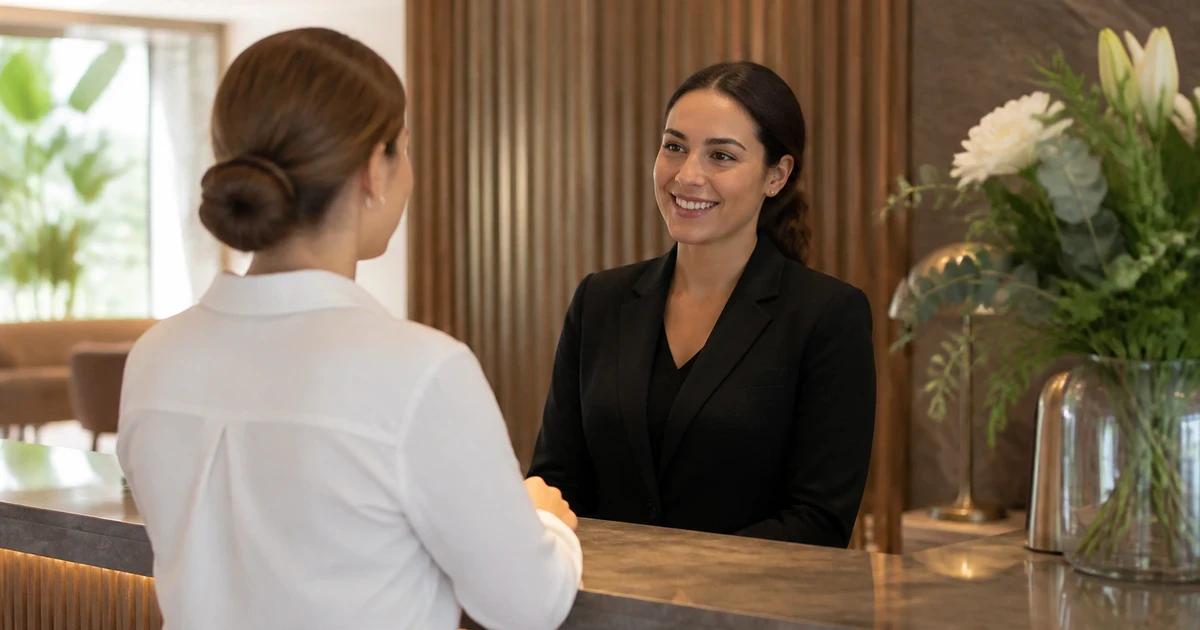
Japanese lessons for hospitality workers should focus on real guest interactions: greeting, confirming requests, apologizing clearly, explaining options, and sounding calm under pressure. You do not need to speak perfect Japanese to serve Japanese guests well, but you do need phrases that are polite, accurate, and easy to say in a busy workplace.
Hospitality Japanese is different from textbook Japanese. A hotel front desk, restaurant floor, café counter, tour desk, or concierge station requires short, reliable language. You need to understand what the guest wants, respond politely, and avoid sounding too casual or too stiff.
From a teacher’s perspective, learners often know more grammar than they can use during customer service roleplay. The solution is not memorizing hundreds of phrases at once. It is practising a small set of useful expressions until your mouth can produce them naturally.
What Hospitality Workers Need in Japanese
Hospitality workers need service Japanese that is polite, brief, and situation-based. The most useful topics are guest greetings, booking details, room or table requests, food questions, payment, apologies, and simple directions.
If you work in a hotel, “hotel Japanese” usually includes:
- Welcoming guests
- Confirming names and reservations
- Asking for a room number
- Explaining check-in or check-out basics
- Handling luggage, waiting time, and simple problems
If you work in a restaurant, “restaurant Japanese” usually includes:
- Asking the number of guests
- Confirming allergies or dietary requests
- Offering menus and drinks
- Explaining availability
- Apologizing for delays or mistakes
The goal is not to sound like a Japanese hotel manual. Your goal is to make the guest feel understood. A simple, correctly pronounced sentence is usually better than a long sentence with uncertain grammar.
A short cultural note: Japanese customer service often uses softer expressions than direct English. For example, instead of saying “Wait,” staff usually choose a polite request such as 少々お待ちください (shōshō o-machi kudasai, please wait a moment). The meaning is simple, but the tone matters.
For hotel-specific phrase study, you can also review Japanese Hotel Phrases: 25 Must-Know Expressions alongside the general hospitality phrases below.
Core Phrases for Hotel and Restaurant Japanese
Start with phrases you can use many times per shift. The best hospitality phrases are flexible: you can use them with guests at a front desk, restaurant entrance, phone counter, or information desk.
Japanese | Romaji | English Meaning |
|---|---|---|
いらっしゃいませ | Irasshaimase | Welcome |
ご予約はございますか | Go-yoyaku wa gozaimasu ka | Do you have a reservation? |
お名前をお願いいたします | O-namae o onegai itashimasu | May I have your name, please? |
何名様ですか | Nanmei-sama desu ka | How many people are in your party? |
かしこまりました | Kashikomarimashita | Certainly / Understood |
少々お待ちください | Shōshō o-machi kudasai | Please wait a moment |
確認いたします | Kakunin itashimasu | I will check |
申し訳ございません | Mōshiwake gozaimasen | I sincerely apologize |
こちらへどうぞ | Kochira e dōzo | This way, please |
お飲み物はいかがですか | O-nomimono wa ikaga desu ka | Would you like something to drink? |
アレルギーはございますか | Arerugī wa gozaimasu ka | Do you have any allergies? |
英語のメニューがございます | Eigo no menyū ga gozaimasu | We have an English menu |
お部屋番号をお願いいたします | O-heya bangō o onegai itashimasu | May I have your room number, please? |
ただいまご用意いたします | Tadaima go-yōi itashimasu | I will prepare it now |
もう一度お願いいたします | Mō ichido onegai itashimasu | Could you say that once more, please? |
Do not try to learn every possible version first. Choose five phrases for your job and practise them until they feel automatic. Then add variations.
For pronunciation, pay special attention to long vowels. In お名前 (o-namae, name), the polite prefix お is short. In 少々 (shōshō, a little), both long “ō” sounds matter. If your long vowels are too short, the phrase may still be understandable, but it can sound less polished. For a deeper comparison of app-based checking and live correction, see Japanese Pronunciation Feedback: Apps vs Teachers.
Example Sentences in Real Service Contexts
Use full sentences only when they help the guest. In hospitality, short and complete is usually more effective than long and complicated.
ご予約はございますか。 Go-yoyaku wa gozaimasu ka. Do you have a reservation?
お名前をお願いいたします。 O-namae o onegai itashimasu. May I have your name, please?
少々お待ちください。確認いたします。 Shōshō o-machi kudasai. Kakunin itashimasu. Please wait a moment. I will check.
申し訳ございません。ただいまご用意いたします。 Mōshiwake gozaimasen. Tadaima go-yōi itashimasu. I sincerely apologize. I will prepare it now.
こちらへどうぞ。 Kochira e dōzo. This way, please.
When practising, say the Japanese line once slowly, then once at natural speed. After that, imagine the guest’s likely response. This turns phrase memorization into customer service practice.
Roleplay Practice That Actually Helps
Roleplay is the fastest way to turn passive Japanese knowledge into usable hospitality Japanese. A good roleplay should be short, realistic, and repeatable.
For hotel Japanese, practise scenes such as:
- A guest arrives and gives a reservation name
- A guest asks to leave luggage
- A guest asks where breakfast is
- A guest says the room key does not work
- A guest wants a taxi or simple direction
For restaurant Japanese, practise scenes such as:
- A guest arrives without a reservation
- A guest asks for an English menu
- A guest asks about allergies
- A guest says the order is wrong
- A guest asks to pay separately
A practical 25-minute one-on-one LINE lesson for hospitality workers can be simple:
- Warm-up: say your job role and one common guest situation.
- Target speaking task: roleplay one hotel or restaurant scene.
- Correction: focus on one grammar point, one phrase choice, and one pronunciation issue.
- Repeat: perform the same roleplay again with cleaner Japanese.
- Learner question time: ask the questions you prepared in LINE before or during the lesson.
If you live outside Japan, propose lesson windows using your own time zone clearly. For example, you can write that you prefer evenings in your country, or give a few possible windows with your city or time zone. Avoid vague messages like “anytime,” because hospitality workers often have changing shifts and need realistic study slots.
If you want to practise guest-facing Japanese one-on-one, you can book a Free Trial lesson with Kind Japanese over LINE and bring one hospitality situation you want to roleplay.
Common Mistakes
From a teacher’s perspective, hospitality learners often need feedback on tone, pronunciation, and choosing the right level of politeness under pressure. These mistakes are fixable when you practise real sentences, not isolated words.
Using casual Japanese with guests.
Short does not mean casual. A phrase like “wait” may be grammatically understandable, but it can sound too direct in customer service. Learn polite service chunks as complete expressions.
Overusing long keigo before you can control it.
Very formal Japanese can sound unnatural if the grammar is broken. Start with stable phrases such as かしこまりました (kashikomarimashita, certainly) and 確認いたします (kakunin itashimasu, I will check), then expand.
Translating English service phrases too literally.
English “No problem” does not always map neatly into Japanese customer service. In many hospitality situations, a Japanese response like かしこまりました (kashikomarimashita, certainly) is safer and more professional.
Ignoring pronunciation rhythm.
Japanese rhythm is based on mora timing. Small っ (small tsu, pause marker), long vowels, and sentence endings can change clarity. For hospitality workers, unclear pronunciation can create practical problems when confirming names, room numbers, times, and orders.
Practising only perfect scenarios.
Real customer service includes delays, mistakes, unclear requests, and apologies. Include problem-solving roleplay so you can stay calm when something goes wrong.
How to Build a Weekly Practice Routine
A useful routine for hospitality Japanese should be small enough to repeat during a busy workweek. Ten focused minutes on the right scene is better than one long study session you cannot maintain.
Try this micro-routine:
- Choose one scene: check-in, table greeting, allergy check, apology, or payment.
- Pick three phrases from the table.
- Say each phrase aloud five times.
- Record yourself once and listen for long vowels and sentence endings.
- Roleplay both sides: staff and guest.
- Write one question you want to ask a teacher next time.
For pronunciation practice, use an app or dictionary audio as a reference, but do not stop there. Human feedback helps you notice whether your sentence sounds clear in context: vowel length, rhythm, pitch awareness, and whether the ending sounds too flat, too abrupt, or too uncertain.
For customer service, practise with emotion too. Say the same apology calmly, then say it while imagining a guest is disappointed. Japanese hospitality language is not only vocabulary; it is also timing, voice, and composure.
FAQ
Do hospitality workers need fluent Japanese?
No. Many hospitality workers can start by learning reliable phrases for greeting, confirming, apologizing, and explaining simple options. Fluency takes time, but clear service Japanese can be built step by step. The most important skill is using the right phrase at the right moment with understandable pronunciation.
Is hotel Japanese different from restaurant Japanese?
Yes, but they overlap. Hotel Japanese often focuses on reservations, room numbers, check-in, luggage, and directions. Restaurant Japanese focuses more on seating, menus, allergies, orders, and payment. Both require polite customer service language, short confirmations, and calm apologies when there is a delay or mistake.
How should I practise Japanese roleplay for hospitality work?
Choose one realistic guest situation and keep the roleplay short. First practise the staff lines slowly, then add the guest’s likely response. Repeat the same scene after correction so your second attempt is smoother. Roleplay works best when you focus on one service goal instead of many grammar points.
Can online lessons help with hospitality pronunciation?
Yes, especially when the lesson includes live correction. A reference app can help you check model audio, but a teacher can listen to your actual sentence and point out long vowels, rhythm, unclear sounds, and sentence-ending tone. For hospitality workers, that feedback directly improves guest-facing clarity.

