Frequent travelers need Japanese that works the second time, the third time, and the tenth time. If you fly often, stay in hotels, or eat out in Japan regularly, the most useful study is not a long vocabulary list. It is repeated practice of the same real situations until the words come out naturally.
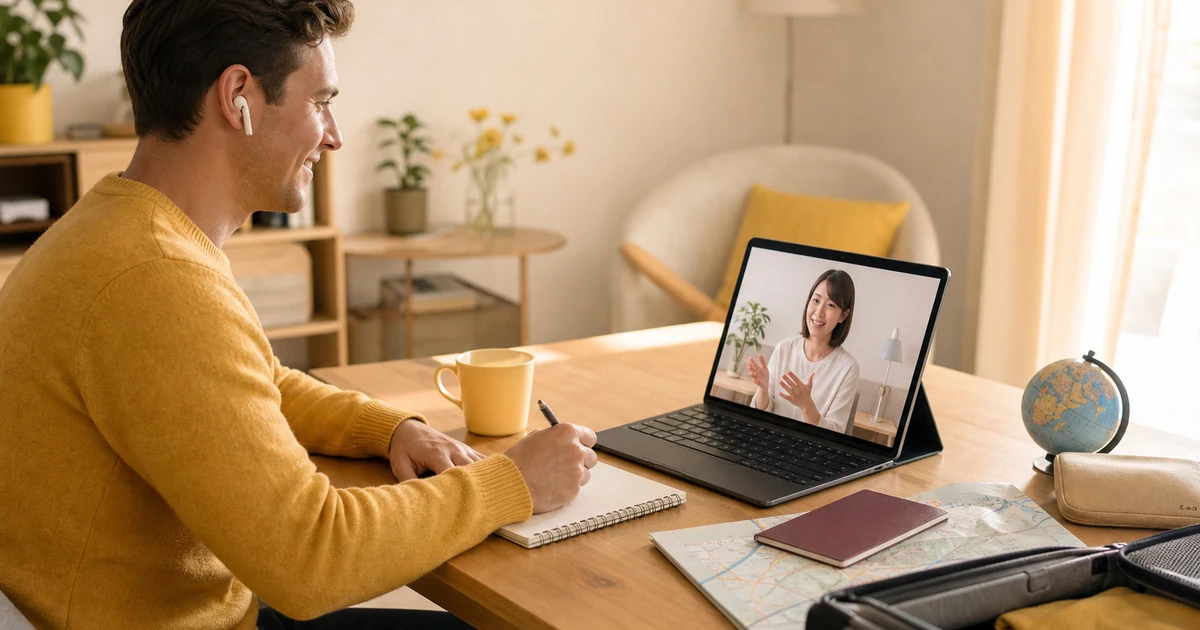
That is where online one-on-one lessons are useful. A live teacher can turn your actual trip pattern into focused travel Japanese practice: airport questions, hotel check-in, restaurant requests, and small repair phrases like “please say that again.” If your bigger goal is overall confidence in speaking, Build Speaking Confidence with a Japanese Tutor is a helpful companion read.
Why Frequent Travelers Need Real Conversation Practice
Frequent travelers usually do not need “more Japanese” in the abstract. They need faster access to the Japanese they already know.
A short live lesson is valuable because it can stay close to your real life. For example:
- You are landing late and need airport transport words.
- You are checking in after a long flight and want a calm hotel script.
- You are deciding what to order at a restaurant without freezing mid-sentence.
From a teacher’s perspective, the best travel practice is usually repeated role-play with quick correction, not memorising one perfect phrase and hoping it fits every situation. In our one-on-one lessons, our teachers often let learners speak through the full situation first, then give feedback on the parts that matter most: wording, politeness, and pronounceability.
A small cultural note helps here. In Japan, short and clear requests are often better than long explanations, especially at an airport or front desk. You do not need to sound dramatic or overly elaborate. You need to be understandable and appropriately polite.
Kind Japanese fits this kind of study well because it offers one-on-one online lessons over LINE, and the standard lesson length is 25 minutes. That is enough time to practise one scenario properly without trying to cram in your whole trip.
Core Travel Japanese for Repeated Trips
These phrases are worth learning because they can be reused across airports, hotels, and restaurants.
Japanese | Romaji | English meaning |
|---|---|---|
空港はどこですか | Kūkō wa doko desu ka | Where is the airport? |
予約しています | Yoyaku shite imasu | I have a reservation |
チェックインをお願いします | Chekkuin o onegai shimasu | I would like to check in |
おすすめはありますか | Osusume wa arimasu ka | Do you have a recommendation? |
これをください | Kore o kudasai | Please give me this one |
もう一度お願いします | Mō ichido onegai shimasu | Once more, please |
These are not “tourist-only” phrases. Frequent travelers use them to move smoothly through routine moments, especially when they return to the same cities or the same types of business trips.
If airport language is your main weak point, Japanese Airport Phrases: 30+ Essential Expressions is a useful companion before your next flight.
Example sentences
空港まで行きたいです。
Kūkō made ikitai desu.
I want to go to the airport.
ホテルでチェックインをお願いします。
Hoteru de chekkuin o onegai shimasu.
I would like to check in at the hotel.
おすすめの日本食レストランはありますか。
Osusume no nihonshoku resutoran wa arimasu ka.
Do you have a recommended Japanese restaurant?
もう一度ゆっくりお願いします。
Mō ichido yukkuri onegai shimasu.
Please say it again slowly.
How a 25-Minute LINE Lesson Can Work
A 25-minute lesson is long enough to complete one focused travel task and fix the most important mistakes. For frequent travelers, that usually means one airport, hotel, or restaurant scenario per lesson.
A practical lesson flow looks like this:
- Warm-up: Say where you are going, what kind of trip it is, and what situation feels hardest.
- Target speaking task: Do one role-play, such as checking in, asking for directions, or ordering food.
- Correction: The teacher points out the most useful improvements, including sentence choice and pronunciation.
- Next-step advice: You leave with one clear thing to rehearse before the next trip.
A useful way to prepare is to bring one real situation, not ten. For example, “I need to ask for late check-in at a hotel,” or “I need to ask whether this train goes to the airport.” That gives the online tutor something concrete to work with.
When you suggest lesson times, give them in your own time zone first. A message like “I am free Tuesday evening in Europe and Thursday morning my time” is clearer than a vague window. If you know the Japanese time difference, you can add it, but your local time should still be the anchor. That makes scheduling easier across time zones.
For a travel learner, a good lesson topic is often small and repeatable. One week it might be airport immigration language. Another week it might be restaurant questions about ingredients or payment. The point is not to cover everything at once. The point is to make the next trip easier than the last one.
Common Mistakes Frequent Travelers Make
The biggest mistake is memorising phrases without knowing when to switch them.
Frequent travelers often recognise a phrase in reading, but freeze when they have to produce it aloud in a new setting. A teacher can help by turning the phrase into a short spoken pattern, not just a vocabulary item.
Another common issue is overloading polite language. Learners sometimes make hotel or restaurant requests too long, which can make them harder to say under pressure. Clear and moderate politeness is usually better than a perfect but unusable script.
From a teacher’s perspective, learners often mix up tsu and shi, and they may also blur similarly shaped katakana when reading quickly. In our one-on-one lessons, our teachers often let the learner finish speaking first, then correct the key point afterward. That approach keeps the conversation moving while still fixing the problem.
A third mistake is translating too literally from English. “I want to go to the airport” is fine in English, but Japanese often sounds better when you choose the most natural request form for the situation. That is exactly where live feedback helps.
If you want to see how a live teacher can guide your travel Japanese more efficiently than self-study alone, book a Free Trial lesson over LINE and try one real travel scenario.
FAQ
Is online Japanese enough for frequent travelers?
Yes, if your goal is practical travel Japanese rather than broad classroom study. Online one-on-one lessons are especially useful for repeated situations like airport transfers, hotel check-in, and restaurant ordering, because you can practise the same pattern until it becomes automatic.
Should I study airport phrases first or hotel phrases first?
Start with the situation you hit most often. If you fly regularly, airport phrases may give you the fastest return. If you stay in the same kind of accommodation every trip, hotel language may matter more. The best order is the one that matches your real itinerary.
What should I bring to a lesson?
Bring one real situation, one or two sentences you already know, and one thing that feels difficult. A teacher can then focus on the exact wording, politeness level, and pronunciation you need. That keeps the lesson practical instead of turning it into general review.
How do I keep improving between trips?
Reuse the same short scripts in different contexts. For example, practice asking for help at an airport, then adapt the same request style for a hotel or restaurant. Short, repeated speaking practice works better than trying to learn entirely new expressions every time you travel.