
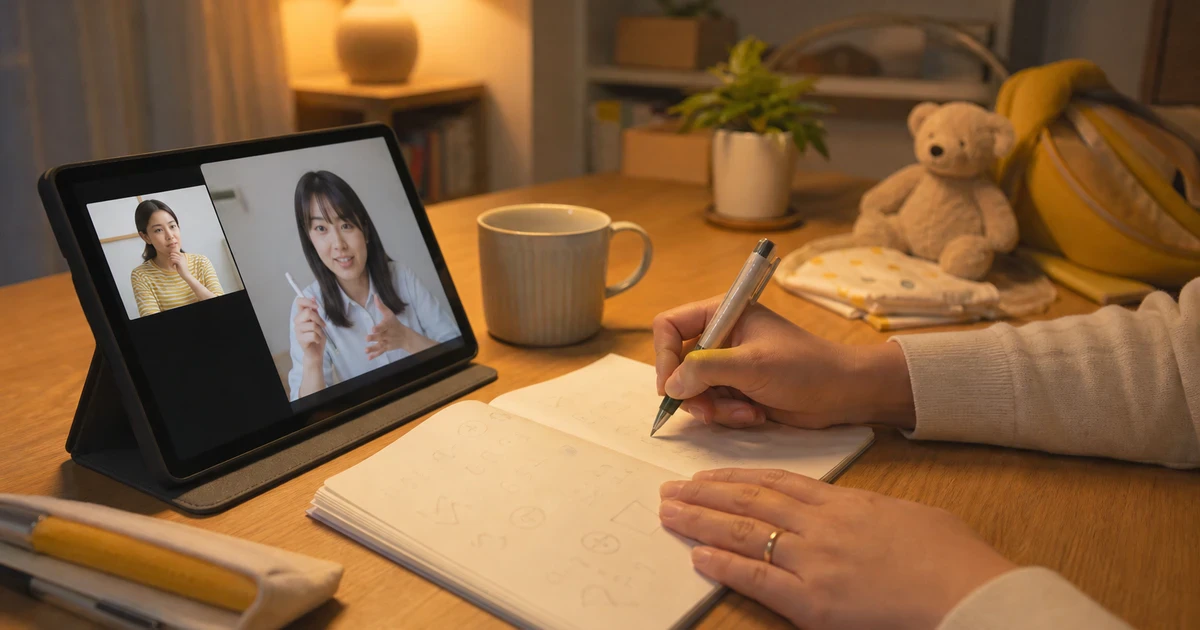
Parents in Japan need Japanese that works in real life: reading a school notice, explaining a fever at a clinic, greeting a neighbor, asking about a form, and responding politely without overthinking every sentence.
This is different from studying Japanese only for travel or tests. You do not need perfect grammar before you speak. You need reliable daily Japanese for situations where your child, home, schedule, and community are involved.
Kind Japanese offers one-on-one online lessons over LINE, with standard lessons lasting 25 minutes. For parents, that format can be useful because your lesson can focus on one real situation at a time: a school message, a doctor visit script, a neighborhood greeting, or the Japanese you need this week.
What Parents in Japan Actually Need First
Parents in Japan usually need practical communication before polished fluency. The most urgent areas are school, health, neighborhood life, and family routines.
For school communication, you may need to:
- Tell the school your child is absent or late.
- Ask what to bring for an event.
- Understand short notices about lunch, uniforms, fees, or schedule changes.
- Speak briefly with a teacher at pickup, drop-off, or a meeting.
For a doctor visit, you may need to explain symptoms clearly, understand dosage instructions, and ask simple follow-up questions. This article is language practice, not medical advice, but learning the right sentence patterns can reduce stress when you need care.
For the neighborhood, you need small but important phrases: greetings, apologies for noise, simple introductions, and polite questions about rubbish rules, building rules, or local events.
A short cultural note: in many Japanese communities, brief greetings matter more than long conversation. A simple, polite greeting said regularly can help you feel less invisible and make daily exchanges smoother.
If you are also comparing how much Japanese is needed for school life more broadly, Kind’s guide to How Much Japanese Do You Need to Study in Japan? gives a useful wider view.
Core Phrases for School, Health, and Daily Life
The fastest way to improve as a parent is to build a small set of reusable sentences. Do not memorize 100 phrases at once. Start with phrases that match your weekly life.
Japanese | Romaji | English Meaning |
|---|---|---|
子ども | kodomo | child |
学校 | gakkō | school |
保育園 | hoikuen | nursery school / daycare |
幼稚園 | yōchien | kindergarten |
小学校 | shōgakkō | elementary school |
先生 | sensei | teacher |
欠席します | kesseki shimasu | will be absent |
遅れます | okuremasu | will be late |
迎えに行きます | mukae ni ikimasu | will go to pick up |
持ち物 | mochimono | things to bring |
連絡帳 | renrakuchō | communication notebook |
熱があります | netsu ga arimasu | has a fever |
咳が出ます | seki ga demasu | has a cough |
病院 | byōin | hospital / clinic |
薬 | kusuri | medicine |
近所 | kinjo | neighborhood |
ごみ | gomi | rubbish / trash |
よろしくお願いします | yoroshiku onegai shimasu | thank you in advance / please treat me well |
Here are simple examples in context:
明日、子どもは学校を休みます。
Ashita, kodomo wa gakkō o yasumimasu.
My child will be absent from school tomorrow.
持ち物をもう一度教えてください。
Mochimono o mō ichido oshiete kudasai.
Please tell me the things to bring one more time.
子どもは昨日から熱があります。
Kodomo wa kinō kara netsu ga arimasu.
My child has had a fever since yesterday.
ごみは何曜日に出しますか。
Gomi wa nan-yōbi ni dashimasu ka.
What day should I put out the rubbish?
These are not fancy sentences, but they are strong sentences. They give you control over common parent situations without requiring advanced Japanese.
How an Online Lesson Can Fit Parent Life
A useful online lesson for parents should connect directly to your next real conversation. In a standard Kind Japanese one-on-one lesson, the 25 minutes can be used in a focused way:
- Warm-up: say what happened this week in simple Japanese.
- Target task: practise one parent situation, such as calling school, reading a notice, or speaking at a clinic.
- Correction: improve word choice, sentence endings, pronunciation, and politeness.
- Repetition: say the corrected version again until it feels usable.
- Next question: prepare one sentence or question you can use after the lesson.
This is especially helpful when your Japanese is “almost enough” but not stable under pressure. From a teacher’s perspective, learners often know the words separately but need feedback on order, naturalness, and tone. For example, a sentence may be grammatically understandable but too casual for school communication.
Our teachers have also seen learners mix up kana shapes such as similar katakana characters, or use anime-style second-person words that sound unnatural in ordinary family, school, or neighborhood settings. In parent life, sounding clear and polite matters more than sounding dramatic or advanced.
Because many people in Japan use LINE for everyday communication, becoming comfortable with short, clear Japanese messages can also support your wider life in Japan. That does not mean every problem should be handled by text. It means your Japanese study should include the kind of short, practical wording you will actually see and send.
If you are preparing for travel-style situations too, this phrase guide to Japanese Travel Words & Phrases for Your Japan Trip can help with stations, shops, and simple requests.
Common Mistakes
Learners often make parent communication harder by trying to sound too complete. In daily Japanese, a short, correct sentence is usually better than a long sentence that collapses halfway through.
Using casual language with schools.
A teacher does not need extremely formal business Japanese from you, but very casual phrasing can sound abrupt. Aim for polite plain communication: clear reason, clear request, and a simple thank-you.
Translating directly from English.
English phrases like “Can you let me know?” or “I was wondering if…” often become too long when translated word for word. In Japanese, “Please tell me one more time” or “Is this okay?” may be more natural.
Avoiding doctor visit practice because it feels stressful.
You do not need to explain everything perfectly. Practise symptom words, time expressions, and simple questions. For example: when it started, where it hurts, whether there is a fever, and how often medicine should be taken.
Mixing up friendly and family language.
Words learned from manga, anime, or casual media can be fun, but they may not fit a school office, clinic reception desk, or neighbor greeting. A teacher can help you replace entertaining Japanese with usable daily Japanese.
A Practical Study Plan for Parents
The best study plan for parents in Japan is situation-based. Instead of studying “Japanese grammar” in a broad way every day, connect grammar to one real-life task.
For school communication, practise:
- Absence and lateness messages.
- Pickup and drop-off timing.
- Asking about forms, events, lunch, or belongings.
- Confirming whether your understanding is correct.
For doctor visit Japanese, practise:
- Body parts and symptoms.
- When the symptom started.
- Medicine instructions.
- Asking whether your child can go to school.
For neighborhood life, practise:
- Greetings.
- Rubbish rules.
- Noise apologies.
- Simple self-introductions.
- Asking where something is located.
For daily Japanese at home and outside, practise:
- Shopping for child-related items.
- Asking for help at a station or city office.
- Reading short signs.
- Explaining family schedules.
If your schedule is tight, prepare one situation before each online lesson. You might bring a school notice, a phrase you heard, or a sentence you want to say. Use screenshots of maps, forms, train routes, or school messages as prompts for role-play, while keeping the lesson focused on language practice rather than administrative support.
When proposing lesson windows, use your own time zone clearly. For example: “weekday evenings in my time zone” or “Saturday morning Japan time.” If you live outside Japan but are preparing to move, practise the same parent situations early so the phrases feel familiar before daily life becomes busy.
You can start with a focused conversation in a Book a Free Trial Lesson with Kind Japanese, then decide which parent-life situations you want to practise next.
FAQ
Do parents in Japan need fluent Japanese?
No. Fluency helps, but parents in Japan first need dependable survival Japanese for school communication, clinics, neighborhood contact, and daily errands. A clear beginner sentence is often enough to solve the immediate problem. The goal is to build usable patterns first, then gradually add detail and natural phrasing.
Can online lessons help with school communication?
Yes, if the lesson is built around realistic school situations. You can practise absence messages, pickup timing, questions about belongings, and polite replies to notices. One-on-one feedback helps because small changes in tone can make your Japanese sound calmer, clearer, and more appropriate for teachers or school staff.
What Japanese should I prepare for a doctor visit?
Prepare symptom words, time expressions, and simple questions. For example, practise saying when a fever started, whether your child has a cough, and asking how to take medicine. Language lessons can help you speak more clearly, but they should not replace professional medical advice from a clinic or doctor.
Is LINE useful for parents living in Japan?
LINE is widely used in Japan, so it is useful to become comfortable with short Japanese messages. For parents, that can mean writing simple confirmations, asking short questions, or understanding everyday wording. The important point is not fancy writing, but clear, polite Japanese that fits daily communication.

