
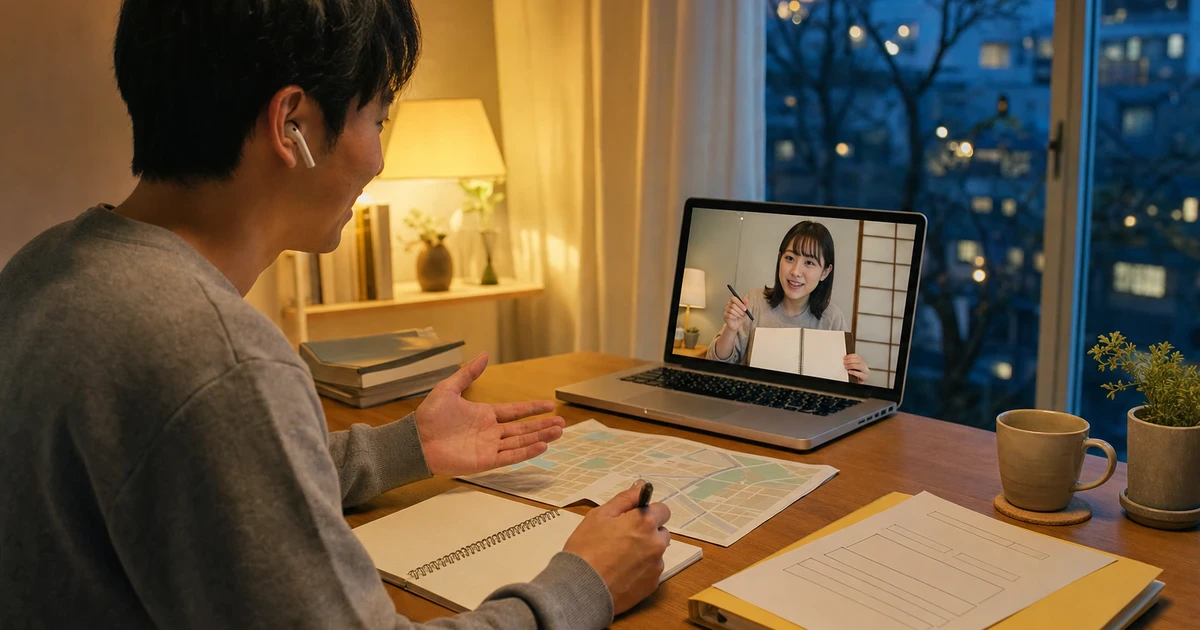
A japanese lesson for school orientation in japan helps you ask the right questions when the first day is full of schedules, rules, forms, and room changes. The goal is not to sound perfect. The goal is to understand what staff need from you, confirm the next step, and leave the desk with clear information you can act on.
Kind Japanese keeps this practical with one-on-one lessons over LINE, and the standard lesson length is 25 minutes, which is enough for a focused role-play and correction cycle. If your orientation is tied to documents, the overview in Japan Student Visa Requirements for Language School can help you separate language practice from paperwork. If you are still judging your pre-arrival level, How Much Japanese Do You Need to Study in Japan? is a useful companion.
What to practise before orientation
Orientation Japanese is different from textbook Japanese. You need short, polite questions that work at the reception desk, in the classroom, and at the academic affairs office. The most useful practice is to learn how to ask for the next action: where to go, what to submit, whether a document is already accepted, and how to confirm your student information.
From a teacher's perspective, learners often know the situation but not the exact question shape. In one-on-one lessons, it helps to let the learner finish the whole sentence first, then correct the key word or pronunciation after. That keeps the practice close to real orientation pressure.
A small cultural note helps here: in many Japanese schools, short and specific questions are easier for staff to answer than a long explanation. Polite directness is usually better than speaking around the point.
Core phrases to practise
These are the phrases that come up most often when you need to ask staff for help during orientation and the first few days on campus.
Japanese | Romaji | English meaning |
|---|---|---|
受付 | uketsuke | reception desk |
学生証 | gakuseishō | student ID card |
学生番号 | gakusei bangō | student number |
履修登録 | rishū tōroku | course registration |
ポータル | pōtaru | portal |
提出済み | teishutsu zumi | already submitted |
教務課 | kyōmuka | academic affairs office |
受付はどこですか。 Uketsuke wa doko desu ka. Where is the reception desk?
学生証はいつもらえますか。 Gakuseishō wa itsu moraemasu ka. When can I get my student ID card?
履修登録の方法を教えてください。 Rishū tōroku no hōhō o oshiete kudasai. Please tell me how to register for courses.
ポータルにログインできません。 Pōtaru ni roguin dekimasen. I cannot log in to the portal.
First-week errands after orientation
The best japanese lesson for school orientation in japan usually does not stop at the campus desk. The first week also includes housing, transport, payment, and local administration, so it is smart to practise those errands in the same speaking style.
- Transport: ask which exit to use, which bus or train to take, and how long the walk is from the station.
- Housing: confirm your room number, key handover, move-in timing, and any building rules you need to know first.
- Bank and payment: ask how to pay school-related fees, whether cash or transfer is expected, and what kind of card or account setup you need.
- City hall or local office: practise asking where to update your address or which counter handles your next form.
- Phone or SIM setup: prepare short questions about activation, data, and what you should bring to the store.
- School office follow-up: ask whether your documents are complete, whether your student number is ready, and whether the portal is working.
If you are staying outside Japan while preparing, it also helps to send your lesson windows in your own time zone. Simple options like “weekday evenings” or “weekend mornings in my local time” are easier to coordinate than vague availability.
Common Mistakes
Learners usually do not fail orientation because they know nothing. They struggle because the situation moves quickly and the question needs to be short, polite, and exact.
From a teacher's perspective, these patterns show up again and again:
- Learners explain too much before asking the actual question. A short request is usually more useful at a desk.
- Learners switch between casual and polite speech in the same sentence. Staff questions should stay consistently polite.
- Learners miss the important detail in a notice because they read too fast. Room names, office names, and portal messages often hide the key information.
- Learners do not practise a fallback question. If you do not understand, it is better to ask again more simply than to guess.
- Learners get stuck on katakana words, especially when the school message includes names, room numbers, or portal instructions.
A teacher can slow the reading down, check the sound of the katakana one by one, and review the trouble spots with hiragana or katakana cards when needed. That kind of focused correction is especially useful when you need to read a notice, not just answer from memory.
A 25-minute LINE lesson flow
Kind Japanese’s standard one-on-one lessons are 25 minutes, which is enough time to build one useful orientation routine without spreading the lesson too thin.
- Warm-up Confirm your current level and the exact situation you want to practise, such as finding the room, checking documents, or asking about portal access.
- Target speaking task Role-play one realistic scene, such as speaking to staff at the reception desk, asking about your faculty, or confirming your student number and course registration.
- Correction Finish the full sentence first, then get brief correction on the most important points: word choice, particles, pronunciation, or katakana reading.
- Learner-kept follow-up questions Save a few short questions you can reuse later in LINE or in your own notes, such as questions about the campus map, a school message, a form, or a train route.
If you want the lesson to feel real, bring a screenshot of a map, a form, a train route, or a school message. Practising from the exact material you will see in daily life makes the language much easier to remember.
FAQ
Do I need advanced Japanese for school orientation?
No. Most learners only need enough Japanese to ask for directions, confirm documents, and understand the next step. A teacher can keep the role-play simple and focus on the exact phrases you need, instead of forcing long answers before you are ready.
What should I ask if I cannot find my classroom?
Ask for the room number, floor, and nearest landmark or office. Short questions are easier for staff to answer than a long explanation. Practising this once in a one-on-one lesson helps you react faster when the campus feels crowded or confusing.
Can one lesson help with both orientation and daily life?
Yes. One lesson can cover orientation first, then move to housing, bank and payment, transport, or city hall language. That gives you a practical set of questions for the first week, not just a single script for the first desk you visit.
Should I prepare my questions in English first?
Yes, if that helps you organize your thoughts. The useful step is to turn the English idea into a short Japanese question you can actually say under pressure. A teacher can help you simplify the wording so it stays natural and manageable.
If you want a japanese lesson for school orientation in japan focused on your own maps, forms, and school messages, book a Free Trial Lesson over LINE.
Keep Learning
If your next step is a campus setting beyond language school, the guide to Japanese for university orientation in Japan can help you prepare for similar first-day conversations. If your role is closer to work or teaching, you may also find online Japanese lessons for international teachers useful, and if you are still comparing study options, read about how to choose the right Japanese language lesson fit.
This guide is part of Kind Japanese's beginner curriculum for online Japanese lessons.

