
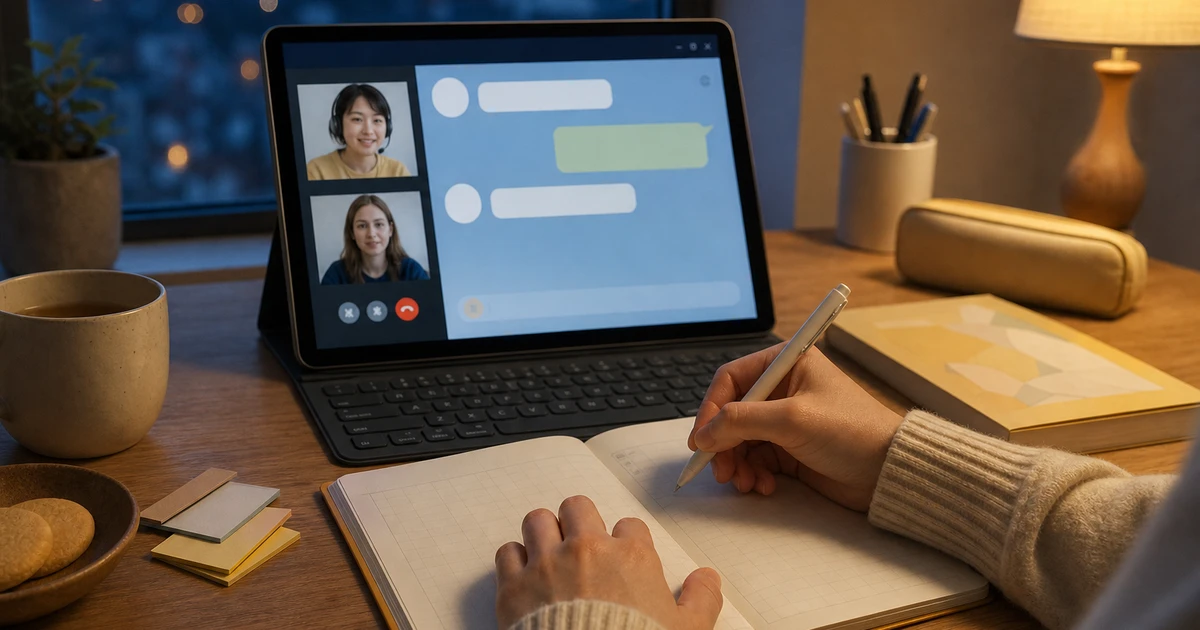
Team chat apps like Slack, Microsoft Teams, and Chatwork are where a huge amount of Japanese workplace communication actually happens. If you can hold a conversation but freeze when typing a quick message to a Japanese colleague, you are not alone. Chat sits in an awkward middle zone: faster and softer than email, but still bound by workplace register and reader expectations.
This article focuses on the language, not the tool. Whether your company runs Slack, Teams, or something else, the same questions come up: How polite should I be? Can I drop the greeting? Is a one-word reply rude? Below you will find a reference table, complete before-and-after rewrites, and practical ways to practise until this feels natural.
Why Team Chat Japanese Has Its Own Register
Team chat Japanese lives between casual speech and formal email. Messages are short and quick, so the fully formal です・ます (desu / masu) keigo of a business email can feel stiff and slow in a fast-moving channel. At the same time, dropping into plain, friend-style Japanese with a manager or client can read as careless.
The practical target for most workplace chat is polite but efficient: keep the desu/masu backbone, trim the long email openers, and lean on a few softening phrases so a short message still feels considerate.
A few forces shape the register:
- Speed. Chat rewards brevity, so long honorific openers are usually dropped.
- Audience. A message to your team is lighter than one to a client or a senior manager.
- Visibility. Channels are semi-public, so tone signals how you treat colleagues.
From a teacher's perspective, learners often nail textbook keigo but struggle with this middle register, because most study materials teach either casual conversation or full formal writing, rarely the in-between that chat demands. If you want the bigger picture on moving from app drills to real output, our guide on Online Japanese Lessons: From App Study to Speech walks through that jump.
Core Phrases for Workplace Chat
The phrases below cover the most common workplace-chat moments: acknowledging, requesting, softening, and signalling that something is done. Every item shows Japanese script, Hepburn romaji, and English meaning.
Japanese | Romaji | English Meaning |
|---|---|---|
承知しました | shōchi shimashita | Understood / got it (polite, safe for seniors) |
了解です | ryōkai desu | Got it (casual, peers only) |
確認します | kakunin shimasu | I'll check it |
ご確認いただけますか | go-kakunin itadakemasu ka | Could you please check this? |
お手隙のときに | otesuki no toki ni | When you have a free moment |
お手数ですが | otesū desu ga | Sorry to trouble you, but… |
対応します | taiō shimasu | I'll handle it |
完了しました | kanryō shimashita | It's done / completed |
少々お待ちください | shōshō o-machi kudasai | Please wait a moment |
助かりました | tasukarimashita | That really helped, thanks |
共有します | kyōyū shimasu | I'll share it (info/file) |
ご相談があります | go-sōdan ga arimasu | I have something to discuss |
Use the table as a lookup, but remember that tone comparison matters more than memorising each entry. 了解です (ryōkai desu) is friendly and fine among peers, while 承知しました (shōchi shimashita) is the safer choice for a manager or client. 確認します (kakunin shimasu) states what you will do, whereas ご確認いただけますか (go-kakunin itadakemasu ka) politely asks the other person to check — one clean, widely accepted request form.
Three Mini Rewrites: Same Message, Right Register
Seeing a weak message become a natural one is the fastest way to feel the register shift. Here are three common scenarios rewritten, each with the reason the tone changed.
Rewrite #1 — Slack acknowledgement to your team. Instead of a bare "OK", acknowledge and confirm the next step.
承知しました。あとで確認します。 Shōchi shimashita. Ato de kakunin shimasu. Understood. I'll check it later.
Why it changed: A single "OK" can read as curt in a channel. Adding 承知しました (shōchi shimashita) plus one concrete next action shows you received the message and know what to do.
Rewrite #2 — Teams review request to a busy senior. Instead of "Please check this," soften the timing so you are not demanding immediate attention.
お手隙のときに、こちらをご確認いただけますか。 Otesuki no toki ni, kochira o go-kakunin itadakemasu ka. When you have a free moment, could you please check this?
Why it changed: お手隙のときに (otesuki no toki ni) removes pressure, and ご確認いただけますか (go-kakunin itadakemasu ka) is a clean, polite request. Together they respect a senior's schedule without being stiff.
Rewrite #3 — Proposing a meeting window in chat. Instead of vaguely asking "When are you free?", offer options and keep it light.
明日の午後、少しお時間をいただけますか。 Ashita no gogo, sukoshi o-jikan o itadakemasu ka. Could I have a little of your time tomorrow afternoon?
Why it changed: Naming a window (tomorrow afternoon) and asking with いただけますか (itadakemasu ka) makes it easy for the reader to say yes. For a deeper set of channel-ready lines, see our Business Japanese Chat Messages for Slack at Work guide.
A Simple Practice Flow for Chat Japanese
Reading examples is not the same as producing them under pressure. Here is a 25-minute one-on-one LINE lesson flow you can use to turn these phrases into instinct, mapped to how Kind Japanese lessons are structured:
- Warm-up (a few minutes). Say aloud two or three phrases from the table, so the polite forms feel spoken, not just typed.
- Target speaking task. Describe a real message you need to send this week — a status update, a request, or a scheduling note — and say it in Japanese as if dictating the chat.
- Correction. A live teacher reshapes your register on the spot: too stiff, too casual, or unclear timing.
- Learner-owned review note. Before the lesson ends, write your own short list of the phrases you want to reuse and one question to bring next time.
When you propose lesson windows, describe your own time zone plainly so scheduling stays simple. For example:
アメリカ時間の夜にレッスンを受けたいです。 Amerika jikan no yoru ni ressun o uketai desu. I want to take lessons in the evening US time.
Because lessons happen over LINE, you can practise the exact medium you use at work — typing short messages, then reading them aloud for tone.
Common Mistakes in Team Chat Japanese
Learners tend to repeat a handful of register slips in workplace chat. From a teacher's perspective, these come up again and again.
- Confusing 了解 with 承知. Learners often use 了解です (ryōkai desu) with a manager because it feels short and handy, but it reads as too casual upward. Use 承知しました (shōchi shimashita) for seniors and clients.
- Copying full email openers into chat. Starting a quick message with a long formal greeting slows the channel and feels mismatched. A short, polite line is enough.
- Ambiguous timing. Asking someone to "check when you can" without softening can feel like pressure. お手隙のときに (otesuki no toki ni, when you have a free moment) frames the same request kindly.
- Over-apologising. Stacking お手数ですが (otesū desu ga) and すみません (sumimasen) in every line dilutes their effect. One softener per request is usually plenty.
A cultural note: Japanese workplace chat values reading the air (空気を読む, kūki o yomu, sensing the mood). Matching the length and warmth of the person you are replying to often matters more than picking a textbook-perfect phrase.
FAQ
Is 了解しました rude to a manager?
It is not aggressively rude, but it reads as too casual toward a manager or client. 了解 (ryōkai) suits peers and juniors. For someone senior, use 承知しました (shōchi shimashita) or, more formally, 承知いたしました (shōchi itashimashita). When unsure, choose the more polite form — it is rarely the wrong call at work.
Can I skip greetings in team chat?
Often, yes. In an ongoing thread with your team, jumping straight to the point is normal and efficient. For the first message of the day or a note to a client, a brief お疲れさまです (otsukaresama desu, thanks for your hard work) is a warm, expected opener. Match the thread's existing tone.
How formal should chat with clients be?
More formal than internal team chat, but still lighter than a full email. Keep the desu/masu backbone, add softeners like お手数ですが (otesū desu ga, sorry to trouble you), and use polite requests such as ご確認いただけますか (go-kakunin itadakemasu ka). Avoid slang and heavy abbreviations, since client channels are semi-formal.
What's the fastest way to improve my chat Japanese?
Practise producing short messages out loud with correction, not just reading examples. Pick real messages you need to send, draft them, and have a teacher adjust your register. One-on-one feedback catches the subtle too-stiff or too-casual slips that self-study and apps usually miss entirely.
Ready to make your workplace Japanese sound natural? Bring one real message you need to send and get it corrected in a Free Trial lesson over LINE with Kind Japanese — a focused, one-on-one way to polish the register that chat apps demand.
LEARN WITH OUR TEACHERS
Ready to use what you learned in a real lesson?
Friendly Kind Japanese teachers support you with live online lessons shaped around your level and goals.

Takeshi Matsuda
Registered Japanese language teacher

Mizuki Shimooka
Native Japanese speaker & English teacher