
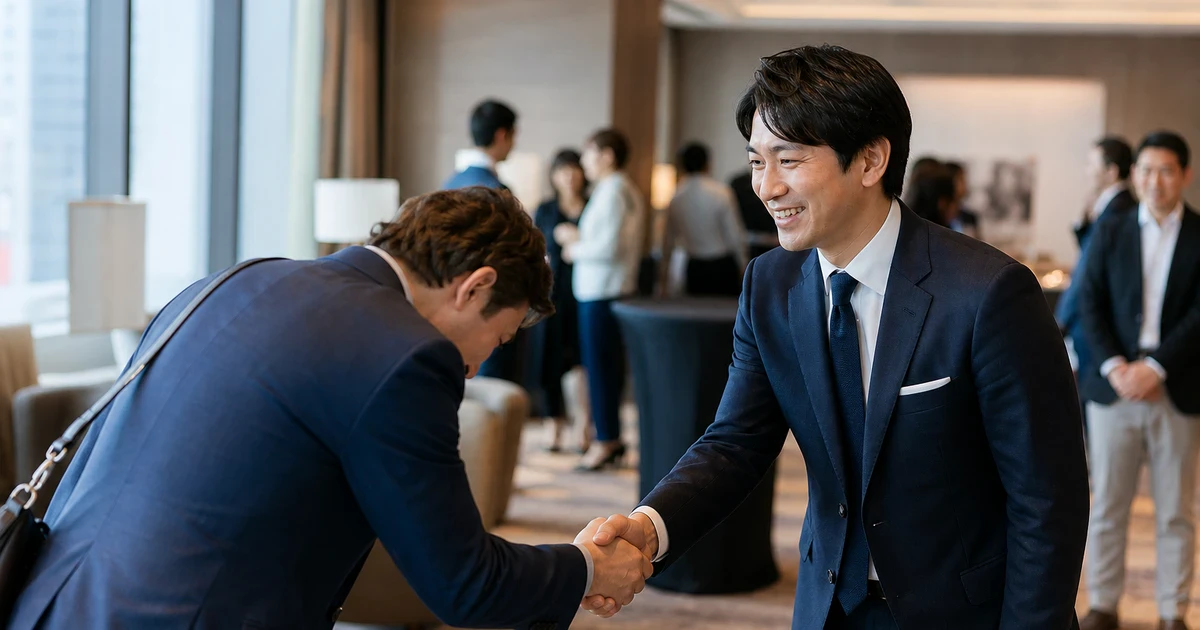
If you need a japanese tutor for networking events in japanese, your goal is not to memorize a long list of formal phrases. Your real goal is to enter a conversation, explain who you are, ask polite questions, exchange contact details when appropriate, and leave the conversation smoothly.
Networking Japanese sits between casual conversation and business Japanese. It is warmer than an interview, but more careful than chatting with close friends. A tutor can help because small choices matter: how direct your question sounds, whether your introduction feels too stiff, and whether your pronunciation is easy to catch in a noisy room.
From a teacher's perspective, learners often know enough grammar to make sentences, but they need feedback on timing, politeness, and spoken delivery. That is especially true for networking, where the other person is not testing your Japanese; they are deciding whether the conversation feels comfortable.
Start With the Conversation Goal
A good networking conversation has a simple flow: greet, introduce yourself, ask about the other person, connect the topic to your own work or study, and close politely.
For Japanese learners outside Japan, the first mistake is often trying to sound “business-level” immediately. You do not need heavy honorific language for every sentence. You need clear, respectful Japanese that lets the other person respond easily.
Useful practice goals include:
- Introducing your work, field, or study in one sentence
- Asking what the other person does without sounding abrupt
- Reacting naturally to their answer
- Explaining why you are interested
- Ending the conversation without disappearing suddenly
- Moving to a contact exchange only when the mood is appropriate
A cultural note: in Japan-related professional settings, exchanging contact details can be less casual than in some countries. LINE is common in Japan for staying in touch, but it is still best to ask gently and give the other person room to decline or choose another contact method.
Core Phrases for Networking Flow
Use phrases that help the conversation move, not phrases that make you sound memorized. The table below gives a compact flow you can practise with a tutor.
Japanese | Romaji | English Meaning |
|---|---|---|
はじめまして | Hajimemashite | Nice to meet you |
今日はよろしくお願いします | Kyō wa yoroshiku onegai shimasu | I look forward to speaking with you today |
どのようなお仕事をされていますか | Dono yō na o-shigoto o sarete imasu ka | What kind of work do you do? |
お仕事についてお話を伺えますか | O-shigoto ni tsuite o-hanashi o ukagaemasu ka | May I ask about your work? |
私は海外で日本語を勉強しています | Watashi wa kaigai de Nihongo o benkyō shite imasu | I study Japanese outside Japan |
その分野に興味があります | Sono bun'ya ni kyōmi ga arimasu | I am interested in that field |
もう少し詳しく聞いてもいいですか | Mō sukoshi kuwashiku kiite mo ii desu ka | May I ask a little more about that? |
よろしければ、連絡先を交換できますか | Yoroshikereba, renrakusaki o kōkan dekimasu ka | If it is okay, could we exchange contact details? |
そろそろ失礼します | Sorosoro shitsurei shimasu | I should excuse myself soon |
お話しできてうれしかったです | O-hanashi dekite ureshikatta desu | I was glad to speak with you |
今日はよろしくお願いします。 Kyō wa yoroshiku onegai shimasu. I look forward to speaking with you today.
どのようなお仕事をされていますか。 Dono yō na o-shigoto o sarete imasu ka. What kind of work do you do?
その分野に興味があります。 Sono bun'ya ni kyōmi ga arimasu. I am interested in that field.
そろそろ失礼します。お話しできてうれしかったです。 Sorosoro shitsurei shimasu. O-hanashi dekite ureshikatta desu. I should excuse myself soon. I was glad to speak with you.
How a 25-Minute LINE Lesson Can Help
A focused 25-minute one-on-one lesson over LINE should turn networking Japanese into a repeatable speaking routine. The value is not only “checking grammar.” It is hearing how your sentence lands in real time.
A practical lesson flow could look like this:
- Warm-up: say who you are and why you are attending the event.
- Target speaking task: practise a 60-second self-introduction.
- Role-play: meet someone in your target field and ask two follow-up questions.
- Correction: adjust politeness, word choice, pronunciation, and sentence length.
- Repeat: say the corrected version again until it feels speakable.
- Learner preparation: write one or two questions in LINE that you want to practise next time.
For scheduling across time zones, propose lesson windows in your own local time first, then clarify the time zone. For example, write that you are available in the evening in your country, and include the city or time zone you use. This avoids confusion without needing unnatural Japanese time expressions.
If speaking itself feels like the bigger barrier, this article on how to Build Speaking Confidence with a Japanese Tutor may help you decide what to practise first.
Common Mistakes
Learners often translate networking phrases too directly from English. The result may be grammatically understandable but socially awkward.
Asking questions too bluntly. “What is your job?” can sound sharp if translated too directly. A softer work question gives the other person space to answer naturally.
Overusing anime-style second-person words. Our teachers have seen learners pick up words for “you” from anime or games that do not fit normal networking situations. In real conversations, it is often more natural to avoid saying “you” directly and use the person’s name or a topic-based question.
Using memorized phrases without listening. Networking is not a speech contest. If the other person gives an unexpected answer, you need a flexible reaction, such as asking for a little more detail.
Stopping after the first sentence. Many learners prepare an introduction but not a follow-up. A tutor can help you build the next two turns, which is where real conversation begins.
Pronunciation that changes the impression. In our one-on-one lessons, teachers may notice small reading or sound confusions, especially with kana and borrowed words. For networking, clarity matters because names, company fields, and contact details often include katakana.
Use AI for Prep, Then Teacher Review
AI can help you prepare, but it should not be your final judge for networking Japanese. Use AI for repetition, phrase generation, and quick drills. Use a teacher for meaning, relationship, politeness, pronounceability, and whether the sentence can actually be reused in speech.
A simple handoff template is:
“I want to use these three sentences at a networking event. Please check whether they sound natural, polite, and easy to say aloud.”
A teacher review order should be:
- Meaning: does the sentence say what you intend?
- Relationship: does it fit a first meeting?
- Politeness: is it respectful without being too heavy?
- Pronunciation: can the other person catch it quickly?
- Reuse: can you adapt it for different people?
For a broader comparison, see AI Japanese Tutor vs Human Teacher: What Works Best. For networking events, the strongest approach is often AI for preparation and a live teacher for correction and role-play.
FAQ
Do I need advanced Japanese to network at events?
No. You can network with beginner or intermediate Japanese if your goals are realistic. Start with greetings, a short self-introduction, one work question, and one polite exit line. Advanced grammar is less important than clear pronunciation, respectful wording, and the ability to continue after the other person answers.
Should I use casual or polite Japanese?
Polite Japanese is the safer default for networking. You do not need extremely formal business language in every sentence, but plain casual speech can sound too familiar at a first meeting. A tutor can help you choose phrases that sound warm, respectful, and natural for your event.
Can I prepare if my event is not in Japan?
Yes. Many Japan-related networking events happen outside Japan or online. Prepare the same core skills: introduce your background, ask about the other person’s work, explain your interest, and close politely. Also practise saying your country, city, field, and reason for learning Japanese clearly.
What should I bring to a lesson?
Bring the event type, your role, and three things you want to say. For example, prepare your self-introduction, one question about the other person’s work, and one closing line. If you already wrote Japanese sentences, bring them for correction and spoken practice.
Book a Focused First Conversation
The best japanese tutor for networking events in japanese is one who helps you practise the actual moment: greeting someone, keeping the conversation moving, correcting awkward phrasing, and repeating until the sentence feels usable.
Kind Japanese offers one-on-one online Japanese lessons over LINE, with standard lessons lasting 25 minutes. To try focused networking role-play and get feedback on your first conversation flow, book a Free Trial Lesson.

