Japanese language learning for beginners gets much easier when you stop trying to learn everything at once. Start with a small set of useful words, a few sentence patterns, and regular speaking practice. That approach gives you real progress fast, because every new item has a job in conversation.
The goal at the beginning is not perfect Japanese. The goal is to understand, answer, and repeat with confidence. From a teacher's perspective, beginners improve fastest when they learn language they can use the same day.
Start with Usable Japanese
Begin with phrases you can use in real situations. Greetings, self-introductions, simple requests, and common reactions give you the fastest route into conversation. Once those are stable, grammar becomes easier because it has something concrete to support.
A good beginner order is:
- Greetings and politeness
- Self-introduction
- Asking for repetition or slower speech
- Everyday verbs
- A few sentence patterns you can reuse
If you want to hear these patterns in short, realistic exchanges, Basic Japanese Conversation Practice for Beginners is a useful next read. It helps turn vocabulary into actual back-and-forth speaking.
Core Starter Phrases
These phrases cover many beginner situations and create a strong base for speaking.
Japanese | Romaji | English Meaning |
|---|---|---|
こんにちは | konnichiwa | Hello |
おはようございます | ohayō gozaimasu | Good morning |
すみません | sumimasen | Excuse me / sorry |
わかりません | wakarimasen | I don't understand |
もういちどおねがいします | mō ichido onegaishimasu | Please say it again |
ゆっくりはなしてください | yukkuri hanashite kudasai | Please speak slowly |
These are not just polite phrases. They are survival phrases for learning. If you can say "I don't understand" and "Please say it again," you can keep a conversation moving instead of getting stuck.
Turn Phrases Into Sentences
Beginners often collect words but stop short of using them in full sentences. The fix is simple: reuse the same pattern with different nouns and verbs. That is how Japanese starts to feel predictable instead of random.
Here are a few simple examples:
わたしはマリアです。
Watashi wa Maria desu.
I am Maria.
きょうはにほんごをべんきょうします。
Kyō wa Nihongo o benkyō shimasu.
Today, I study Japanese.
すみません、もういちどおねがいします。
Sumimasen, mō ichido onegaishimasu.
Excuse me, please say it again.
ゆっくりはなしてください。
Yukkuri hanashite kudasai.
Please speak slowly.
にほんごで、すこしはなせます。
Nihongo de, sukoshi hanasemasu.
I can speak a little Japanese.
A small cultural note helps here: in Japanese, a simple polite request often sounds better than a long explanation. A short sentence with sumimasen and one clear request is usually enough.
If you want more building blocks for these sentences, Basic Japanese Verbs: 50 Essential Verbs for Beginners is a good companion resource. Verbs are the engine of beginner Japanese, and a few high-frequency ones go a long way.
How to Practice Each Day
Daily practice works best when it is short, focused, and repeatable. You do not need a huge study session. You need a routine that gives you repeated exposure and a chance to speak.
A practical beginner routine looks like this:
- Review 5 to 10 phrases out loud.
- Shadow one short audio or video clip.
- Make 3 original sentences with one verb pattern.
- Read them aloud slowly.
- Repeat one sentence with a different noun or time expression.
This kind of practice builds both recognition and production. You begin to notice the same patterns appearing again and again, which lowers the pressure of learning.
Three study habits matter most:
- Say the sentence aloud, not only in your head.
- Recycle the same pattern with new words.
- Mix listening with speaking instead of treating them as separate skills.
Beginners often think they need more and more vocabulary before they can speak. In reality, a smaller number of well-practised words is more useful than a large list you cannot use.
Why One-on-One Feedback Helps
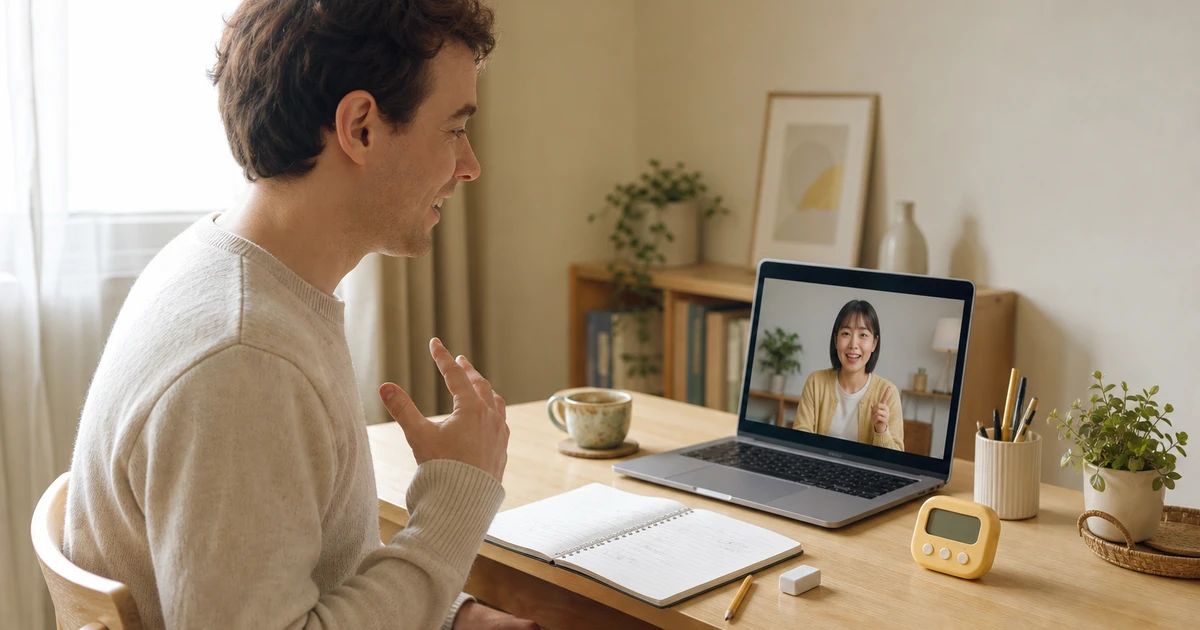
A teacher can help beginners catch problems that self-study usually misses: pronunciation, word order, particle use, and whether a sentence sounds natural in context. That feedback matters early, because small mistakes become habits if nobody points them out.
Kind Japanese offers one-on-one lessons over LINE, and its standard lessons are 25 minutes. That format is a good fit for beginners because it keeps the lesson focused on one speaking goal instead of trying to cover everything at once.
A useful beginner lesson focus can be as simple as this:
- One greeting or self-introduction
- One target sentence pattern
- One short speaking task
- One correction pass
- One improved answer spoken again
For example, you might come in with a sentence like "I study Japanese every day" and ask a teacher to make it more natural, easier to pronounce, or better suited to your level. That is often more useful than trying to study ten grammar points in a row.
During a one-on-one lesson, it also helps to say what kind of situation you want to handle. A beginner who can say "I want to introduce myself" or "I want to order food" gives the teacher a clear target and gets more useful practice in return.
Common Mistakes
From a teacher's perspective, beginners often make the same few mistakes, and they are all fixable.
- Learning too many isolated words without sentence practice. Vocabulary is useful, but words become memorable when they appear in a real sentence.
- Waiting until they feel ready to speak. Speaking early is better, even if the sentence is simple.
- Relying on romaji for too long. Romaji can help at the start, but it should not replace kana practice.
- Trying to make every sentence complex. Short, correct sentences are better than long, unstable ones.
- Ignoring pronunciation and rhythm. Japanese becomes much easier to understand when the sounds are steady and clear.
A beginner does not need to sound advanced to communicate well. Clear, polite, and simple is enough at the start.
FAQ
How should a complete beginner start learning Japanese?
Start with greetings, self-introduction, simple requests, and a few high-frequency verbs. Then practice short sentences out loud every day. A beginner should aim to build usable speech first, because that makes grammar and listening easier to remember.
Is it better to study grammar first or speaking first?
Both matter, but beginners usually benefit from speaking early with simple grammar. When you practice a pattern in a real sentence, the grammar has a purpose. That makes it easier to remember than studying rules in isolation.
Should I use romaji when I start?
Romaji can help you get moving quickly, especially for pronunciation and first phrases. It should only be temporary, though. Beginners should move toward hiragana and katakana as soon as possible so reading and listening develop together.
How can one-on-one lessons help a beginner?
One-on-one lessons give beginners immediate feedback on pronunciation, sentence order, and natural phrasing. They also make it easier to practice a small goal without pressure. That is especially helpful when you want to speak before you feel fully confident.
If you want a teacher to check your first sentences and help you build a simple speaking habit, book a Free Trial over LINE.