
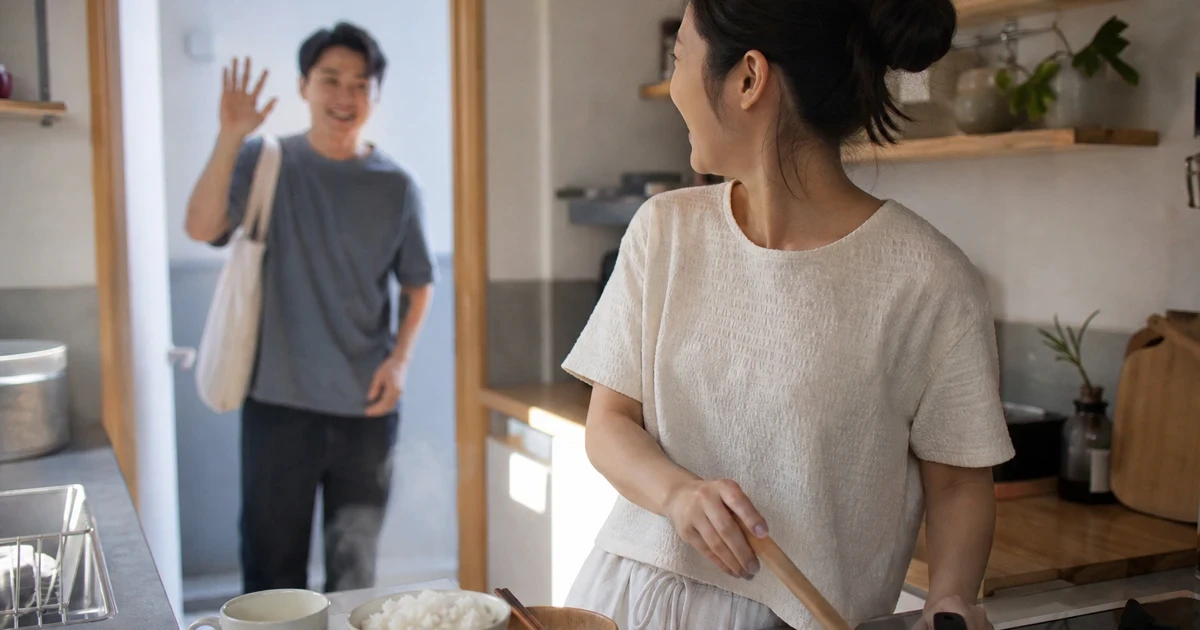
A natural Japanese morning conversation is usually short: choose the right greeting, mention one or two actions, and respond according to your relationship with the listener. You do not need a long script. A few flexible phrases can help you speak from the moment you wake up until you leave home.
The first goal is not memorising every possible expression. It is learning a simple sequence that you can reuse every morning until the words begin to feel automatic.
Start With the Right Morning Greeting
The first decision is how to say good morning at the appropriate level of politeness. A search such as “hello good morning in Japanese” may suggest a direct translation, but Japanese greetings depend strongly on the relationship and setting.
Use the casual greeting with family, close friends, or someone who has already established a relaxed tone. Use the polite version with people you do not know well, colleagues in a formal setting, or someone senior to you. The daytime greeting is generally used later, although the boundary is not determined by one exact time.
Japanese | Hepburn romaji | English meaning |
|---|---|---|
おはよう | ohayō | good morning, casual; often typed “ohayou” |
おはようございます | ohayō gozaimasu | good morning, polite; often typed “ohayou gozaimasu” |
こんにちは | konnichiwa | hello or good afternoon |
やあ | yā | hi or hey, very casual; sometimes typed “yaa” |
毎朝 | maiasa | every morning |
起きます | okimasu | wake up or get up |
顔を洗います | kao o araimasu | wash one’s face |
何をしますか | nani o shimasu ka | what do you do? |
します | shimasu | do |
行ってきます | ittekimasu | I am leaving and will return |
いってらっしゃい | itterasshai | take care; reply to someone who is leaving and expected to return |
A very casual greeting such as the fourth entry is not a universal replacement for “hello.” It suits close relationships and can sound too familiar in a formal situation. When unsure, begin with the polite morning greeting and listen to how the other person responds.
Build a Morning Sequence With the Te-Form
The te-form is the most useful way to connect morning actions in their natural order. Instead of producing several disconnected sentences, place earlier actions in the te-form and finish the sequence with a final verb in the tense and politeness level you need.
For example, you can connect “wake up,” “wash my face,” and “eat breakfast” as one smooth answer. Start with two actions, then add another only when the shorter version feels comfortable.
This four-sentence set moves from a first greeting to a routine question, an action sequence, and departure:
田中さん、おはようございます。
Tanaka-san, ohayō gozaimasu.
Good morning, Mr./Ms. Tanaka.
毎朝、何をしますか。
Maiasa, nani o shimasu ka.
What do you do every morning?
毎朝、六時に起きて、顔を洗って、朝ご飯を食べます。
Maiasa, roku-ji ni okite, kao o aratte, asagohan o tabemasu.
Every morning, I wake up at six, wash my face, and eat breakfast.
では、行ってきます。
Dewa, ittekimasu.
Well, I am leaving now and will return.
Practise the long sentence in small meaning groups, but do not pause after every word. The point of the te-form is to make the actions sound connected. Once the sequence is stable, change one detail: the time, the food, or the first action.
Turn the Phrases Into a Real Exchange
A useful morning conversation needs a listener, not just a list of verbs. Build each exchange around four choices: the meaning you want, your relationship with the other person, the speaking rhythm, and the next sentence that keeps the interaction moving.
Try this practice sequence:
- Decide whether the relationship is casual or polite.
- Give the greeting with a relaxed voice and an appropriate gesture.
- Ask or answer one question about the morning routine.
- Connect two or three actions.
- Add one next sentence about leaving, work, study, or the day ahead.
A short cultural note helps here: a morning greeting may be accompanied by a small nod or bow, especially in a more formal setting. The gesture does not need to be dramatic. At home, the leaving phrase and its usual reply also express an expectation that the person will return, so they carry more social meaning than a simple goodbye.
Repeat the same exchange with different roles. Imagine greeting Tanaka as a colleague, then imagine speaking to a close friend. The information may stay the same, but the appropriate greeting and tone can change.
Practise in a Focused LINE Lesson
A standard Kind Japanese one-on-one lesson lasts 25 minutes and takes place online over LINE. A possible lesson flow can combine a warm-up greeting, one target speaking task, correction, and a learner-owned review note without trying to cover an entire morning vocabulary list at once.
For a morning Japanese practice lesson, you could prepare:
- A warm-up greeting for a specific relationship.
- A target task describing what you do every morning.
- One connected te-form sequence.
- A question about meaning, naturalness, or pronunciation.
- A personal review note containing the corrected pattern and your next question.
Teachers often begin by checking whether essential conjugation is secure, particularly dictionary and te-forms, before moving into expressions and conversation practice. They may let a learner complete a full speaking turn before offering indirect feedback, revisit recurring kana confusion with cards, and clarify when wording learned from textbooks or anime sounds less natural in daily conversation.
A compact teacher-review packet makes feedback more precise. Include what you intended to mean, your relationship with the listener, the line that was difficult to say, and one next sentence you want to produce. You can also use the structure in Morning Japanese Study: One-on-One Lesson Plan to make the routine sustainable.
If you want lessons in your morning, propose a few possible windows in your own time zone. Include your city or time-zone name, UTC offset, and exact dates so that neither side has to guess; treat those windows as proposals rather than confirmed availability. How to Choose Morning Online Japanese Lessons offers more planning guidance.
When you are ready to practise your own sequence with live feedback, book a Free Trial Lesson over LINE.
Common Mistakes
Most morning-conversation errors come from mismatching the relationship, translating English too directly, or building an action list without a clear final verb.
- Using the casual greeting too widely. Learners often remember the shortest form first and use it with everyone. Choose the polite form when the relationship or setting calls for greater distance.
- Stacking two greetings. English speakers may combine “hello” and “good morning,” but Japanese usually needs one greeting suited to the time and context.
- Listing dictionary-form verbs. A string such as “wake up, wash, eat” sounds unfinished if every verb remains separate. Use the te-form for the earlier actions and complete the sequence with one final verb.
- Treating the departure phrase as a general goodbye. It is used when leaving a place with the expectation of returning. A different farewell may be needed when that meaning does not fit.
- Copying an anime character’s tone. Fictional dialogue can exaggerate casualness, gendered style, or personality. Learners often need feedback on whether a phrase matches the real relationship and situation they have in mind.
FAQ
How do I say good morning politely in Japanese?
Use the polite greeting in the table with people you do not know well, senior colleagues, or someone you are meeting for the first time that day. Use the casual form with family and close friends, while matching the other person’s tone when the relationship or setting is unclear.
Can I use the daytime greeting in the morning?
The daytime greeting is generally better after the morning, so choose one of the two morning greetings in the table earlier in the day. Exact boundaries are flexible and context dependent, but learners sound more natural when they notice local usage instead of treating clock time as an absolute rule.
How can I practise morning conversation alone?
Narrate one real morning sequence aloud: waking up, washing, eating, and leaving. Record yourself, listen for missing particles or uneven rhythm, then prepare a small teacher-review packet containing your intended meaning, the relationship between speakers, one difficult line, and the next sentence you want to say.

