
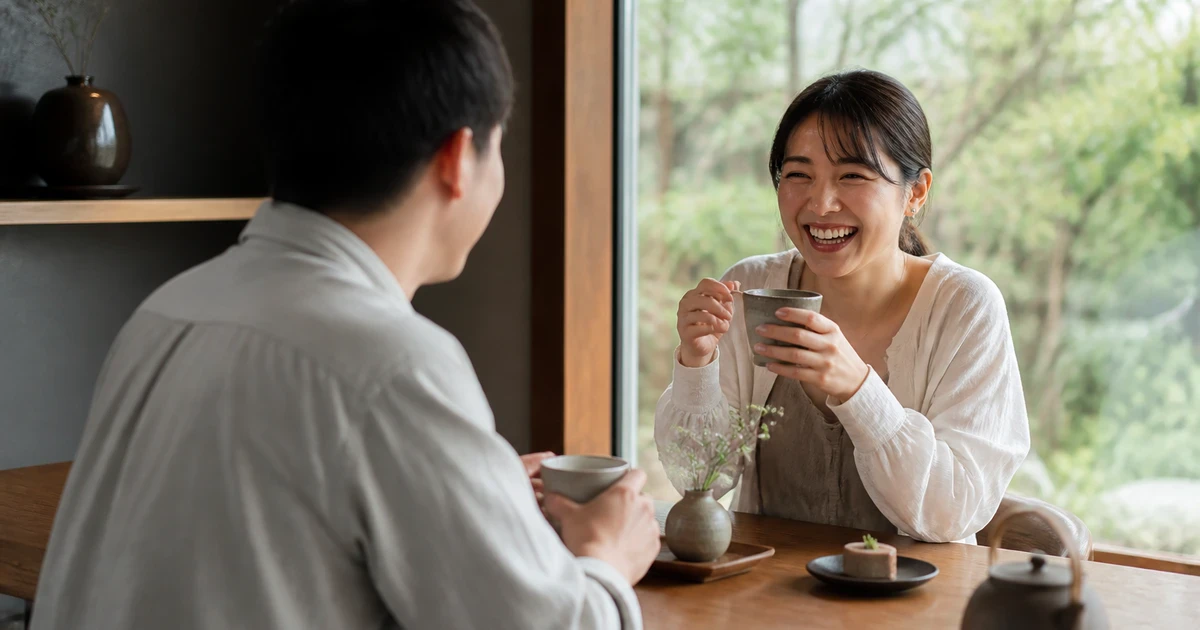
The shortest answer is 雑談 (zatsudan, casual conversation or chit-chat). It works well when people talk informally without a fixed purpose, particularly before a meeting, during a break, or while getting acquainted.
Japanese also has warmer or more specific alternatives. Choosing the right one depends on whether you mean friendly chatter, everyday small talk, a digital chat, or the general verb “to talk.”
The Best Japanese Words for Chit-Chat
The most useful choices are 雑談 (zatsudan, casual conversation), おしゃべり (oshaberi, friendly chatting), and 世間話 (sekenbanashi, everyday small talk). They overlap, but they are not completely interchangeable.
Japanese item | Hepburn | English meaning |
|---|---|---|
雑談 | zatsudan | casual conversation; chit-chat |
雑談する | zatsudan suru | to chat casually |
おしゃべり | oshaberi | friendly chatting; chatter |
おしゃべりする | oshaberi suru | to chat in a friendly, informal way |
世間話 | sekenbanashi | small talk about everyday matters |
話す | hanasu | to talk; to speak |
チャット | chatto | online text chat |
相づち | aizuchi | brief listener responses; backchanneling |
雑談 (zatsudan, casual conversation) is the safest general translation. It can describe relaxed interaction among friends, classmates, or colleagues.
おしゃべり (oshaberi, friendly chatting) feels more personal and lively. Depending on context, it can also suggest that someone talks a lot, so tone matters.
世間話 (sekenbanashi, everyday small talk) focuses on ordinary subjects such as weather, local events, or daily life. チャット (chatto, online text chat) usually points to digital communication rather than face-to-face conversation.
Choosing a Word That Fits the Situation
Choose according to the purpose and atmosphere of the exchange. English “chat” covers everything from light chitchat to a serious discussion, but Japanese often makes the distinction clearer.
Use the neutral expression from the table when:
- Colleagues talk informally before work begins.
- Classmates exchange casual information between lessons.
- You want to describe unstructured conversation without sounding especially warm or negative.
Choose the friendlier expression when:
- Friends spend time talking for enjoyment.
- Family members catch up about their lives.
- The enjoyable act of talking matters more than the subject.
Use the everyday-small-talk expression when the topic itself is ordinary and socially safe. A “good chat” in English might mean either enjoyable chit-chat or a meaningful conversation, so translate the intended meaning rather than the individual words.
Cultural note: Brief listener reactions are important in many Japanese conversations. 相づち (aizuchi, listener responses) show attention and help the other person continue; they do not necessarily mean complete agreement.
For more help moving beyond memorized greetings, read Learn Japanese Small Talk That Actually Flows.
Four Natural Examples in Context
These four examples show how the main choices work in complete sentences.
会議の前に同僚と少し雑談しました。
Kaigi no mae ni dōryō to sukoshi zatsudan shimashita.
I chatted briefly with a colleague before the meeting.
週末は姉とよくおしゃべりします。
Shūmatsu wa ane to yoku oshaberi shimasu.
I often chat with my older sister on weekends.
近所の人と天気について世間話をしました。
Kinjo no hito to tenki ni tsuite sekenbanashi o shimashita.
I made small talk about the weather with a neighbor.
友達とオンラインでチャットしています。
Tomodachi to onrain de chatto shite imasu.
I am chatting online with a friend.
Notice that the first three sentences concern spoken conversation, while the final sentence clearly refers to an online chat. Learners often need feedback on this distinction because translating the English verb “chat” with the same Japanese expression every time can sound unnatural.
Common Mistakes and Dictionary Search Noise
The main mistake is treating every result for “chat” or “chit-chat” as usable Japanese. Context, register, and even the structure of the search page can change what a result actually means.
Using the digital term for every conversation. チャット (chatto, online text chat) is appropriate for messaging, but it is not normally the best default for people casually talking in the same room.
Assuming “talk” and “chit-chat” have identical nuance. 話す (hanasu, to talk or speak) is a broad verb. It can describe an important discussion, a presentation, or a casual exchange, while the more specific expressions in the table emphasize relaxed conversation.
Reading English index fragments as Japanese information. Search engines sometimes show words taken from neighboring entries, technical labels, or navigation tags:
- A page displaying “chitchat chitted” may have joined separate English entries. It does not show that “chitted” is the past tense of “chitchat.”
- The sequence “chitted chitting” may come from an inflection index for another English headword. Neither form is Japanese romaji.
- Fragments such as “chitting tch” can cross an entry boundary. Similarly, “tch tty” may be clipped technical navigation rather than pronunciation guidance.
- A multilingual page may include the German verb “chatten.” Labels such as “technical information jmdict” identify page information or a dictionary data source, not a natural phrase to memorize.
Some English dictionaries write “chitchat” as one word, while others use “chit-chat.” That spelling issue does not affect which Japanese expression you should choose.
Turning Vocabulary Into Real Conversation
Speaking practice should focus on continuing a chat, not merely remembering its label. Prepare one familiar subject, one follow-up question, and two short listener reactions so that you can practise both speaking and responding.
At Kind Japanese, teachers lead 25-minute one-on-one lessons over LINE. A sample lesson can include a brief warm-up, a target speaking task, correction of word choice or pronunciation, and time for the learner to write a personal review note or question list.
If you are deciding how much conversational practice to combine with independent study, Can You Learn Japanese by Yourself? offers a useful framework. To test your small-talk skills in a focused conversation, book a Free Trial Lesson.
FAQ
What is the most natural Japanese word for chit-chat?
Use 雑談 (zatsudan, casual conversation) when you mean unstructured talk, especially in neutral or workplace contexts. おしゃべり (oshaberi, friendly chatting) feels warmer and more personal, while 世間話 (sekenbanashi, everyday small talk) emphasizes safe topics; the best choice depends on the relationship, setting, purpose, and how formal the exchange should feel.
Can チャット replace 雑談?
Usually, no. チャット (chatto, online text chat) often suggests typing, whereas 雑談 (zatsudan, casual conversation) can happen face to face or online. If you mean relaxed spoken chit-chat, use the neutral or friendly expressions in the table instead of automatically borrowing the English word when speaking.
How can I get better at Japanese small talk?
Prepare two familiar topics, ask simple follow-up questions, and practise reacting before trying to tell a long story. Record yourself if that helps, then note one point about vocabulary, one about pronunciation, and one question for a teacher; focused repetition makes a short conversation easier to continue naturally.

