
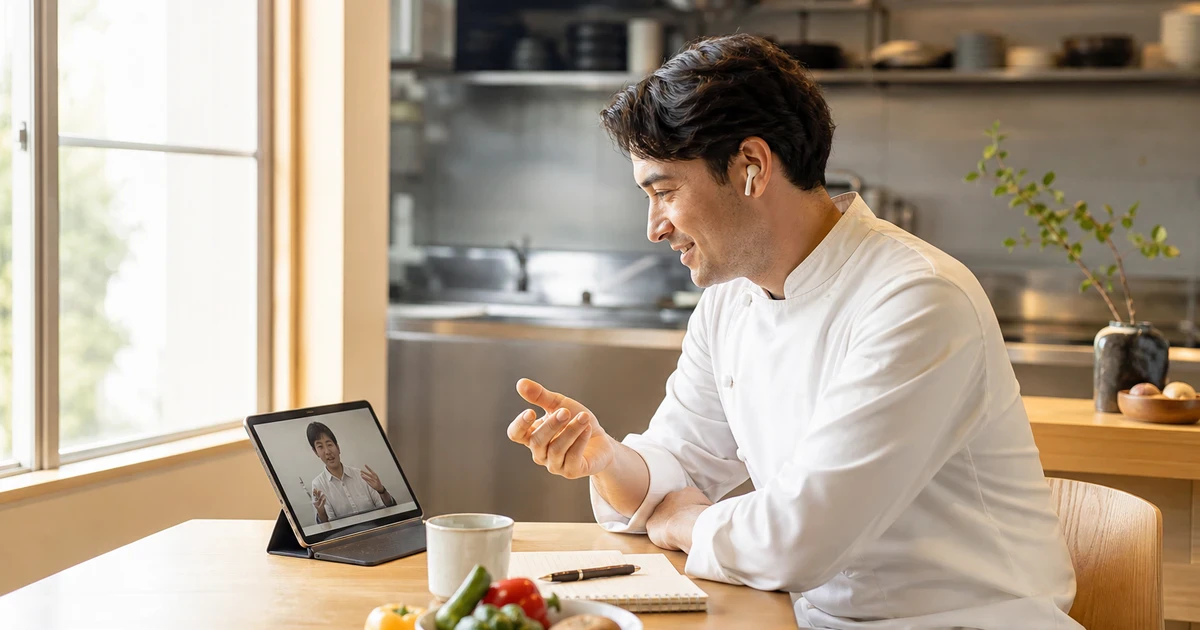
Online Japanese lessons for chefs working in Japan should solve a very specific problem: you need Japanese that works in a busy kitchen, not Japanese that only sounds good in a textbook. The most useful lessons focus on short instructions, fast replies, allergy checks, and smooth teamwork.
If you are still building your basics, Japanese Lessons for Adult Beginners Online is a useful companion. For chefs, the key is to learn language that can be used immediately on the line, during prep, and in quick handoffs between staff.
What Chefs Need Most
The most useful Japanese for chefs working in Japan is usually not long conversation. It is the language of timing, coordination, and confirmation.
A one-on-one tutor can help you practice the exact moments that matter in a kitchen:
- understanding kitchen instructions quickly
- checking allergies and ingredient changes
- confirming teamwork during service
- asking for repetition in a polite, clear way
- responding with short, natural lines under pressure
A small cultural note helps here: in many Japanese kitchens, short and calm communication is often better than long explanations. Clear does not have to mean elaborate. It usually means accurate, timely, and easy to act on.
Here is a compact reference list of phrases that often come up in kitchen work.
Japanese | Romaji | English Meaning |
|---|---|---|
すみません | sumimasen | excuse me / sorry / get attention |
アレルギー | arerugī | allergy |
確認してください | kakunin shite kudasai | please check / confirm |
少々お待ちください | shōshō omachi kudasai | please wait a moment |
手が足りません | te ga tarimasen | we do not have enough staff / hands |
These phrases matter because they are flexible. You can use them for ingredients, timing, and coordination without needing a long speech every time.
Useful Phrases for the Kitchen
The best kitchen Japanese is often built from short patterns that can be reused in many situations. In online Japanese lessons, that means practising the same line in different roles: speaking to a senior staff member, replying to a coworker, or checking a customer-related detail.
Here are four simple example sentences you can rehearse.
私はえびアレルギーです。
Watashi wa ebi arerugī desu.
I am allergic to shrimp.
この料理に卵は入っていますか。
Kono ryōri ni tamago wa haitte imasu ka.
Does this dish contain egg?
少し塩を減らしてください。
Sukoshi shio o herashite kudasai.
Please reduce the salt a little.
次は私が盛り付けます。
Tsugi wa watashi ga moritsukemasu.
I will plate the next one.
From a teacher’s perspective, learners often know a phrase when they read it slowly but lose it when a senior staff member speaks quickly. That is why role-play matters. It turns a memorized sentence into something you can actually use in a real shift.
Our teachers have also seen learners confuse similar katakana such as ツ, シ, ソ, ン, and リ. In kitchen work, that can matter when you read labels, menus, or ingredient cards. A quick correction can prevent a small reading problem from becoming a workplace problem.
If you are unsure how to read the script on packaging or in a prep note, a live teacher can help you slow the line down, check the sounds, and practise it again. That is much more useful than only reviewing vocabulary in your head.
How a 25-Minute LINE Lesson Helps
Kind Japanese offers one-on-one online Japanese lessons over LINE, and the standard lesson is 25 minutes. For chefs, that length is often enough to focus on one situation without wasting time.
A practical 25-minute LINE lesson can look like this:
- warm-up: one short update about your current kitchen situation
- target speaking task: one role-play around a real instruction, allergy check, or teamwork exchange
- teacher feedback: correction of wording, clarity, and tone
- repeat: say the line again in a cleaner, more natural form
- close: choose the one sentence you want to use next shift
That structure works well because kitchen Japanese is highly situational. You do not need to practise everything at once. You need one usable line, then another, then another.
A teacher can also listen for the parts that affect clarity most:
- long vowels, so words do not collapse too quickly
- the timing of small っ, so the rhythm stays natural
- the contrast between similar sounds such as tsu, su, and shi
- sentence-ending intonation, so a question does not sound like a statement
Before correction, the main question is simple: did the listener understand the message? After correction, the focus shifts to whether the line sounds cleaner, easier to repeat, and more natural in a real kitchen exchange.
Role-play is especially useful for chefs working in Japan because it lets you practise pressure without real consequences. You can rehearse a senior staff member giving a fast instruction, a coworker asking for confirmation, or a brief allergy check before service. That is where a one-on-one tutor is more effective than passive study.
If you want a lesson that stays close to your actual work, bring one concrete situation and practise it from start to finish. A small adjustment in wording can make the whole exchange smoother.
Common Mistakes
The most common mistakes are not dramatic. They are small, practical, and easy to miss until a real shift exposes them.
- Memorising a phrase but not being able to say it quickly when someone speaks fast
- Focusing on grammar while ignoring rhythm and sentence ending
- Using a vague answer when the kitchen needs a clear confirmation
- Mixing up similar-looking katakana on labels, ingredient cards, or menus
- Trying to say too much instead of giving a short, workable response
One particularly common issue is over-reading the sentence. A learner may understand a line on paper but hesitate when it comes out in real conversation. That is why teacher feedback should be tied to live speaking, not only written review.
Another issue is switching too late into action language. In a kitchen, people often need a direct response, not a long explanation. A good lesson will help you say the same thing more simply.
Here is a useful mindset for teamwork: confirm the instruction, repeat the key word, then act. That pattern is simple, but it reduces confusion quickly. It also makes your Japanese sound more dependable during service.
If you are a beginner and still need a gentler introduction to lesson structure, the free-trial stage is the right place to start. A good place to prepare is Japanese Free Trial Lesson Questions to Ask, especially if you want your first conversation to stay practical.
FAQ
Do I need advanced Japanese before starting?
No. The best starting point is the language you need for your next shift, not perfect fluency. A one-on-one tutor can help you practise short, useful lines for instructions, ingredients, and simple confirmation. That makes online Japanese lessons practical even for beginners.
Can these lessons help with allergies and ingredient checks?
Yes. Allergy language is one of the most valuable areas for chefs working in Japan. You can practise asking whether a dish contains a specific ingredient, confirming substitutions, and giving a clear answer when a teammate checks a menu item or prep detail.
Is a LINE lesson useful if I am busy in the kitchen?
Yes. A LINE lesson keeps the lesson focused on one spoken situation, which is ideal when your schedule is tight. Instead of studying a long list of words, you can practise one exchange, get teacher feedback, and repeat it until it is easy to use.
What should I bring to a free trial?
Bring one real kitchen situation, one phrase you already use, and one point that feels unclear. If you have a screenshot of a menu, ingredient note, or work message, that can help too. The goal is to make the free trial focused, concrete, and useful.
If you want to practise your own kitchen situations with a live teacher, book a Free Trial and start with a focused one-on-one lesson over LINE.

