
Traveling to Japan feels very different when you can actually say what you need out loud. You do not need perfect grammar to order food, ask for directions, or check into a hotel—you need a small set of phrases you can produce quickly and a little practice speaking them under pressure. That is exactly what travel-focused conversation lessons are for.
This guide walks you through the practical travel Japanese most tourists reach for, with short roleplay scenarios for restaurants, trains, hotels, and help requests. Everything here is designed to be spoken, not memorized silently, so you arrive ready to open your mouth.
Why Conversation Lessons Beat Phrasebooks for Travel
Phrasebooks give you sentences; conversation lessons give you the ability to use them when a real person answers back. The gap between reading a phrase and saying it to a station attendant is enormous, and it only closes with practice.
From a teacher's perspective, learners often know more than they can produce on the spot. The vocabulary is in there, but retrieval is slow, so a fast-talking waiter or a noisy platform throws them off. Speaking practice trains that retrieval until short phrases come out automatically.
A few things travelers gain from live conversation lessons over LINE:
- Speed under pressure. You rehearse until "Where is the station?" comes out without hesitation.
- Listening for the reply. Real trips fail when you understand your line but not the answer.
- Confidence to start. Even a shy "Sumimasen" (excuse me) gets a friendly response in Japan.
If you are just beginning, our Beginner Online Japanese Conversation Lessons walk through the same speaking-first approach at a gentler pace.
Core Travel Japanese Phrases
Start with a compact set of high-frequency phrases. These cover a large share of everyday tourist situations, and they work politely almost anywhere.
Japanese | Romaji | English Meaning |
|---|---|---|
すみません | Sumimasen | Excuse me / Sorry (to get attention) |
〜はどこですか | ~ wa doko desu ka | Where is ~? |
これをください | Kore o kudasai | I'll have this, please |
いくらですか | Ikura desu ka | How much is it? |
英語のメニューはありますか | Eigo no menyū wa arimasu ka | Do you have an English menu? |
おすすめは何ですか | Osusume wa nan desu ka | What do you recommend? |
助けてください | Tasukete kudasai | Please help me |
ありがとうございます | Arigatō gozaimasu | Thank you |
大丈夫です | Daijōbu desu | I'm fine / No, thank you |
写真を撮ってもいいですか | Shashin o totte mo ii desu ka | May I take a photo? |
Notice that すみません (sumimasen, excuse me) does double duty as both an apology and a way to flag someone down—it is probably the single most useful word on the whole trip.
Roleplay: Restaurants
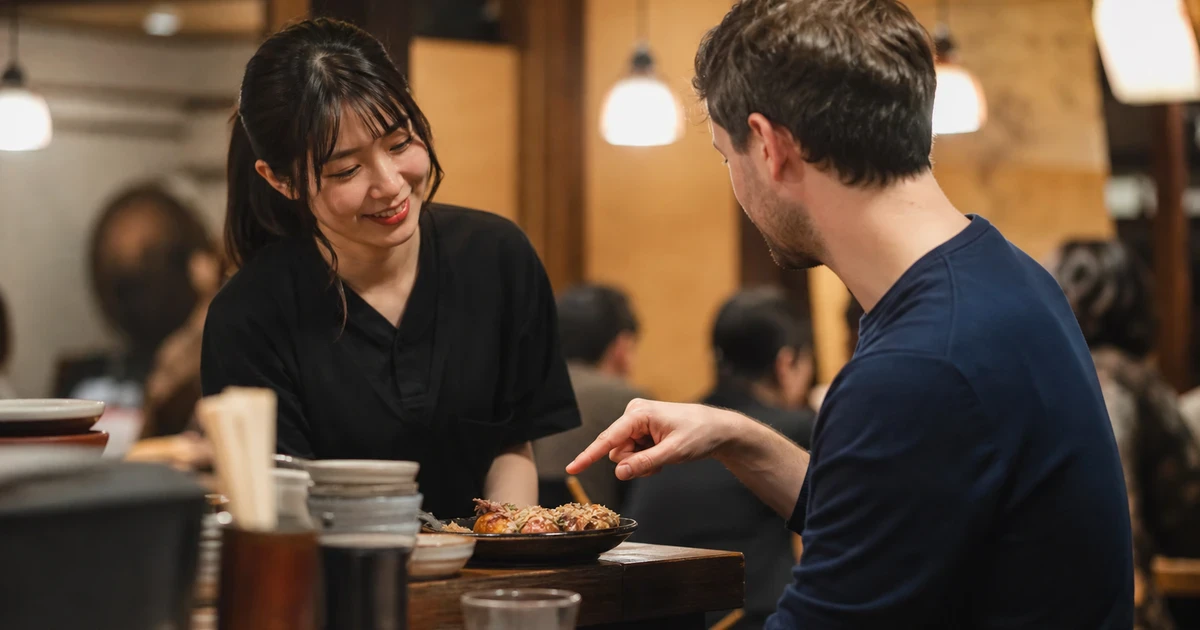
Restaurants are where most travelers first test their Japanese, so rehearse the whole flow: getting a table, ordering, and paying. A short roleplay makes the sequence feel familiar before you ever sit down.
Try this mini-dialogue out loud, playing both parts:
- Staff: 何名様ですか。(Nan-mei-sama desu ka. / How many people?)
- You: 二人です。(Futari desu. / Two people.)
Then, to order:
これをください。 Kore o kudasai. I'll have this, please.
おすすめは何ですか。 Osusume wa nan desu ka. What do you recommend?
When you are ready to pay, head to the register and say:
お会計をお願いします。 O-kaikei o onegai shimasu. The bill, please.
Cultural note: in many Japanese restaurants you pay at the front register rather than at your table, and tipping is not expected. A clear "Arigatō gozaimasu" (thank you) on the way out is the perfect ending.
If you want to name the cuisine, say 日本料理店 (Nihon ryōriten, a Japanese restaurant) rather than a phrase that could just mean "a restaurant located in Japan."
Roleplay: Trains, Directions, and Getting Around
Directions and train stations cause the most panic, so practice both asking and understanding the answer. Getting lost is normal; asking clearly is the skill that saves your day.
Use these openers to ask for directions:
駅はどこですか。 Eki wa doko desu ka. Where is the station?
東京駅に行きたいです。 Tōkyō-eki ni ikitai desu. I want to go to Tokyo Station.
When someone answers, listen for a few key words: 右 (migi, right), 左 (hidari, left), まっすぐ (massugu, straight ahead), and そこ (soko, there). You will not catch every word, and you do not need to—catching the direction is enough.
A common real moment: you realize you missed your stop. A calm way to explain it:
すみません、駅を通り過ぎました。 Sumimasen, eki o tōrisugimashita. Excuse me, I passed the station.
Practicing the reply-listening side is where a live teacher helps most, because a phrasebook cannot talk back at natural speed.
Roleplay: Hotels and Asking for Help
Hotels and help requests round out your travel toolkit, covering check-in, small requests, and moments when something goes wrong. These are lower-stress than they feel once you have the phrases ready.
At check-in:
チェックインをお願いします。 Chekku-in o onegai shimasu. Check-in, please.
For a common request:
- 荷物を預かってもらえますか。(Nimotsu o azukatte moraemasu ka. / Could you hold my luggage?)
- Wi-Fiのパスワードは何ですか。(Wi-Fi no pasuwādo wa nan desu ka. / What is the Wi-Fi password?)
And when you genuinely need help—lost, unwell, or confused—do not hesitate to say:
助けてください。 Tasukete kudasai. Please help me.
Pairing 助けて (tasukete, help) with すみません (sumimasen, excuse me) to open almost always gets a kind, patient response. Building the nerve to speak at all is half the battle, and our guide to Build Speaking Confidence with a Japanese Tutor covers practical ways to get there.
Practicing Before Your Trip with Kind Japanese
The best preparation is speaking your travel phrases aloud with someone who can gently correct you before it matters. Kind Japanese offers one-on-one lessons over LINE, and a focused, travel-themed session fits neatly into 25 minutes.
Here is a sample 25-minute LINE lesson flow built around travel prep:
- Warm-up (a few minutes). Quick greetings and a simple "Where are you going in Japan?" exchange to settle in.
- Target speaking task. Roleplay one real scenario—ordering in a restaurant, buying a train ticket, or checking into a hotel—with your teacher playing the staff.
- Correction. Your teacher listens to your whole turn, then offers feedback so your phrases sound natural and clear rather than textbook-stiff.
- Your review note. You write down one phrase to keep and one question to ask next time, so you own what you practiced.
One thing our teachers do in these one-on-one lessons is let you finish speaking before correcting, then gently point out anything that sounds unnatural—because textbook lines are occasionally different from what people actually say in a shop or station. That kind of live, self-paced feedback on pronunciation and word choice is hard to get from an app or a book.
To propose lesson times from your own time zone, keep it simple and concrete. For example, you might say you want an evening session your local time and name the window directly:
アメリカ時間の夜にレッスンを受けたいです。 Amerika jikan no yoru ni ressun o uketai desu. I want to take lessons in the evening US time.
You can try all of this in a Free Trial conversation lesson over LINE with Kind Japanese—bring the two or three travel situations you're most nervous about and practice them before you fly.
Common Mistakes
Learners preparing for travel tend to make the same small slips, and catching them early makes a big difference on the ground.
- Confusing similar kana sounds. New readers often mix up look-alike characters and sounds, which can turn a place name into the wrong word. Reading practice with a teacher fixes this quickly.
- Skipping すみません. Learners jump straight to a question without opening with すみません (sumimasen, excuse me), which can sound abrupt. Lead with it to sound polite.
- Only practicing your own line. Many travelers rehearse the question but never the answer, then freeze when the reply comes. Practice listening for 右 (migi, right) and 左 (hidari, left) too.
- Over-formal or over-casual mixing. Learners sometimes blend polite and casual endings in one sentence. Stick to the -masu/-desu forms for travel; they are safe and polite everywhere.
- Memorizing without saying it aloud. Silent study builds recognition, not production. Say each phrase out loud until it feels automatic.
FAQ
How much Japanese do I really need for a trip?
Less than you think for the basics. A handful of core phrases—greetings, "Where is ~?", "This one, please," and "How much?"—covers most tourist situations. The bigger win is being able to say them quickly and understand short replies, which conversation practice builds far faster than reading alone.
Can beginners take travel-focused conversation lessons?
Yes. Travel Japanese is one of the friendliest starting points because the phrases are short, practical, and immediately useful. A one-on-one teacher can adjust to your level, focus on the situations you will actually face, and correct your pronunciation gently so you feel confident speaking on your trip.
How should I practice roleplay on my own?
Say both parts aloud. Play yourself ordering food, then play the staff replying, and record it if you can. Focus on smooth delivery of your line plus catching key answer words like right, left, and straight. Then bring the tricky moments to a live lesson for correction.
Is a free trial enough to prepare for travel phrases?
A free trial is a great way to test the approach and get feedback on your most important situations. In a focused trial conversation, you can share your goal, run one roleplay, and hear how natural you sound. From there you decide how much more practice you want before your trip.

