
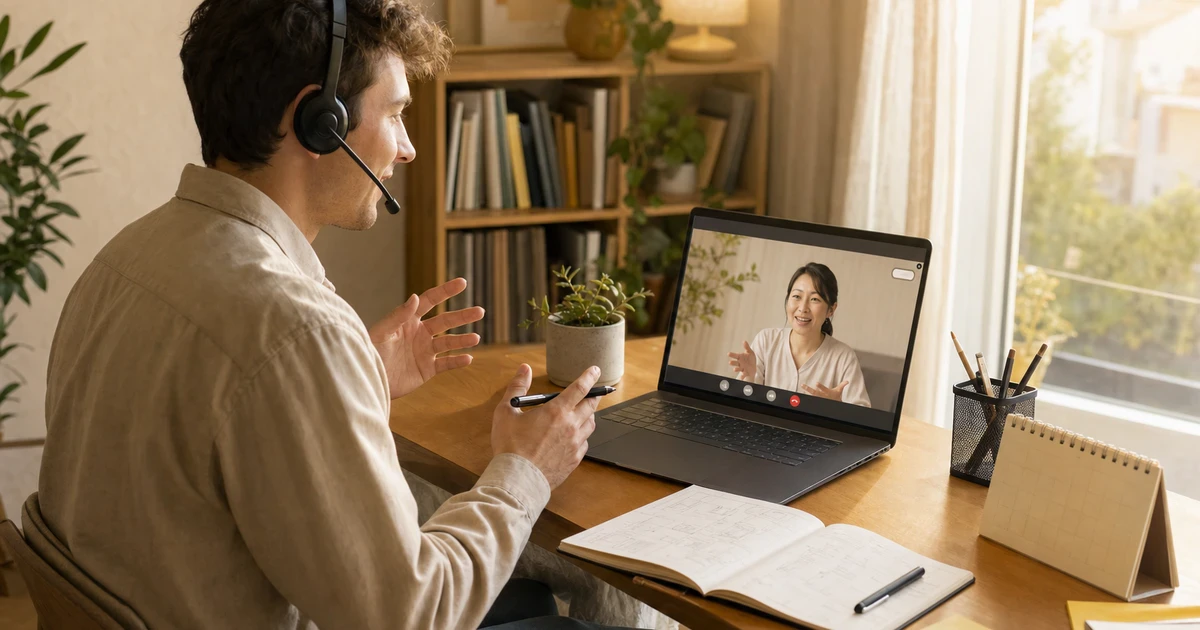
Engineers moving to Japan need Japanese that survives real work: short team standups, careful documentation questions, workplace chat, and polite clarification when something is blocked. General textbook study helps, but it often does not train the exact moments where an engineer needs to speak quickly and clearly.
Online Japanese lessons can be especially useful before relocation because you can practise from your current country, use your own work context, and build repeatable phrases before your first Japanese-language meeting. Kind Japanese offers one-on-one online lessons over LINE, with standard lessons lasting 25 minutes, so the practice can stay focused instead of turning into a broad lecture.
What Engineers Should Practise First
The first priority is not “business Japanese” in the abstract. It is the small set of work situations you will repeat every week after moving to Japan.
For software engineers, product engineers, data engineers, and technical specialists, useful practice usually starts with:
- Giving a short status update in a team standup
- Explaining a blocker without sounding too direct
- Asking for clarification about a ticket, document, or specification
- Confirming what you understood before implementing something
- Writing simple workplace chat messages
- Reading internal documentation and asking targeted questions
From a teacher’s perspective, learners often know grammar passively but need feedback on whether their sentence sounds natural in a live work situation. For example, “I don’t understand” may be grammatically correct, but in a team setting you may want a softer phrase such as “Could I confirm one point?” or “I may be misunderstanding this part.”
If you are deciding whether structured lessons are worth it, this practical question may help: do you need Japanese only for study, or do you need Japanese that works under workplace pressure? For a broader comparison, see Is It Worth Paying for Japanese Lessons?.
Core Phrases for Standups, Docs, and Chat
Use a small phrase bank first, then practise changing details inside each sentence. The goal is not to memorise 100 lines; it is to become flexible with 10 useful patterns.
Japanese | Romaji | English Meaning |
|---|---|---|
進捗を共有します | Shinchoku o kyōyū shimasu | I will share my progress |
昨日は実装を進めました | Kinō wa jissō o susumemashita | Yesterday, I worked on the implementation |
今日はテストを確認します | Kyō wa tesuto o kakunin shimasu | Today, I will check the tests |
一点確認してもよろしいですか | Itten kakunin shite mo yoroshii desu ka | May I confirm one point? |
仕様をもう一度確認したいです | Shiyō o mō ichido kakunin shitai desu | I would like to check the specification again |
この部分で少し詰まっています | Kono bubun de sukoshi tsumatte imasu | I am a little stuck on this part |
ドキュメントを確認しました | Dokyumento o kakunin shimashita | I checked the documentation |
チャットで共有します | Chatto de kyōyū shimasu | I will share it in chat |
修正が必要かもしれません | Shūsei ga hitsuyō kamo shiremasen | A correction may be needed |
もう少し詳しく教えていただけますか | Mō sukoshi kuwashiku oshiete itadakemasu ka | Could you explain in a little more detail? |
Here are simple workplace examples you can practise aloud:
昨日はログイン画面の実装を進めました。 Kinō wa roguin gamen no jissō o susumemashita. Yesterday, I worked on implementing the login screen.
今日はエラーの原因を確認します。 Kyō wa erā no gen'in o kakunin shimasu. Today, I will check the cause of the error.
この仕様をもう一度確認してもよろしいですか。 Kono shiyō o mō ichido kakunin shite mo yoroshii desu ka. May I check this specification one more time?
ドキュメントを読んで、質問をチャットで共有します。 Dokyumento o yonde, shitsumon o chatto de kyōyū shimasu. I will read the documentation and share my questions in chat.
A short cultural note: Japanese workplace communication often values visible confirmation. Even when you understand 80%, it is usually better to confirm the remaining 20% politely than to stay silent and implement the wrong thing.
A 25-Minute LINE Lesson Flow
A focused 25-minute one-on-one LINE lesson should feel like work simulation, not random conversation. For engineers moving to Japan, a practical lesson flow could look like this:
- Warm-up: explain your current role and relocation goal in simple Japanese.
- Target speaking task: give a 30-second standup update.
- Correction: adjust grammar, word choice, politeness, and sentence length.
- Role-play: ask a teammate about a ticket, bug, or unclear requirement.
- Wrap-up: keep your own LINE question list for the next lesson, such as phrases you want to test or situations you want to role-play.
This does not require you to be advanced. A beginner can practise “Yesterday I studied,” “Today I will check,” and “I have one question.” An intermediate learner can practise softer workplace phrasing. An advanced learner can work on nuance: when to be brief, when to explain background, and how to avoid sounding too blunt.
When proposing lesson windows, use your own time zone clearly. For example, write that you are available in the evening US time, morning UK time, or after work in Central European Time. Clear time-zone wording reduces confusion before the lesson even begins.
Role-Play Scenarios That Fit Engineering Work
Role-play is useful because workplace Japanese is not only about correct sentences. You need timing, repair phrases, and the ability to continue after correction.
Try these compact scenarios with a one-on-one tutor:
Team standup
- You: “Yesterday, I checked the API error.”
- Teammate: “Is it fixed?”
- You: “Not yet. I found the likely cause, but I want to confirm the specification.”
Documentation question
- You: “I read the document, but I want to confirm one point.”
- Teammate: “Which part?”
- You: “The authentication flow. Should this happen before or after user registration?”
Workplace chat
- You: “I checked the log. A correction may be needed.”
- Teammate: “Can you share details?”
- You: “Yes. I will summarize the issue in chat.”
Speak-correct-repeat practice is the key. First, say the sentence naturally. Then receive teacher feedback. Then say it again immediately, with the correction included. This loop helps you build usable speaking habits, not just notes in a notebook.
Self-study is still valuable, especially for vocabulary and grammar review. But if you are preparing for relocation, combine self-study with live correction so your Japanese becomes usable in meetings. For a balanced view, read Can You Learn Japanese by Yourself?.
Common Mistakes
Learners often make predictable mistakes when they move from study Japanese into engineering communication.
Sounding too final when unsure.
Saying “This is wrong” can sound harsher than intended. In a workplace setting, “A correction may be needed” or “I would like to confirm this part” often keeps the discussion moving.
Overusing casual anime language.
Our teachers have seen learners bring in second-person words such as 君 (kimi, you), そなた (sonata, archaic you), and あんた (anta, blunt you), or catchphrases like だってばよ (dattebayo, anime-style catchphrase). These can be funny in fiction but are usually unsuitable for workplace chat or team meetings.
Confusing similar katakana shapes.
In our one-on-one lessons, learners sometimes mix up ツ (tsu, katakana “tsu”) and シ (shi, katakana “shi”), or ソ (so, katakana “so”) and ン (n, katakana “n”). For engineers, this matters because katakana appears constantly in technical terms, product names, and borrowed words.
Translating English workplace tone too directly.
English messages like “Please fix this” may be normal in some teams, but a direct Japanese version can feel abrupt. A teacher can help you soften requests while keeping the message clear.
FAQ
Do engineers moving to Japan need business Japanese or technical Japanese?
You need a practical mix. Technical vocabulary helps with documentation, but workplace communication also requires polite clarification, short updates, and careful requests. Start with team standups, workplace chat, and documentation questions. Then add vocabulary from your actual engineering field as your work context becomes clearer.
Can beginners take online Japanese lessons before relocating?
Yes. Beginners can practise simple but useful work sentences from the start: what they did yesterday, what they will do today, and what they do not understand yet. A one-on-one tutor can keep the language level realistic while still connecting practice to relocation and engineering situations.
How should I prepare for a LINE lesson?
Prepare one work situation, not a long topic list. For example, bring a standup update, a documentation question, or a workplace chat message you want to say naturally. Also prepare your time-zone availability clearly, using wording such as evening US time or morning UK time.
Is the JLPT enough for engineering communication in Japan?
The JLPT is useful for language knowledge, reading, and listening, but it does not include a speaking section. Engineers still need live speaking practice for meetings, role-play, and teacher feedback. You can turn JLPT grammar and vocabulary into spoken workplace answers, but that practice is separate from the test itself.
If you want to practise engineering-focused Japanese in a one-on-one LINE lesson, book a Free Trial lesson with Kind Japanese.

