
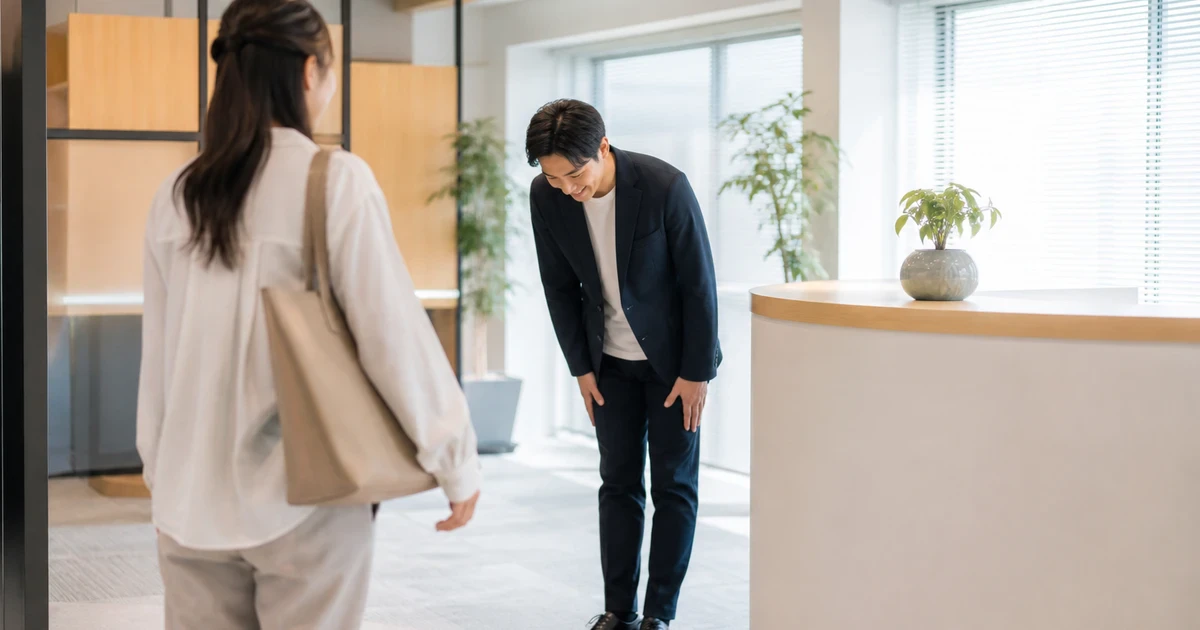
Starting a new job, joining a new team, or meeting Japanese coworkers online can feel intimidating because the first greeting sets the tone. A good japanese lesson for greeting new coworkers in japanese should not only give you phrases; it should help you choose the right level of politeness, say your role clearly, and sound natural under pressure.
In Japanese workplaces, greetings are usually short, polite, and relationship-aware. You do not need a long speech. You need a clean self-introduction, a respectful closing phrase, and enough flexibility to respond when someone greets you back.
What to Say on Your First Day
The safest first-day greeting is polite, simple, and modest. You usually include your name, your new department or role, and a closing phrase that asks for good relations.
A basic structure is:
- Greeting
- Name
- Department, role, or project
- Short positive line
- Polite closing
For example, you might say that you are joining from today, give your name, and end with a respectful phrase. In English, this sounds formal, but in Japanese it is normal. The goal is not to impress everyone with complex grammar. The goal is to show that you understand workplace distance.
A short cultural note: Japanese workplace greetings often value humility over confidence. Saying “I will do my best” can sound more natural than listing your strengths in detail, especially when meeting a team for the first time.
Core Phrases for New Coworker Greetings
Use these phrases as building blocks, not as a script to memorize mechanically. The best greeting depends on whether you are meeting your manager, a teammate, a client-facing colleague, or a group in a morning meeting.
Japanese | Romaji | English Meaning |
|---|---|---|
はじめまして | Hajimemashite | Nice to meet you |
本日からお世話になります | Honjitsu kara osewa ni narimasu | I will be working with you from today |
田中と申します | Tanaka to mōshimasu | My name is Tanaka |
営業部に配属されました | Eigyōbu ni haizoku saremashita | I have been assigned to the Sales Department |
開発チームで働きます | Kaihatsu chīmu de hatarakimasu | I will work on the development team |
まだ慣れないことも多いですが | Mada narenai koto mo ōi desu ga | There are still many things I am not used to |
一生懸命頑張ります | Isshōkenmei ganbarimasu | I will do my best |
ご指導のほどよろしくお願いいたします | Go-shidō no hodo yoroshiku onegai itashimasu | I appreciate your guidance |
どうぞよろしくお願いいたします | Dōzo yoroshiku onegai itashimasu | I look forward to working with you |
こちらこそよろしくお願いいたします | Kochira koso yoroshiku onegai itashimasu | Likewise, I look forward to working with you |
The phrase よろしくお願いいたします (yoroshiku onegai itashimasu, I look forward to working with you) is especially important. It does not translate perfectly into English, but it signals respect, cooperation, and a good attitude.
Example Introductions You Can Practise
A first greeting should sound like something you can actually say. If your Japanese level is beginner, keep the sentence short. If your level is intermediate or advanced, add one detail about your role or project.
本日からお世話になります。田中と申します。 Honjitsu kara osewa ni narimasu. Tanaka to mōshimasu. I will be working with you from today. My name is Tanaka.
開発チームで働きます。どうぞよろしくお願いいたします。 Kaihatsu chīmu de hatarakimasu. Dōzo yoroshiku onegai itashimasu. I will work on the development team. I look forward to working with you.
まだ慣れないことも多いですが、一生懸命頑張ります。 Mada narenai koto mo ōi desu ga, isshōkenmei ganbarimasu. There are still many things I am not used to, but I will do my best.
こちらこそ、どうぞよろしくお願いいたします。 Kochira koso, dōzo yoroshiku onegai itashimasu. Likewise, I look forward to working with you.
A teacher can help you adjust these sentences so they match your real situation. For example, if you are not formally “assigned” to a department, a teacher may help you use a softer sentence about the team you will work with instead.
Common Mistakes
From a teacher’s perspective, learners often need feedback on three things: politeness level, word choice, and pronunciation clarity. The sentence may be grammatically correct but still sound too casual, too dramatic, or slightly unnatural for a workplace.
Using anime-style second-person words. Learners sometimes pick up words like 君 (kimi, you), あんた (anta, you), or character-specific expressions from anime. These can sound rude, old-fashioned, or fictional in a real office. In a first greeting, you usually do not need a direct “you” at all.
Making the greeting too long. A first-day greeting is not a full life story. Two or three clear sentences are usually stronger than a long speech with many difficult phrases.
Overusing casual forms. Phrases that are fine with friends can sound careless with new coworkers. For first meetings, polite forms are the safer default.
Pronouncing similar kana unclearly. In our one-on-one lessons, our teachers sometimes see learners confuse similar-looking kana such as ツ (tsu, katakana tsu) and シ (shi, katakana shi), or ソ (so, katakana so) and ン (n, katakana n). For workplace greetings, this matters because names, departments, and loanwords often use katakana. A teacher can let you finish your sentence first, then give focused feedback on the parts that affected clarity.
How to Practise in a 25-Minute LINE Lesson
A standard Kind Japanese one-on-one lesson is 25 minutes over LINE, which works well for focused workplace role-play. You can practise one realistic greeting several times instead of studying a long list of disconnected phrases.
A practical lesson flow could look like this:
- Warm-up: say your name, job, level, and workplace situation in simple English or Japanese.
- Target speaking task: introduce yourself to a new coworker, then to a manager, then to a small team.
- Correction: refine politeness, sentence order, pronunciation, and any words that sound too casual.
- Role-play: respond when the coworker says よろしくお願いします (yoroshiku onegai shimasu, I look forward to working with you).
- Learner-kept questions: write down the phrases or questions you personally want to review in LINE, so you can keep your own practice organized.
If you are arranging lessons across time zones, propose windows in your own local time clearly. For example, write “weekday evenings US time” or “Saturday morning Central European Time” in English first if that is easiest, then practise saying your preference in Japanese later. Avoid vague scheduling language until your time zone is clear.
This kind of practice is also useful if you are setting broader study goals. For a structured approach, you may like Kind Japanese’s guide to New Year Japanese Learning Goals That Actually Stick, especially if workplace Japanese is one of your priorities.
FAQ
What is the safest Japanese greeting for new coworkers?
The safest greeting is a short polite self-introduction: say you are joining from today, give your name, mention your team or role, and close with a respectful phrase. You do not need advanced keigo for every sentence. Clear, polite, and natural is better than memorizing a speech you cannot say comfortably.
Should I use casual Japanese with coworkers my age?
Use polite Japanese at first, even if your coworkers seem friendly or close in age. Workplace relationships are not based only on age; role, seniority, company culture, and situation matter. You can become more casual later if the other person clearly sets that tone.
How can I sound less nervous when introducing myself?
Practise a short version until it feels automatic. Then practise one response for when someone greets you back. Many learners freeze after the first sentence, so role-play helps you continue naturally. One-on-one feedback can also catch pronunciation or rhythm issues that self-study may miss.
Do I need keigo to greet new coworkers?
You need polite workplace Japanese, but you do not need to master every keigo pattern before greeting coworkers. A few reliable phrases are enough for a first meeting. As your role becomes clearer, you can learn more precise expressions for managers, clients, emails, and meetings.
For a focused japanese lesson for greeting new coworkers in japanese, book a Book a Free Trial Lesson over LINE with Kind Japanese and practise the exact greeting you want to use.

