
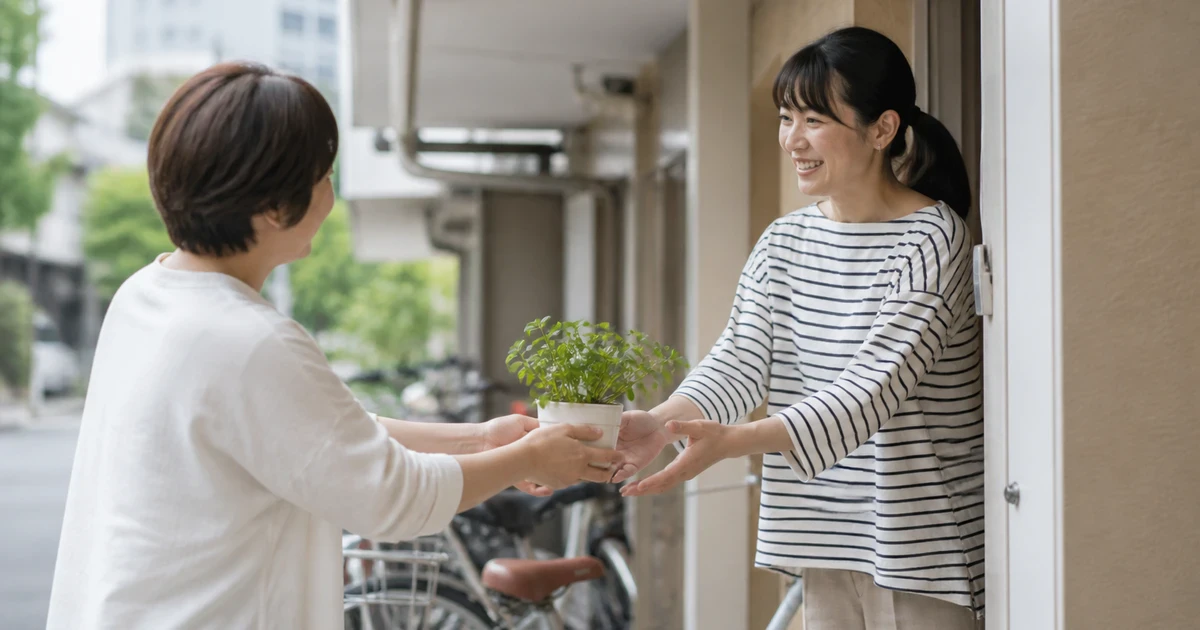
Moving into a new apartment, joining a local event, or meeting the person next door can feel surprisingly stressful in Japanese. A japanese lesson for neighborhood introductions in japan should not just give you phrases to memorize. It should help you sound polite, brief, warm, and not too intense.
Neighborhood Japanese is different from travel Japanese. You are not ordering food or asking for directions. You are starting a relationship that may stay casual for years. The goal is usually simple: greet clearly, introduce yourself, show consideration, and leave space for the other person.
This guide focuses on greetings, small talk, and polite distance. It is especially useful if you live outside Japan now but want to prepare before moving, visiting long-term, or speaking with Japanese neighbors in your community.
What To Say First
The safest first introduction is short, polite, and easy to answer. You do not need a long self-introduction. In many neighborhood situations, less is better.
A natural first meeting usually includes:
- A greeting
- Your name
- A simple reason for speaking
- A polite closing phrase
For example, if you have just moved in, you can say that you are new to the building or area. If you are meeting someone in a shared hallway, elevator, or entrance, keep your voice calm and your sentence short.
Cultural note: in Japan, neighborhood friendliness often works through repeated small greetings rather than one deep conversation. A simple hello today, another greeting next week, and a short comment later can feel more natural than trying to become close immediately.
Japanese | Romaji | English Meaning |
|---|---|---|
はじめまして | Hajimemashite | Nice to meet you |
近くに引っ越してきました | Chikaku ni hikkoshite kimashita | I moved nearby |
これからよろしくお願いします | Kore kara yoroshiku onegai shimasu | I look forward to getting along with you from now on |
おはようございます | Ohayō gozaimasu | Good morning |
こんにちは | Konnichiwa | Hello / good afternoon |
こんばんは | Konbanwa | Good evening |
いい天気ですね | Ii tenki desu ne | Nice weather, isn’t it? |
すみません、少しお聞きしてもいいですか | Sumimasen, sukoshi o-kiki shite mo ii desu ka | Excuse me, may I ask you something briefly? |
ご迷惑をおかけしないように気をつけます | Gomeiwaku o okake shinai yō ni ki o tsukemasu | I will be careful not to cause trouble |
また今度 | Mata kondo | Another time / sometime soon |
はじめまして。近くに引っ越してきました。 Hajimemashite. Chikaku ni hikkoshite kimashita. Nice to meet you. I moved nearby.
これからよろしくお願いします。 Kore kara yoroshiku onegai shimasu. I look forward to getting along with you from now on.
いい天気ですね。 Ii tenki desu ne. Nice weather, isn’t it?
また今度、ゆっくりお話しできたらうれしいです。 Mata kondo, yukkuri ohanashi dekitara ureshii desu. I would be happy if we could talk more sometime.
Keep Small Talk Small
Neighborhood small talk works best when it is light, brief, and easy to escape from. Weather, the building, local shops, trash rules, noise, and seasonal events can be safe topics. Personal questions can feel too sudden.
Good topics include:
- Weather
- How long you have lived nearby
- A nearby supermarket, station, or park
- Simple thanks after receiving help
- Short apologies for possible inconvenience
Be careful with questions like “Do you live alone?”, “How old are you?”, or “What is your job?” They may sound normal in some cultures, but they can feel too direct in a first neighbor conversation.
A useful learning pattern is to practice two versions of every phrase: one very short version for the hallway, and one slightly longer version for a planned introduction. Learners often memorize full textbook sentences, then struggle because real neighbor conversations are shorter and less predictable.
If you want broader speaking practice beyond this situation, the Kind Japanese article Build Speaking Confidence with a Japanese Tutor can help you think about how to turn memorized phrases into spoken responses.
A 25-Minute LINE Lesson Flow
A practical Japanese lesson for this topic should feel like rehearsal, not a vocabulary lecture. In Kind Japanese’s standard one-on-one online lessons over LINE, the lesson length is 25 minutes, which is enough to focus on one realistic neighborhood situation.
Here is a sample 25-minute lesson agenda:
- Warm-up: say your name, country, and current Japanese level in simple Japanese.
- Target situation: choose one scene, such as moving into an apartment, meeting a neighbor in the elevator, or asking about trash day.
- Role-play: practice the first 20 seconds of the conversation several times.
- Correction: adjust politeness, word choice, pronunciation, and sentence length.
- Repeat: say the corrected version again until it feels usable.
- Learner-owned review note: write down what you tried to say, the corrected sentence, and one question to ask next time.
Before a LINE lesson, prepare one specific situation in your own words. For example: “I want to introduce myself after moving into an apartment in Osaka,” or “I want to ask a neighbor where to put cardboard.” This helps a one-on-one Japanese tutor focus the practice instead of guessing your real-life need.
If you live outside Japan, propose lesson windows in your own time zone. You can write your preferred day, local time, and time zone clearly, such as “Tuesday evening, US Eastern Time” or “Saturday morning, Central European Time.” Do not assume the other person will convert your local schedule automatically.
Common Mistakes
Learners often sound too formal, too casual, or too eager when introducing themselves to neighbors. The words may be correct, but the social distance can feel slightly off.
Using anime-style second-person words. Words like very casual or dramatic “you” forms can sound strange in ordinary neighborhood life. In many first meetings, you can avoid saying “you” directly and use the person’s name later if you learn it.
Talking too long in the first greeting. A first hallway greeting is not a full biography. Give your name or basic situation, then let the other person decide whether to continue.
Forgetting the closing phrase. A phrase like 「よろしくお願いします」, yoroshiku onegai shimasu, meaning “I look forward to getting along with you” or “Please treat me kindly,” helps close the introduction naturally.
Overusing direct translations. “Let’s be friends” can sound too strong as a first neighbor greeting. It is usually better to show friendliness through polite, repeated greetings.
Ignoring pronunciation in kana-heavy phrases. Our teachers have noted that some learners mix up similar-looking kana such as tsu/shi or so/n. For neighborhood introductions, pronunciation matters because short phrases must be understood quickly. A teacher can let you finish your sentence first, then guide you toward a clearer version.
For learners also building reading confidence, Easiest Way to Remember Kanji Without Guessing is useful when address signs, apartment notices, and local instructions start to appear in daily life.
Practice Routine Before You Move
The best routine is small but repeated. Practice one greeting, one small-talk line, and one polite exit until you can say them without translating word by word.
Try this micro-routine three times a week:
- Day 1: Record yourself saying your first introduction.
- Day 2: Practice one small-talk line with different greetings.
- Day 3: Role-play a short neighbor exchange out loud.
- Day 4: Write one correction note: what you tried to say, what sounded unnatural, and what you want to ask a teacher.
- Day 5: Repeat the corrected version without looking.
A correction-note loop is simple:
- What you tried to say: “I moved here, please be kind to me.”
- Better sentence: “I moved nearby. I look forward to getting along with you.”
- Repeat question: “Can I say this in an apartment hallway?”
- Next LINE lesson focus: practice the same line with natural speed and polite distance.
A Japanese lesson becomes more effective when you bring this loop to class. You are not asking for random conversation; you are asking for a usable neighbor introduction that fits your real situation.
For a focused japanese lesson for neighborhood introductions in japan, book a Book a Free Trial Lesson over LINE and bring one neighborhood situation you want to handle politely.
FAQ
Do I need very formal Japanese for neighborhood introductions?
You usually need polite Japanese, not extremely formal business Japanese. Simple desu/masu-style sentences are enough for most first meetings. The bigger issue is social distance: avoid sounding too casual, too personal, or too long. A short greeting, brief context, and polite closing phrase usually work better than advanced grammar.
What should I say if I have just moved in?
A simple pattern is best: greet the person, say you moved nearby, and close politely. You can use a phrase like “I moved nearby” followed by 「よろしくお願いします」, yoroshiku onegai shimasu, meaning “I look forward to getting along with you” or “Please treat me kindly.” Keep it warm and brief.
Can I practice this in a LINE lesson before going to Japan?
Yes. A LINE lesson is well suited to short role-play because you can focus on one practical scene, repeat it, and correct small wording problems. For example, you can rehearse meeting a neighbor in the elevator, asking about trash rules, or greeting someone outside your apartment building.
Is a one-on-one Japanese tutor better than memorizing phrases?
Memorized phrases are a useful start, but a one-on-one Japanese tutor can help you choose the right phrase for the relationship, place, and level of politeness. Neighborhood Japanese depends on tone and distance. Feedback helps you avoid sentences that are grammatically correct but too stiff, too casual, or too personal.

