
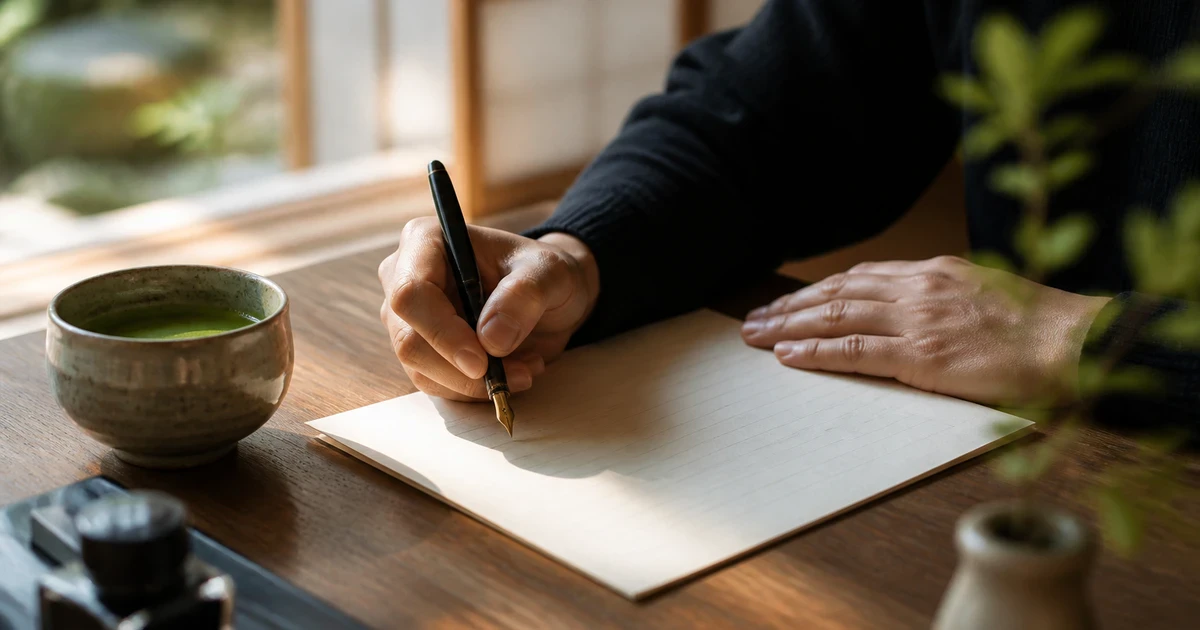
Japanese writing practice works best when you combine recognition, memory, handwriting, typing, and feedback. Copying characters can help a beginner, but effective practice also teaches you to communicate meaning naturally.
Japanese uses hiragana, katakana, and kanji. Hiragana supports grammar, katakana represents many loanwords, and kanji carries meaning while requiring repeated visual recognition.
A useful routine is short, focused, and repeatable: choose a small target, write it by hand, type it, then use it in a sentence. A teacher can check whether your sentence sounds natural, polite, and appropriate for the relationship.
Start With a Small Writing Target
The best place to start is one practical writing goal rather than a large list of characters. You might practise introducing yourself, describing your weekend, or writing a short request.
A beginner can work through this sequence:
- Recognise the character and read it aloud.
- Trace it once or twice using tracing sheets.
- Copy it without looking at the model.
- Type the same word on a phone or computer.
- Write one original sentence using it.
- Check the meaning and word order.
Handwriting slows your attention down. Notice stroke direction, balance, and the space each character occupies. You do not need beautiful calligraphy; readable writing connected to useful language is the goal.
For kanji, boxes make spacing easier. Traditional 原稿用紙 (genkōyōshi; often typed as “genkouyoushi” in searches) uses square boxes for Japanese composition, usually placing one character or punctuation mark in each box. Even outside formal manuscript writing, a genkō-yōshi-style sheet helps you notice character size and spacing.
You can make a simple grid yourself or use a printable sheet. Consistent boxes do not need to be exact, but setting a regular size in millimeters can make spacing easier to judge.
Build Recognition and Memory
Writing a character repeatedly is not enough if you cannot recognise it later. Strong Japanese writing practice alternates between producing a character and identifying it in words, messages, and short texts.
Use this memory cycle:
- Look at a model and read the word.
- Cover the model and reproduce it.
- Compare your answer with the original.
- Say the word and explain its meaning.
- Use it in a sentence the same day.
- Review it again later in the week.
Faint practice lines can help at first, but gradually remove them. A blank sheet reveals whether you truly remember the shape. You can print a sheet from a PDF, use tracing sheets, or create your own grid with boxes.
Digital tools also have a supporting role. An app on iOS or Android can help you review characters, and Duolingo may provide useful exposure to basic vocabulary. Still, app recognition is not the same as producing a sentence. Type Japanese regularly, but also practise choosing words and arranging them for a real situation.
Use Words in Context
The following expressions are useful for short personal writing and polite communication.
Japanese | Hepburn romaji | English meaning |
|---|---|---|
日記 | nikki | diary or journal |
練習 | renshū | practice |
書く | kaku | to write |
読む | yomu | to read |
伝える | tsutaeru | to communicate or convey |
意味 | imi | meaning |
確認する | kakunin suru | to check or confirm |
丁寧な表現 | teinei na hyōgen | polite expression |
After copying a word, change one part of the sentence. Replace the activity, place, time, or reason while keeping the grammar pattern. This turns copying into active practice.
毎日日記を書いています。
Mainichi nikki o kaite imasu.
I write in a diary every day.
この言葉の意味を確認します。
Kono kotoba no imi o kakunin shimasu.
I will check the meaning of this word.
自分の考えを日本語で伝えたいです。
Jibun no kangae o Nihongo de tsutaetai desu.
I want to communicate my thoughts in Japanese.
先生に丁寧な表現を聞きました。
Sensei ni teinei na hyōgen o kikimashita.
I asked my teacher about a polite expression.
Japanese writing often leaves the relationship between speakers implicit. A sentence may be grammatically correct but too direct for a customer, colleague, or older person. Writing practice should include audience and context, not only grammar accuracy.
Common Mistakes in Japanese Writing Practice
Learners often confuse similar-looking kana, especially when reading quickly. Katakana シ (shi, katakana syllable “shi”) and ツ (tsu, katakana syllable “tsu”) differ in the direction and placement of their strokes. ソ (so, katakana syllable “so”) and ン (n, katakana syllable “n”) can also be difficult when handwriting is small or rushed.
A helpful correction method is to finish the whole sentence before reviewing every error. Then compare confusing characters side by side and practise two or three words containing each one. This keeps writing meaningful while targeting visual accuracy.
Learners also sometimes copy fictional speech into ordinary writing. Expressions associated with anime characters may be memorable, but they can sound unnatural or overly dramatic in daily communication. Check who would say an expression, to whom, and in what setting.
Grammar endings need the same attention. Learners may produce the wrong て形 (te-kei, te-form) because they memorised one verb without connecting it to its pattern. Group similar verbs together, read them slowly, and write several examples from memory.
Politeness is another common difficulty. Japanese has several ways to ask whether something is acceptable, and the best choice depends on the situation and relationship. Repeated exposure and practice are necessary before these differences feel automatic.
A teacher can give live feedback on kana shape, register, grammar endings, and whether a sentence communicates the intended meaning. A standard Kind Japanese lesson is a focused 25-minute one-on-one lesson over LINE, giving you space to bring a short paragraph, message, or writing question.
For more context on personalised online study, read Online Japanese Lessons: From App Study to Speech. If you are considering a first conversation with a tutor, Japanese Trial Lesson: What Happens and What to Expect explains what to prepare.
A Practical Weekly Writing Routine
A sustainable routine is more valuable than an ambitious plan you abandon. Try this pattern:
- Day 1: copy five useful words and read them aloud.
- Day 2: write the words from memory and check the shapes.
- Day 3: type three sentences using the words.
- Day 4: rewrite the sentences more naturally.
- Day 5: write a short paragraph without a model.
- Day 6: review corrections and record one question.
- Day 7: reread the paragraph and notice what feels easier.
Keep a learner-owned review note. Record the original sentence, the corrected version, the reason for the change, and one new sentence using the same pattern. This builds memory more effectively than simply collecting corrected sheets.
A live teacher can help you decide whether a problem is spelling, grammar, word choice, politeness, or unclear context. One-on-one practice is especially useful when you can already write basic sentences but are unsure whether they sound natural.
If you want focused guidance for your own writing goal, book a Free Trial Lesson with Kind Japanese.
FAQ
Is handwriting still important if I mainly type Japanese?
Handwriting remains useful because it strengthens visual recognition, stroke order, spacing, and recall. You do not need to handwrite everything, but combining a few handwritten words with regular typing helps you recognise kanji and notice mistakes that predictive input may hide. It also makes unfamiliar characters easier to remember later.
Can an app replace Japanese writing practice with a teacher?
An app can support vocabulary review, typing, and character recognition, but it cannot reliably judge your intended meaning, relationship with the reader, or natural level of politeness. A teacher adds human feedback and helps you reuse corrected sentences in spoken communication. That combination connects written accuracy with practical conversation.
How many Japanese characters should a beginner practise?
A beginner should practise a small number of useful characters at a time, then place them into words and sentences. Reviewing fewer items repeatedly is usually more effective than copying a long list once, especially when each item is read, written, typed, and used meaningfully. Gradually increase the amount as recall becomes easier.
What should I bring to a Japanese writing lesson?
Bring a short paragraph, message, diary entry, or sentence that reflects your real goal. You can also bring one confusing character, grammar pattern, or question about tone, so the teacher can focus feedback on accuracy, meaning, and practical communication. A specific example usually creates more useful discussion than an isolated vocabulary list.

