
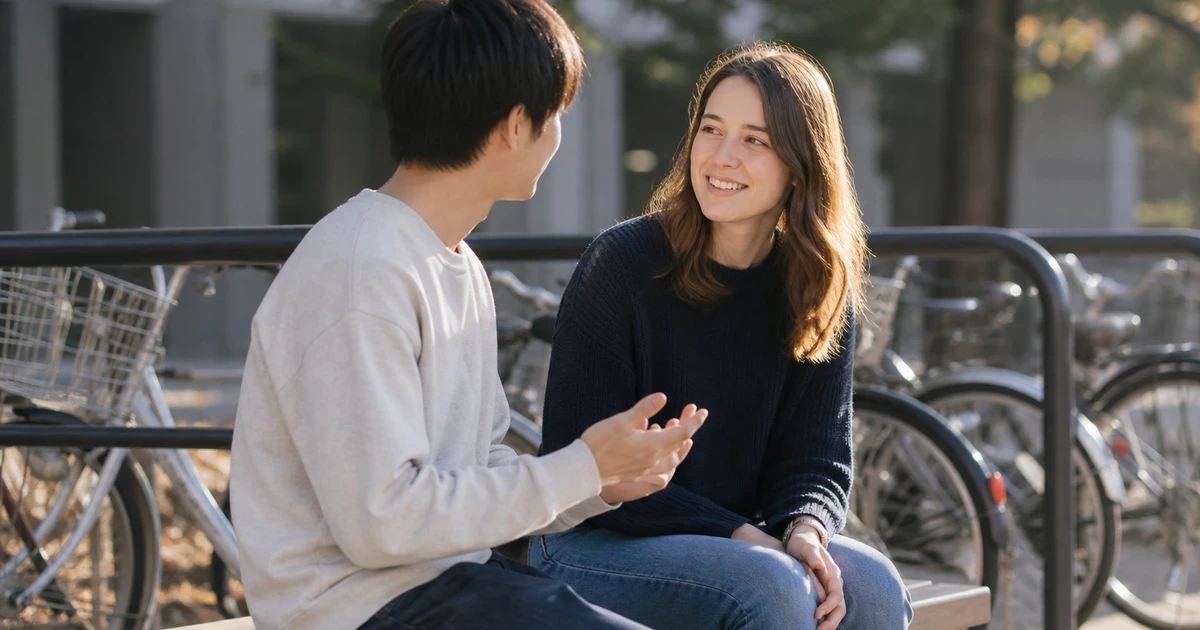
Japanese lessons for exchange students should prepare you for real campus life, not only textbook grammar. Before you arrive in Japan, the most useful study areas are self-introductions, orientation questions, campus Japanese, club visits, office procedures, daily-life errands, and polite boundaries around part-time work.
You do not need perfect Japanese before your exchange begins. You need reliable phrases, listening practice, and teacher feedback so you can ask for help without freezing. Kind Japanese offers one-on-one online lessons over LINE, so you can practise the situations you expect to face before you are standing at the university counter.
What Exchange Students Should Learn First
The first priority is practical speaking: introducing yourself, confirming information, and asking for help at school. Many exchange students study grammar for months but have not practised saying simple things under pressure.
Start with these campus situations:
- Class self-introduction
- Orientation check-in
- Asking about documents
- Confirming your faculty, student number, or course registration
- Visiting the international office
- Asking about clubs and circles
- Explaining your Japanese level
- Asking whether part-time work is allowed under your situation
- Handling daily life, such as housing, payment, transport, and phone setup
From a teacher's perspective, learners often know the words separately but need feedback on sentence endings, politeness level, and whether the phrase sounds natural in a school setting. For example, a sentence that is grammatically possible may still sound too casual at the office or too stiff when speaking to classmates.
If you are an adult beginner or returning learner, it can also help to review how online lessons work in general through Japanese Lessons for Adult Beginners Online, then adapt that approach to student life.
Core Campus Japanese Phrases
Use these phrases as your first exchange-student survival set. They are suitable for campus orientation, student office questions, club visits, and basic lesson planning.
Japanese | Romaji | English meaning |
|---|---|---|
交換留学生です | Kōkan ryūgakusei desu | I am an exchange student |
オリエンテーションはどこですか | Orientēshon wa doko desu ka | Where is orientation? |
学部はどちらですか | Gakubu wa dochira desu ka | Which faculty are you in? |
学生番号はこちらです | Gakusei bangō wa kochira desu | Here is my student number |
書類は提出しました | Shorui wa teishutsu shimashita | I submitted the documents |
ポータルを確認します | Pōtaru o kakunin shimasu | I will check the portal |
もう一度説明していただけますか | Mō ichido setsumei shite itadakemasu ka | Could you explain once more? |
この授業を履修したいです | Kono jugyō o rishū shitai desu | I want to register for this class |
サークルを見学してもいいですか | Sākuru o kengaku shite mo ii desu ka | May I observe the club/circle? |
アルバイトについて確認したいです | Arubaito ni tsuite kakunin shitai desu | I want to confirm about part-time work |
寮のチェックインは何時ですか | Ryō no chekkuin wa nanji desu ka | What time is dorm check-in? |
支払い方法を教えてください | Shiharai hōhō o oshiete kudasai | Please tell me the payment method |
アメリカ時間の夜にレッスンを受けたいです | Amerika jikan no yoru ni ressun o uketai desu | I want to take lessons in the evening US time |
A useful cultural note: in Japanese campus settings, it is normal to ask clear confirmation questions politely. You are not bothering staff by confirming document status, room location, or portal steps. A calm, polite question is often better than pretending you understood everything.
Orientation, Office Questions, and First-Week Errands
Orientation Japanese is about listening for keywords and asking short follow-up questions. You may hear fast explanations about forms, course registration, health checks, student ID cards, portals, and campus rules.
A likely staff-student exchange may sound like this:
- Staff asks: 学部はどちらですか (Gakubu wa dochira desu ka, Which faculty are you in?)
- You answer with your faculty name and add: 交換留学生です (Kōkan ryūgakusei desu, I am an exchange student)
- Staff asks for: 学生番号 (gakusei bangō, student number)
- You ask: 書類は全部そろっていますか (Shorui wa zenbu sorotte imasu ka, Are all the documents complete?)
- Staff says to check the portal, and you confirm: ポータルを確認します (Pōtaru o kakunin shimasu, I will check the portal)
Before arrival, practise follow-up questions for these areas:
- Faculty and department: “Which counter should I go to?”
- Student number: “Is this number correct?”
- Document status: “Are any documents missing?”
- Portal confirmation: “Where can I check the announcement?”
- Housing: “What time is check-in?”
- Payment or bank account: “What payment methods are accepted?”
- Phone or SIM setup: “Where can I ask about mobile service?”
Keep your first-week Japanese short and polite. Long explanations are harder to control when you are tired, carrying luggage, or listening in a noisy office.
Class Introductions, Clubs, and Part-Time Boundaries
Class introductions should be simple, warm, and easy to repeat. You do not need a long speech. You need your name, home university or country, study field, and one friendly sentence.
はじめまして。交換留学生のマリアです。 Hajimemashite. Kōkan ryūgakusei no Maria desu. Nice to meet you. I am Maria, an exchange student.
経済学を勉強しています。 Keizaigaku o benkyō shite imasu. I am studying economics.
日本語をもっと話せるようになりたいです。 Nihongo o motto hanaseru yō ni naritai desu. I want to become able to speak more Japanese.
Clubs and circles are also important for campus life. In Japan, university clubs can vary widely in schedule, seriousness, cost, and expectations. Before joining, it is natural to observe first and ask about practice days, beginner participation, and fees.
For part-time work, do not rely on casual advice from classmates. Rules and permissions can depend on your status and school procedures, so use Japanese lessons to practise how to ask the university office clearly. Keep the question general, polite, and focused on confirmation rather than assuming permission.
A 25-Minute LINE Lesson Flow for Campus Japanese
A focused 25-minute one-on-one lesson over LINE can turn vague preparation into usable speaking practice. The goal is not to memorise every possible sentence; the goal is to become ready for the first few conversations you will actually have.
A practical lesson flow could be:
- Warm-up: introduce yourself as an exchange student and explain your arrival situation.
- Target speaking task: practise one scene, such as orientation check-in or asking about club observation.
- Correction: receive teacher feedback on grammar, natural wording, pronunciation, and politeness.
- Repeat: say the corrected version again until it feels smoother.
- Learner-kept questions: write down your own follow-up questions to practise or ask in a future lesson.
For time zones, propose lesson windows in your own local time, not only Japan time. For example, say that you want lessons in the evening US time or the morning in Europe, then confirm the exact day and time clearly. This reduces confusion when you are preparing before departure.
If you are unsure what to ask in your first session, Japanese Free Trial Lesson Questions to Ask can help you prepare focused goals before speaking with a teacher.
Common Mistakes
Learners often prepare exchange Japanese too broadly. “I want to speak Japanese on campus” is a good goal, but it becomes easier when you break it into exact scenes: office counter, classroom, club visit, dorm check-in, payment question, and daily-life help.
A second common mistake is using casual Japanese too early with staff. Friendly classmates may use relaxed language, but university offices, teachers, and club leaders often call for polite forms. You do not need advanced honorific language for every sentence, but you should practise polite endings and soft requests.
Learners also confuse recognition with production. You may understand orientation, portal, and student ID words when reading them, but speaking them quickly at a counter is different. Teacher feedback helps you check vowel length, sentence rhythm, and whether your question is understandable in real time.
Finally, some exchange students over-prepare for perfect grammar and under-prepare for repair phrases. Phrases like “Could you explain once more?” and “Where can I check that?” are essential because real campus conversations rarely go exactly as planned.
To practise your own exchange-student situations before arrival, book a Free Trial Lesson with Kind Japanese and use it to test your self-introduction, orientation questions, or club conversation.
FAQ
Do exchange students need Japanese before arriving in Japan?
You can begin exchange life with limited Japanese, but basic speaking practice makes the first week much easier. Focus on introductions, orientation questions, office procedures, housing, payment, and daily help. Even beginner-level Japanese is useful if you can say it clearly and politely.
What should I practise for campus orientation?
Practise asking where to go, confirming your faculty, showing your student number, checking document status, and asking where portal information appears. Orientation often includes fast instructions, so repair phrases are important. Being able to ask for one more explanation can prevent small misunderstandings from becoming stressful.
How can Japanese lessons help with clubs?
Japanese lessons can help you practise polite questions before visiting a club or circle. Useful topics include asking whether observation is allowed, when activities happen, whether beginners can join, and whether there are fees. This preparation helps you sound respectful without making your Japanese too stiff.
Should I study formal Japanese or casual Japanese first?
Start with polite everyday Japanese because it works in more campus situations, especially with staff, teachers, and people you have just met. Casual Japanese is useful for friends, but it is easier to relax later than to repair an overly casual first impression in an office or formal setting.

