
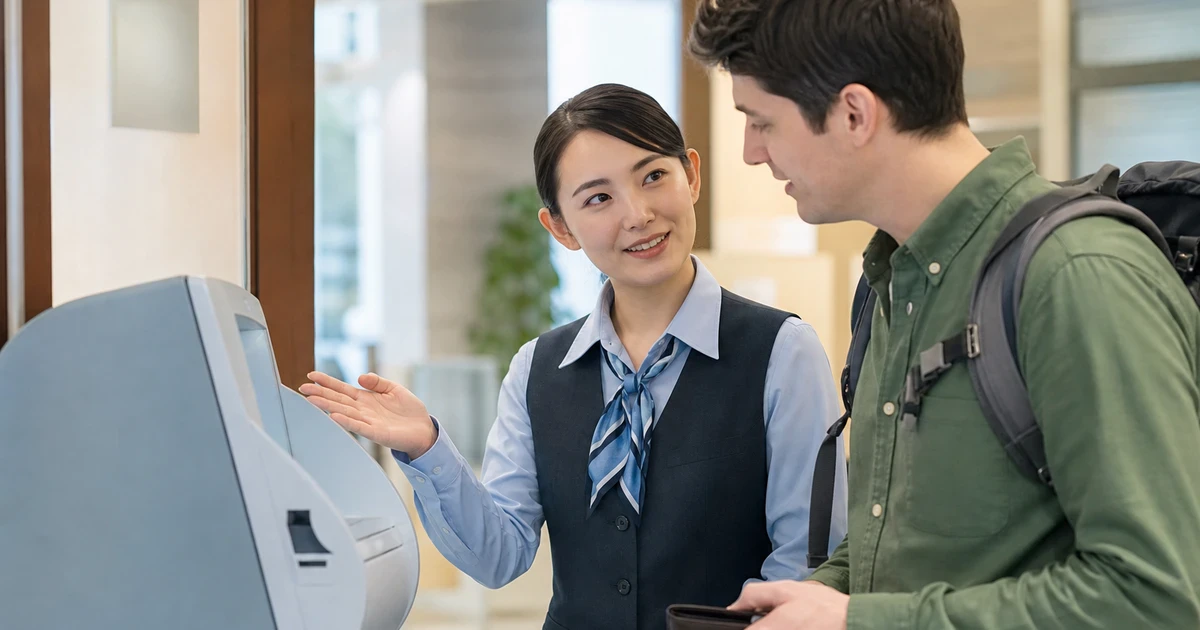
A japanese lesson for ATM help in japan should focus on one clear goal: helping you ask for help calmly when a bank machine, cash card, PIN, fee, or transfer screen becomes confusing.
ATMs in Japan can feel stressful because the language is short, formal, and full of bank-specific words. Even if the machine has an English option, you may still need to speak to a staff member, explain what went wrong, or confirm whether your card works. That is where live practice matters.
This guide gives you the core phrases, simple sentence patterns, and a realistic one-on-one lesson flow you can practise before visiting a bank or convenience-store ATM in Japan.
What You Need to Say First
Start with the problem, not the whole story. A bank staff member or convenience-store clerk needs to know whether you want to withdraw cash, check a balance, make a transfer, pay a fee, or ask why your card is not working.
For learners preparing to live or study in Japan, ATM Japanese belongs in the same “first-week survival” group as transport, housing, school orientation, city hall, phone or SIM setup, and daily-life help. If you are planning a longer stay, you may also want to read How Much Japanese Do You Need to Study in Japan? for a broader language-level picture.
The most useful first sentence is:
すみません。ATMの使い方がわかりません。 Sumimasen. ATM no tsukaikata ga wakarimasen. Excuse me. I do not know how to use the ATM.
This sentence is simple, polite, and clear. You are not asking the staff member to do the transaction for you; you are asking for guidance.
Core ATM Phrases to Practise
Use these phrases as your main practice set. Do not only memorise them silently. Say them aloud, then practise changing one detail at a time: cash withdrawal, balance check, transfer, PIN, fee, or card problem.
Japanese | Romaji | English Meaning |
|---|---|---|
現金を引き出したいです | Genkin o hikidashitai desu | I want to withdraw cash |
残高を確認したいです | Zandaka o kakunin shitai desu | I want to check my balance |
振込をしたいです | Furikomi o shitai desu | I want to make a bank transfer |
手数料はいくらですか | Tesūryō wa ikura desu ka | How much is the fee? |
暗証番号を忘れました | Anshō bangō o wasuremashita | I forgot my PIN |
キャッシュカードが使えません | Kyasshu kādo ga tsukaemasen | My cash card does not work |
通帳は必要ですか | Tsūchō wa hitsuyō desu ka | Do I need my passbook? |
画面が日本語だけです | Gamen ga Nihongo dake desu | The screen is only in Japanese |
もう一度お願いします | Mō ichido onegai shimasu | Could you say that again, please? |
ゆっくりお願いします | Yukkuri onegai shimasu | Please speak slowly |
ここを押せばいいですか | Koko o oseba ii desu ka | Is it okay if I press here? |
これはどういう意味ですか | Kore wa dō iu imi desu ka | What does this mean? |
A cultural note: in Japan, staff may avoid touching your card, wallet, or screen unless necessary. It is often more natural to ask for verbal guidance and confirm each step yourself.
Practice the ATM Conversation
ATM Japanese is easier when you practise it as a short conversation, not as isolated vocabulary. A teacher can play the bank staff member and help you sound polite without becoming overly formal.
Here are four useful sentence patterns in context:
現金を引き出したいです。 Genkin o hikidashitai desu. I want to withdraw cash.
手数料はいくらですか。 Tesūryō wa ikura desu ka. How much is the fee?
キャッシュカードが使えません。 Kyasshu kādo ga tsukaemasen. My cash card does not work.
ここを押せばいいですか。 Koko o oseba ii desu ka. Is it okay if I press here?
From a teacher’s perspective, learners often need feedback on pronunciation before they need more vocabulary. For example, our teachers have seen learners mix up katakana such as ツ (tsu, a katakana sound) and シ (shi, a katakana sound), or ソ (so, a katakana sound), ン (n, a katakana sound), and リ (ri, a katakana sound). On an ATM screen, one small reading mistake can make the whole menu feel harder.
A good practice round should include:
- saying the problem in one sentence
- asking one confirmation question
- listening for a short answer
- repeating the key word you heard
- deciding what to press or ask next
This is also useful if you are preparing documents, bank setup, or school procedures before arrival. For visa-related preparation, keep financial paperwork separate from ATM practice and check current requirements through official channels; this overview of Japan Student Visa Requirements for Language School can help you understand the broader process.
Common Mistakes
Learners often try to translate from English too directly. “I need money” can sound vague or too personal. “I want to withdraw cash” is clearer and more appropriate at a bank or ATM.
Another common mistake is overusing casual anime-style words for “you” or sentence endings. In a bank situation, simple polite Japanese is safer than character-like speech. You do not need dramatic expressions; you need short, respectful sentences.
Learners also often forget to ask for repetition. If the staff member explains something quickly, do not pretend you understood. A simple “Could you say that again, please?” or “Please speak slowly” keeps the conversation moving.
Finally, many learners practise only the successful version: card works, PIN is correct, cash comes out. Real practice should include small problems:
- the card is rejected
- the PIN is wrong
- the screen changes to Japanese
- the fee is unclear
- the transfer menu is confusing
- the ATM is not available at that time
A 25-Minute LINE Lesson Plan
A standard Kind Japanese one-on-one lesson is 25 minutes, which is enough time to practise one realistic ATM scenario with correction.
A focused lesson can look like this:
- Warm-up: explain your banking situation in simple English or Japanese.
- Target phrase check: practise withdrawal, balance, fee, card, PIN, and transfer phrases.
- Role-play: the teacher acts as bank staff while you ask for help.
- Correction: focus on pronunciation, particles, and sentence endings.
- Repeat with pressure: try the same scenario again more smoothly.
- Final check: prepare two or three questions you can use at a real ATM or bank counter.
If you live outside Japan, propose lesson windows in your own time zone clearly. For example, say that you want to practise in the evening US time, morning UK time, or after work in your country. This avoids confusion and helps you think practically about when you are most alert for speaking practice.
FAQ
Can I use English at ATMs in Japan?
Many ATMs have English menus, especially in airports, convenience stores, and larger banks, but not every function may be available in English. You may still need Japanese if your card does not work, if a fee appears, or if you need help from staff nearby.
What Japanese level do I need for ATM help?
You do not need advanced Japanese for basic ATM help. You need a small set of clear phrases, polite sentence endings, and listening practice for short replies. Beginners can handle many situations if they practise the exact flow before using a real machine.
Should I memorise kanji for banking first?
Kanji helps, but survival practice should start with recognition and speaking. Learn key words such as cash withdrawal, balance, fee, PIN, and transfer. Then practise asking what a screen means. A teacher can help you connect the written word to a usable spoken question.
Can a teacher help me prepare for a bank visit?
Yes, one-on-one feedback can help you practise the exact situation: explaining your problem, asking what to press, confirming fees, and recovering when you do not understand. The goal is not perfect banking Japanese; it is calm, polite communication under real-life pressure.
For a practical japanese lesson for ATM help in japan, book a Free Trial Lesson with Kind Japanese over LINE.

