
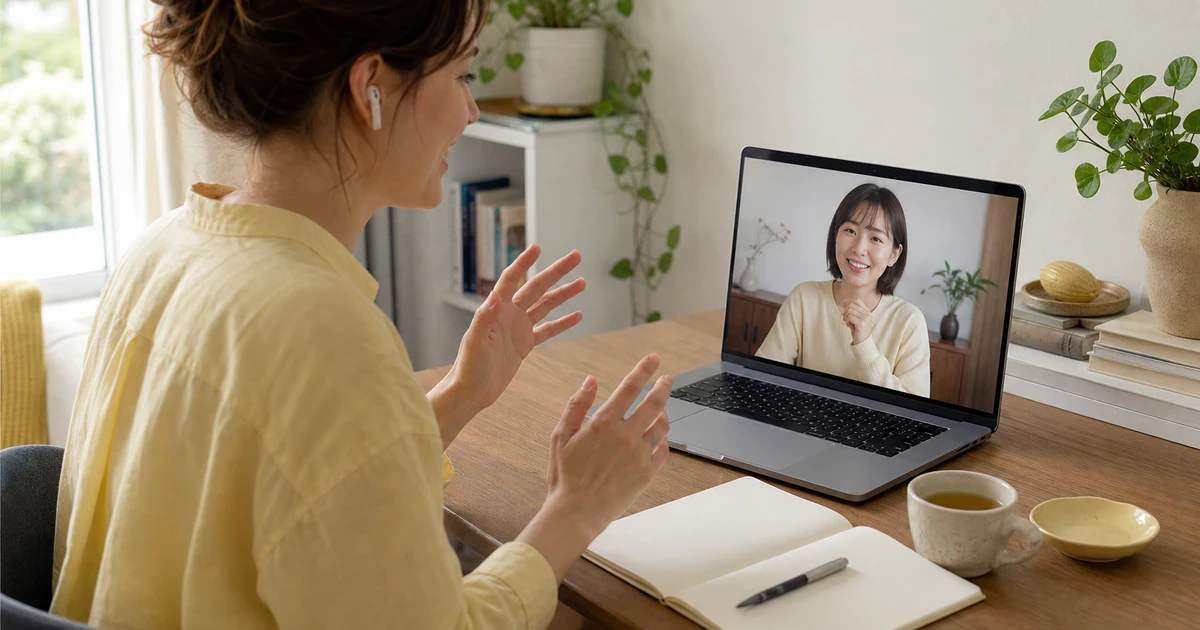
online japanese lessons for beginners afraid to speak work best when the lesson is designed for small, safe turns instead of long, intimidating conversations. If you are nervous, the goal is not to sound perfect. The goal is to speak once, get corrected, and speak again with more control.
For many learners, one-on-one online Japanese is easier than group study because the attention stays on one voice, one goal, and one correction loop. If you want a broader confidence-building angle, Build Speaking Confidence with a Japanese Tutor is a useful companion read.
Why Nervous Beginners Need A Different Lesson Design
A beginner who is afraid to speak usually does not need more theory first. They need a lesson design that lowers pressure and makes speaking feel manageable.
From a teacher's perspective, beginners often do better when the first speaking task is very short, very concrete, and tied to one familiar situation. That might be introducing yourself, asking for repetition, or saying what you want to practise today.
Good beginner lessons usually do three things:
- Keep the topic narrow.
- Correct one sentence at a time.
- Return to the same sentence so the learner can say it again.
That last step matters. A correction is most useful when it is followed by a second attempt. Without that repeat, the learner may hear the correct form but never feel it in their own mouth.
A calm online Japanese lesson also helps because the learner can focus on the teacher's voice and their own answer instead of worrying about a room full of other people. If you want more examples of that style, Japanese Conversation Practice Online: Speak Naturally shows how speaking can stay practical rather than overwhelming.
What A Good Beginner Lesson Should Include
A good one-on-one lesson should feel structured, but not rigid. Kind Japanese's standard one-on-one lessons are 25 minutes, which is enough time for a warm-up, a target task, and correction without letting the pressure build.
A useful beginner lesson usually includes:
- A short warm-up with simple questions.
- One speaking task based on a real situation.
- Live correction that stays focused.
- A chance to say the corrected sentence again.
- A learner-owned review note or question list for later.
The most helpful lessons are not the ones with the most content. They are the ones where the learner leaves with one or two things they can actually say more clearly next time.
A small cultural note also helps here. In Japanese conversation, a brief pause is normal. Taking a second to think is not rude. In fact, it is often better than rushing into an unclear sentence.
What To Bring To A Free Trial
A free trial should be used to test comfort, not performance. If you book through LINE, bring a clear idea of your current level and one thing you want to solve.
Use this simple trial preparation flow:
- Current level: say what you can already do and what still feels hard.
- Goal: choose one goal, such as speaking more confidently or answering basic questions.
- One speaking situation: pick one real situation, such as self-introduction, ordering food, or asking for clarification.
- One question: ask about the specific part that confuses you most.
- Teacher feedback: listen for one clear correction that you can reuse.
- Next-step advice: decide what you would practise next if the lesson feels like a good fit.
If you are worried about “doing it right,” remember that the point of a free trial is to see whether the lesson style feels safe enough for you to speak. You do not need to prepare a long script.
A practical self-check before you book:
- Can I say my name, level, and goal in simple English or Japanese?
- Can I name one situation I want to practise?
- Can I ask for repetition if I do not understand?
- Can I accept correction without treating it as failure?
If the answer is yes to even one or two of these, you are ready to try.
A Practical 25-Minute Lesson Flow
A focused lesson works best when each part has a clear job. A 25-minute structure keeps the pace steady and gives the learner a real chance to speak without getting tired.
A simple agenda looks like this:
- Warm-up: a short check-in and one easy question.
- Target speaking task: a role-play or response based on one real situation.
- Correction: the teacher stops, fixes one sentence, and explains the change briefly.
- Speak-correct-repeat: the learner says the same idea again using the corrected form.
- Review note: the learner writes down one sentence, one correction, or one question to keep for later.
This kind of flow is especially useful for beginners who freeze when they are asked an open-ended question. Instead of “Speak freely for five minutes,” the learner gets a smaller target and a clear path through it.
A role-play can be very simple. For example, the learner can practise greeting someone, asking to speak slowly, or saying that they are nervous. The important part is not the topic itself. The important part is whether the learner gets to try, hear correction, and try again.
If you compare online Japanese options, ask yourself whether the lesson style makes space for correction and repeat practice. That is usually more helpful than a lesson that only pushes conversation speed.
Reference Phrases For Speaking Practice
These phrases are useful because they help a beginner stay in the conversation instead of silently giving up.
Japanese | Romaji | English Meaning |
|---|---|---|
これで合っていますか | Kore de atte imasu ka | Is this correct? |
もう一度お願いします | Mō ichido onegai shimasu | Please say it again |
ゆっくり話してください | Yukkuri hanashite kudasai | Please speak slowly |
どう言えばいいですか | Dō ieba ii desu ka | How should I say it? |
まだ練習したいです | Mada renshū shitai desu | I still want to practise |
These are not “magic phrases.” They are tools for keeping the lesson moving when you feel stuck.
Example Sentences
今日は少し緊張しています。
Kyō wa sukoshi kinchō shite imasu.
I am a little nervous today.
もう一度ゆっくりお願いします。
Mō ichido yukkuri onegai shimasu.
Please say it again slowly.
これで合っていますか。
Kore de atte imasu ka.
Is this correct?
私は話す練習をしたいです。
Watashi wa hanasu renshū o shitai desu.
I want to practise speaking.
Common Mistakes
From a teacher's perspective, learners often make the same beginner mistakes when they are afraid to speak. The good news is that these are fixable once you know what to watch for.
- Trying to say a perfect long sentence before saying a short one.
- Memorising phrases but not practising how to change one word inside them.
- Treating correction as proof of failure instead of a normal part of learning.
- Preparing only vocabulary and not one real situation to talk about.
- Avoiding speaking entirely because the first sentence feels too slow.
A common pattern is that learners know more than they can currently say. That gap is normal. One-on-one feedback helps shrink it because the teacher can hear exactly where the sentence breaks and give you a cleaner version to repeat.
Another common issue is over-preparing. A beginner may study a lot at home but still freeze when asked a simple question. In that case, the answer is not more theory. The answer is more low-pressure speaking practice with immediate correction.
FAQ
Are online Japanese lessons good for beginners who are afraid to speak?
Yes. They can be a very good fit if the lesson is built around short turns, clear correction, and repeat practice. One-on-one online Japanese is often easier than group study because the pressure stays lower and the speaking task can match your current level.
What should I say in a free trial if I am nervous?
Say that you are nervous, name one goal, and choose one speaking situation you want to practise. A teacher can then shape the lesson around that. You do not need a perfect introduction. A simple, honest explanation is usually the most useful starting point.
Do I need to speak a lot before booking a lesson?
No. Beginners can benefit from speaking from the start, as long as the task is small enough. A first lesson is often about building comfort, not proving fluency. The teacher can slow the pace, correct one sentence, and help you repeat it.
How should I propose lesson times if I live outside Japan?
Offer two or three windows in your own time zone and state the time zone clearly. For example, you can say which evenings or weekend slots work for you. That makes scheduling easier and avoids confusion when you are contacting the teacher over LINE.
If you're comparing online japanese lessons for beginners afraid to speak, a Free Trial lesson via LINE is the simplest way to see whether the one-on-one style feels comfortable enough for you to start speaking.

