
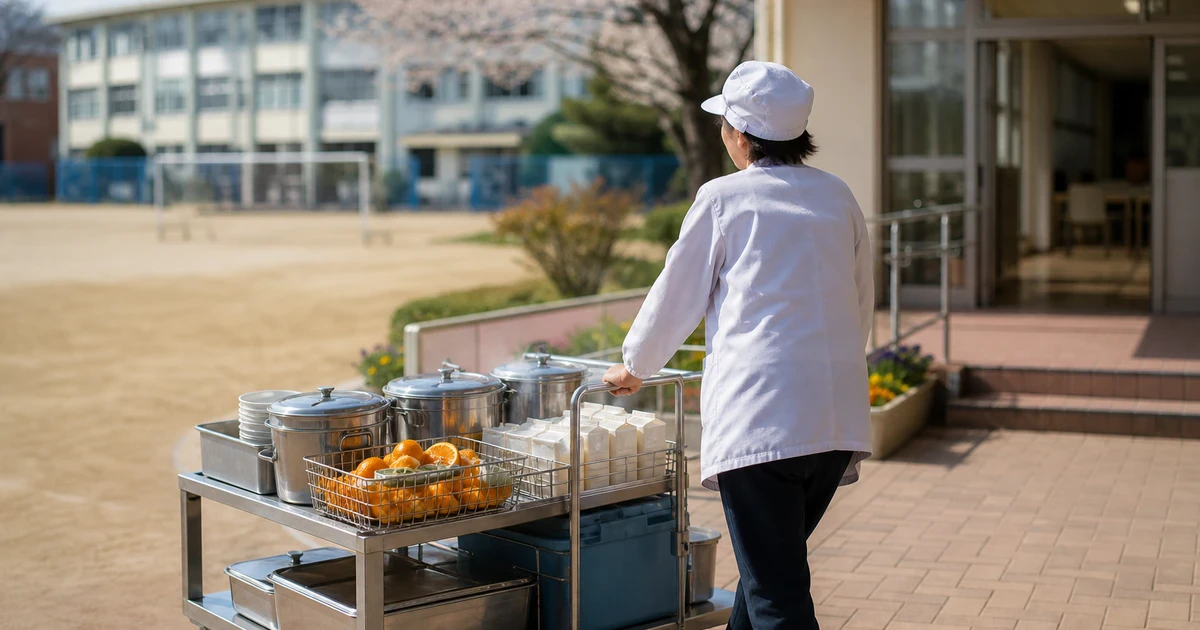
Japanese students commonly eat an organized school lunch, a homemade bento, or food bought from a cafeteria or convenience store. The choice depends mainly on the student’s age, school system, family routine, dietary needs, and location.
Many elementary and junior high students receive school lunch. High school arrangements are more varied, while university and college students generally choose from several options and manage their own lunch money.
Lunch Choices by School Level
Age is the clearest starting point, but no single pattern applies to every Japanese school.
- Elementary school: Many students eat an organized school lunch. It may be served in the classroom, where meals are placed on desks after students help distribute them.
- Junior high: Organized lunch is also common, although the exact system depends on the municipality and school. For an elementary junior high comparison, local policy matters as much as the students’ ages.
- High school: High schools may provide school lunch, operate a cafeteria, sell food, or expect students to bring a bento. Some students buy lunch before arriving at school.
- University or college: Students usually choose independently. Common options include a campus cafeteria, a homemade bento, a nearby restaurant, and convenience-store food.
Local systems that provide school lunch decide how meals are prepared, delivered, and eaten. Lunch may take place in a classroom, dining room, or cafeteria, so scenes from television and anime should not be treated as universal.
What a Japanese School Lunch Contains
An organized school lunch commonly combines a staple food, a main dish, vegetables, and a drink. Rice, bread, or noodles may be served with soup, fish, chicken, pork, tofu, beans, vegetables, fruit, milk, or an occasional deep-fried item.
The precise ingredients change according to the menu, region, season, available produce, allergies, and students’ developmental needs. Curry, grilled fish, stews, rice dishes, and noodles are familiar possibilities, but there is no national menu that every school follows.
Japan’s Ministry of Education, Culture, Sports, Science and Technology explains that school meals are planned for nutritional balance and used as “living teaching materials.” Its English guide to Japanese school lunches and dietary education connects lunch with food safety, healthy choices, regional culture, production, and distribution.
Cultural note: At many schools, students participate in serving and cleanup. Lunch is therefore not only time for eating; it can also provide practice in cooperation and shared responsibility. For more context about cleaning routines, see Do Japanese Schools Have Janitors?.
A bento is different because its contents are selected at home. It might contain rice, vegetables, egg, fish, meat, fruit, or small side dishes. Portion sizes and combinations vary widely, and a visually elaborate bento is not the everyday standard for every family.
Older students have greater freedom. A cafeteria meal may offer good convenience between classes, while a student buying food may compare taste, nutritional value, portability, and price in yen. The amount of money available can influence the final choice, but there is no reliable universal lunch budget.
What Surveys and Regional Menus Show
Local survey evidence suggests that curry and noodles are popular, but favorite foods differ between schools and regions. A municipal result should never be presented as proof of what every Japanese student prefers.
In its school-lunch survey, Shibetsu City asked elementary and junior high students about their favorite meals. Curry received the most responses overall, followed by ramen and butter rolls. When several noodle categories were considered together, the results also showed broad enthusiasm for noodle dishes.
This survey is useful because it records what students were actually asked and separates elementary and junior high responses. It is still evidence from one municipality, not a nationwide ranking. Preferences may change across places, age groups, and generations.
Regional menus add another layer. The Ministry of Agriculture, Forestry and Fisheries documents a Nagasaki regional stew used in school-lunch efforts and an Okinawan mozuku seaweed rice bowl associated with school lunch. These examples show how local dishes and ingredients can become part of dietary education without appearing throughout Japan.
Useful Japanese Lunch Vocabulary and Practice
The most useful distinction is between an organized school meal and lunch in the general sense. The following vocabulary covers school lunches, bento, ingredients, preferences, and buying food.
Japanese | Romaji | English meaning |
|---|---|---|
給食 | kyūshoku | organized school lunch |
昼ご飯 | hirugohan | lunch |
お弁当 | obentō | boxed lunch; bento |
学食 | gakushoku | student cafeteria |
コンビニ | konbini | convenience store |
献立 | kondate | menu; planned meal |
食材 | shokuzai | food ingredient |
栄養 | eiyō | nutrition |
食育 | shokuiku | dietary education |
好きな食べ物 | suki na tabemono | favorite food |
揚げ物 | agemono | deep-fried food |
食物アレルギー | shokumotsu arerugī | food allergy |
円 | en | yen; Japanese currency unit |
いくらですか | ikura desu ka | how much is it? |
Use these four sentences to compare lunch routines and explain dietary needs.
この小学校では、教室で給食を食べます。
Kono shōgakkō de wa, kyōshitsu de kyūshoku o tabemasu.
At this elementary school, students eat school lunch in the classroom.
私は高校にお弁当を持って行きます。
Watashi wa kōkō ni obentō o motte ikimasu.
I take a bento to high school.
大学では、学食でカレーを食べることが多いです。
Daigaku de wa, gakushoku de karē o taberu koto ga ōi desu.
At university, I often eat curry in the student cafeteria.
アレルギーがあるので、食材を確認します。
Arerugī ga aru node, shokuzai o kakunin shimasu.
I have an allergy, so I check the ingredients.
Learners often understand food vocabulary but need feedback on particles, categories, and natural follow-up questions. If producing even a familiar answer makes you freeze, the preparation ideas in What Is Test Taking Anxiety? A Practical Guide can also be adapted to low-pressure speaking practice.
A standard Kind Japanese one-on-one lesson is 25 minutes and takes place online over LINE. A lunch-themed lesson can include a warm-up, a target speaking task, correction, and a learner-owned review note or question list. You can use these examples with teachers and bring a menu photo or cafeteria sign as a prompt.
For personalized practice describing meals and asking natural questions, book a Free Trial Lesson over LINE.
Common Mistakes
The biggest mistake is using “school lunch” for every meal eaten at school. 給食 (kyūshoku, organized school lunch) refers to the meal provided through a school system, while 昼ご飯 (hirugohan, lunch) is the general word. A bento eaten in a classroom is not automatically school lunch.
Learners also often choose the wrong location particle. Use で (de, particle marking the place of an action) for the location where someone eats. The particle に (ni, destination or location marker) has other functions and does not normally mark the place of eating.
Another common confusion is between 食べます (tabemasu, eat) and 買います (kaimasu, buy). A student may buy lunch at a convenience store and then eat it at school, so the verbs describe separate actions.
Avoid saying that all schools provide the same meal. Elementary and junior high arrangements vary locally, and the differences become greater at high school and university. Survey findings and individual menus should always be connected to their specific school, city, or age group.
FAQ
Do all Japanese students eat school lunch?
No. Organized school lunch is common in many elementary and junior high schools, but arrangements vary by municipality and school. High school, university, and college students may instead bring bento, use a cafeteria, visit a convenience store, or choose another lunch option available near campus that day.
What is usually served in a Japanese school lunch?
An organized school lunch often combines rice, bread, or noodles with soup, a main dish, vegetables, and milk. The exact menu depends on the locality, season, ingredients, dietary requirements, and school system, so curry, grilled fish, tofu dishes, or a deep-fried item are examples rather than universal standards.
Do Japanese students bring bento from home?
Yes, some students bring a bento, especially where organized lunch is not provided or where family and school routines favor packed food. Contents differ widely, but rice, egg, vegetables, fish, meat, and fruit are common possibilities; allergies, preferences, portability, and household choices shape the final meal.
What do university students in Japan eat for lunch?
University students usually decide among campus cafeterias, bento, nearby restaurants, convenience-store meals, and food prepared at home. Their choice can change with class location, available time, money, dietary needs, and appetite, so there is no single college lunch that represents students throughout Japan on every day.

