
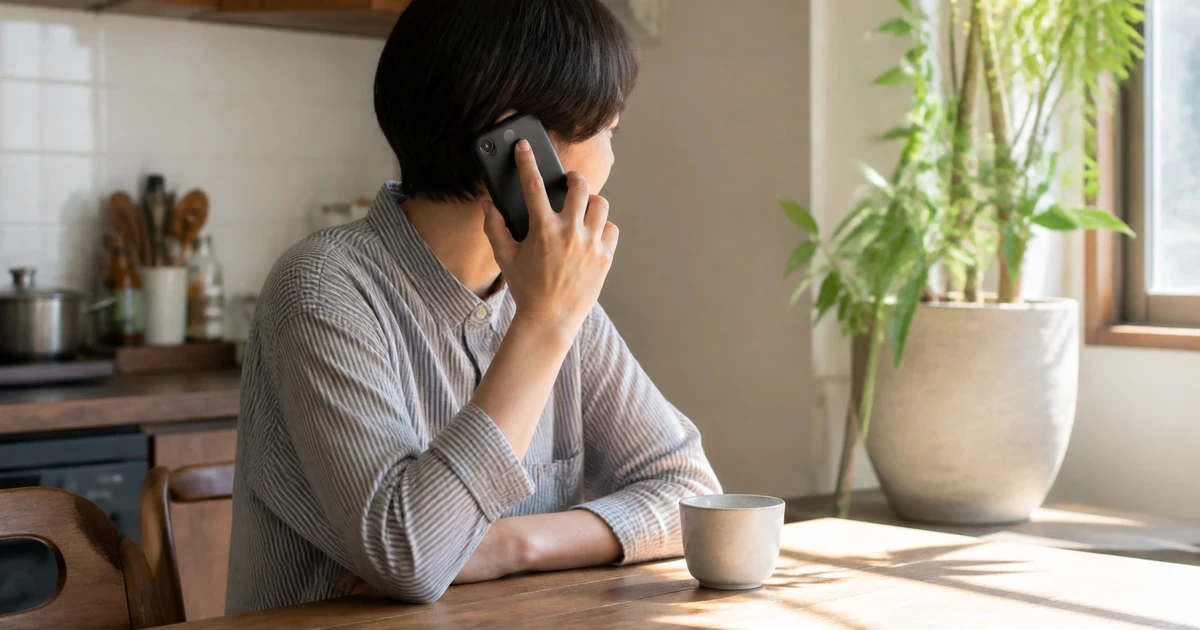
Calling a Japanese restaurant is one of those small tasks that feels enormous the first time you try it. There is no menu to point at, no gestures to fall back on, and the person on the other end speaks quickly and expects you to keep up. This is exactly why a focused japanese lesson for calling a restaurant in japanese pays off so fast: a phone call is short, predictable, and full of set phrases you can rehearse until they feel automatic.
This guide walks through the three calls learners actually make — booking a table, changing a booking, and cancelling — and shows how to practise each one out loud with feedback.
Why the Phone Feels Harder Than the Table
Speaking face-to-face gives you visual context. On the phone, all of that disappears, so your ears and your set phrases have to do the work alone. From a teacher's perspective, learners often understand every word on paper but freeze when a real voice delivers it at natural speed.
The good news: restaurant calls follow a script. Staff will almost always ask the same handful of things — date, time, number of people, and a name. Once you can recognise and answer those four, you can handle most of the conversation.
A short, spoken practice format works better here than silent study. In our one-on-one lessons over LINE, a common approach is to let the learner finish an entire sentence before offering feedback, rather than interrupting mid-phrase — it keeps the "phone rhythm" intact and shows where the real breakdowns happen.
Core Phrases for Reservations, Changes, and Cancellations
Keep this list short and drill it out loud. These are the phrases that carry almost every restaurant call.
Japanese | Romaji | English Meaning |
|---|---|---|
予約をお願いします | Yoyaku o onegai shimasu | I'd like to make a reservation |
今晩、空いていますか | Konban, aite imasu ka | Are you available tonight? |
何名様ですか | Nan-mei-sama desu ka | How many people? (staff asks this) |
二名でお願いします | Ni-mei de onegai shimasu | For two people, please |
予約を変更したいです | Yoyaku o henkō shitai desu | I'd like to change my reservation |
予約をキャンセルしたいです | Yoyaku o kyanseru shitai desu | I'd like to cancel my reservation |
禁煙席はありますか | Kin'en-seki wa arimasu ka | Do you have non-smoking seats? |
もう少しゆっくりお願いします | Mō sukoshi yukkuri onegai shimasu | A little more slowly, please |
Cultural note: many Japanese restaurants confirm your booking by reading your name and phone number back to you. Being ready to say your number digit by digit — calmly and slowly — removes most of the stress from the end of the call.
Hear the Calls in Context
Reading phrases is not the same as producing them under pressure. Say each of these aloud, then imagine the staff member's likely reply.
今晩七時に二名で予約をお願いします。 Konban shichi-ji ni ni-mei de yoyaku o onegai shimasu. I'd like to make a reservation for two people at seven tonight.
予約の時間を八時に変更できますか。 Yoyaku no jikan o hachi-ji ni henkō dekimasu ka. Could I change my reservation time to eight o'clock?
すみません、今日の予約をキャンセルしたいです。 Sumimasen, kyō no yoyaku o kyanseru shitai desu. Excuse me, I'd like to cancel today's reservation.
予約は田中の名前でお願いします。 Yoyaku wa Tanaka no namae de onegai shimasu. Please put the reservation under the name Tanaka.
もう一度お願いします。 Mō ichido onegai shimasu. Could you say that once more, please?
That last phrase is your safety net. Using it politely is not a failure — native callers ask for repetition too, and it keeps the conversation moving instead of stalling.
A Sample 25-Minute LINE Lesson for Restaurant Calls
Phone practice is ideal for a short, tightly focused session. Here is how a single 25-minute lesson over LINE can be structured around this exact scenario, with your live teacher playing the restaurant staff.
- Warm-up (about 4 minutes): Read the core phrases aloud so your teacher can hear pronunciation and rhythm before the role-play begins.
- Target speaking task (about 12 minutes): Run three short role-plays back to back — book a table, then call again to change the time, then cancel. Your teacher answers naturally, sometimes speaking a little faster to build your listening stamina.
- Correction (about 6 minutes): Your teacher replays the moments that broke down — a dropped particle, a rushed number, a katakana word misread — and you say the corrected version until it feels smooth.
- Learner-owned review note (about 3 minutes): You write your own two-line note: one sentence you struggled with, and its corrected form. This is your review, kept by you, so it stays useful after the lesson ends.
To make the most of a session, propose a lesson window in your own time zone that matches when you feel alert — for example, "I'd like to take a lesson in the evening, US time," or in Japanese, アメリカ時間の夜にレッスンを受けたいです (Amerika jikan no yoru ni ressun o uketai desu, I want to take lessons in the evening US time). Being specific helps you and your teacher plan calmly.
This kind of one-on-one Japanese tutor practice is the fastest route to phone confidence, because you rehearse the real thing with a live person correcting you in the moment. If you want a broader foundation first, it also pairs well with our guide on how to Build Speaking Confidence with a Japanese Tutor.
Common Mistakes a Teacher Can Correct
These patterns come up again and again, and a live correction loop clears them quickly.
Dropping the particle を. Learners often say 予約お願いします and lose the object marker. 予約をお願いします (Yoyaku o onegai shimasu) sounds cleaner and more complete on the phone.
Being too casual. Saying 予約したい ("I wanna reserve") to a stranger sounds abrupt. Attach a polite frame: 予約をお願いします or ~したいです softens it appropriately.
Misreading katakana over the phone. Loanwords like キャンセル (kyanseru, cancellation) and メニュー (menyū, menu) trip people up, and similar-looking kana are a frequent source of confusion. In our lessons, teachers regularly help learners untangle look-alike characters — pairs such as ツ and シ, or ぬ and め — using flashcards to drill the shapes that keep getting swapped. Cleaner reading means cleaner speaking.
Rushing numbers. Times and counts have their own readings: 四時 is yo-ji, not yon-ji, and 二名 (ni-mei) is more natural than 二人 (futari) when a restaurant asks 何名様. Slow down on numbers; that is where most miscommunication happens.
Forgetting a repair phrase. When you don't catch something, silence makes it worse. もう一度お願いします (Mō ichido onegai shimasu, once more please) keeps you in control of the call.
If reading katakana and kanji menus is your real weak point, the Easiest Way to Remember Kanji Without Guessing is a helpful companion to this speaking practice.
FAQ
Do I really need to speak Japanese to book a table?
Many restaurants in tourist areas have some English or online booking, but the majority of local, popular, or small restaurants take reservations by phone in Japanese only. Even a short scripted call — date, time, number of people, and your name — opens doors that English booking apps cannot reach.
What is the fastest way to prepare for a real call?
Rehearse out loud with a live partner, not just in your head. A one-on-one Japanese tutor can play the restaurant staff, speak at natural speed, and correct you the instant something breaks. A single 25-minute lesson focused only on reservations, changes, and cancellations builds surprising confidence fast.
How do I ask them to slow down without sounding rude?
Use もう少しゆっくりお願いします (Mō sukoshi yukkuri onegai shimasu, a little more slowly, please) or もう一度お願いします (Mō ichido onegai shimasu, once more please). These are polite, standard, and expected. Japanese staff generally slow down happily, so asking is far better than guessing and getting the booking wrong.
Can I practise this over LINE from another country?
Yes. A LINE lesson connects you with a live teacher wherever you are, so you can run phone-call role-plays from home in your own time zone. You speak, get corrected, repeat the fixed version, and leave with a short review note in your own words.
Ready to Pick Up the Phone
A restaurant call is short, and that is exactly why it is the perfect thing to master with focused speaking practice. Rehearse the three calls, drill the core phrases, and let a teacher catch the small errors before they reach a real staff member.
If you'd like a live, personalised japanese lesson for calling a restaurant in japanese, book a Free Trial lesson with Kind Japanese over LINE — bring one call you want to make, and practise it out loud with a teacher until it feels easy.

