
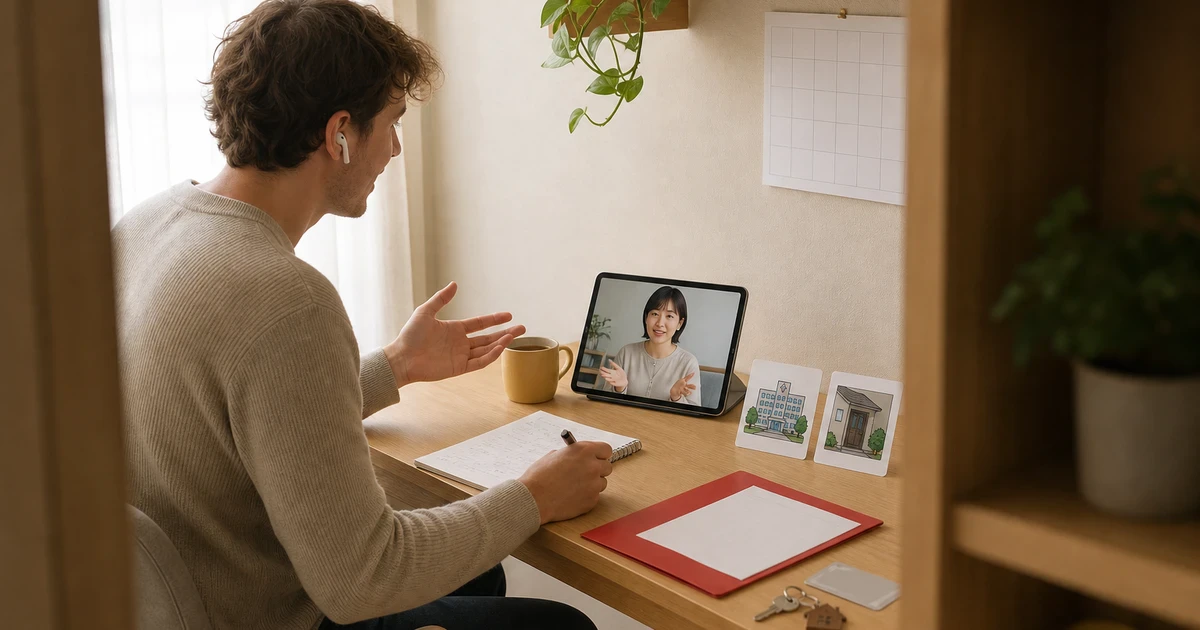
Relocation to Japan becomes much easier when your Japanese is built around the first week, not around abstract textbook chapters. The language you need most is practical: asking for directions, handling city hall paperwork, understanding housing instructions, speaking politely at work, and solving small daily-life problems before they become stressful.
If you are planning a move, start with the phrases that help you survive real errands. If you are still deciding how much to study before the move, How Much Japanese Do You Need to Study in Japan? is a useful companion. If your first step is a short visit before relocation, Japanese Travel Words & Phrases for Your Japan Trip helps you separate travel language from move-in language.
What to Learn First
For relocation to Japan, the highest-value Japanese is the language of daily life, city hall, housing, transport, and workplace Japanese.
A good order is:
- Basic greetings and polite requests.
- Housing and move-in language.
- City hall and document-related language.
- Phone, SIM, bank, and payment language.
- Workplace Japanese for the first day and first week.
From a teacher's perspective, learners improve faster when they keep review and preview steady instead of cramming. Short, repeated practice is especially helpful for the exact situations you will face after moving.
A small cultural note matters here: in many service settings in Japan, a calm and polite request often works better than a direct demand. You do not need elaborate speech, but you do need a softer tone than many learners use in their first draft.
Core Phrases for Daily Life
For daily life, learn phrases that solve one problem at a time: where something is, what something means, and what you should do next.
Japanese | Romaji | English meaning |
|---|---|---|
すみません | sumimasen | Excuse me / sorry |
〜はどこですか | ... wa doko desu ka | Where is ...? |
もう一度お願いします | mō ichido onegai shimasu | Please say it once more |
市役所 | shiyakusho | city hall |
住所変更 | jūsho henkō | change of address |
入居 | nyūkyo | move in |
よろしくお願いします | yoroshiku onegai shimasu | Please treat me well / nice to meet you |
何時に出勤すればいいですか | nanji ni shukkin sureba ii desu ka | What time should I clock in? |
Use these phrases as building blocks, not as isolated memorized lines. If you can ask where something is, confirm a form, and ask for repetition, you can handle far more of the first week than you might expect.
For housing, focus on check-in language, room instructions, trash rules, and how to ask for clarification. For city hall, focus on being able to say you need help with your address, forms, or a process you do not understand. For workplace Japanese, focus on short, polite questions that keep you moving.
Example Sentences You Can Use
These sentences are simple on purpose. They are close to the kinds of lines you actually need in relocation to Japan.
市役所はどこですか。
Shiyakusho wa doko desu ka.
Where is the city hall?
この住所で大丈夫ですか。
Kono jūsho de daijōbu desu ka.
Is this address okay?
もう一度お願いします。
Mō ichido onegai shimasu.
Please say it once more.
この部屋に入居します。
Kono heya ni nyūkyo shimasu.
I am moving into this room/apartment.
明日から出勤します。
Ashita kara shukkin shimasu.
I will start going to work from tomorrow.
If you can already say these kinds of lines aloud, your next step is not more vocabulary lists. Your next step is speaking them in a realistic context until the words come out cleanly and politely.
A Practical 25-Minute Online Lesson Flow
A standard Kind Japanese one-on-one lesson is 25 minutes, so the best use of the time is focused and specific.
A practical flow is:
- Warm-up: say what situation you need help with, such as city hall, housing, or workplace Japanese.
- Target speaking task: role-play one real scene, such as asking for a form, checking move-in instructions, or introducing yourself at work.
- Correction: fix grammar, word choice, and pronunciation right away.
- Next-step advice: choose one thing to repeat before the next lesson.
That pattern works especially well in an online lesson because you can stay close to the exact language you need for relocation to Japan. If you have a move coming up, bring one concrete situation instead of asking for broad “beginner Japanese.”
For scheduling, propose lesson windows in your own time zone first, then add Japan time if that helps you compare. A clear message such as “I can study on Tuesday evening in my time zone” is easier to work with than a vague “sometime this week.”
In one-on-one lessons over LINE, the strongest gains usually come from a speak-correct-repeat loop. You try the sentence, the teacher corrects it, and you say it again until it sounds natural enough to use in real life.
Common Mistakes
From a teacher's perspective, learners often try to study the wrong layer first. They memorize travel phrases, but then freeze when they need housing language, city hall language, or workplace Japanese for the first week.
Another common issue is overcomplicating polite requests. In relocation situations, short and clear is usually better than long and impressive. If you can say what you need simply, the conversation becomes much easier to manage.
Teachers also often see katakana confusion that affects real-life forms and names. The pairs ツ (tsu, katakana "tsu") and シ (shi, katakana "shi"), or ソ (so), ン (n), and リ (ri), can be easy to mix up when you are in a hurry. Steady review helps more than one big study session.
A final mistake is using anime-style or otherwise nonstandard expressions for ordinary adult conversation. A teacher can help you separate expressive fiction language from the Japanese that is actually natural in daily life and at work.
If you want to practice your relocation phrases with a live teacher before the move, you can book a Free Trial lesson over LINE and use it to test your current level and your most urgent speaking situation.
FAQ
What Japanese should I learn first before moving to Japan?
Start with polite requests, city hall language, housing language, transport basics, and workplace Japanese. Those areas cover the first week of real life more effectively than broad textbook lists. The goal is to handle forms, directions, move-in instructions, and simple work conversations with confidence.
Can online lessons really help with relocation to Japan?
Yes. An online lesson is a good fit when you need exact role-play practice for daily life, city hall, housing, or workplace Japanese. One-on-one feedback is especially useful because you can correct the sentence you actually plan to use instead of practicing generic examples.
How should I prepare for a lesson if I am moving soon?
Bring one real situation, one sentence you want to say, and one question you expect to hear. For example, you might practice a move-in check-in, a city hall form question, or a first-day workplace introduction. That keeps the lesson focused and practical.
Do I need advanced Japanese before relocation to Japan?
No. Many learners start with survival Japanese and build from there. The important part is choosing phrases that match your immediate tasks. If you can ask for help, confirm details, and respond politely, you already have a strong base for the move.

