
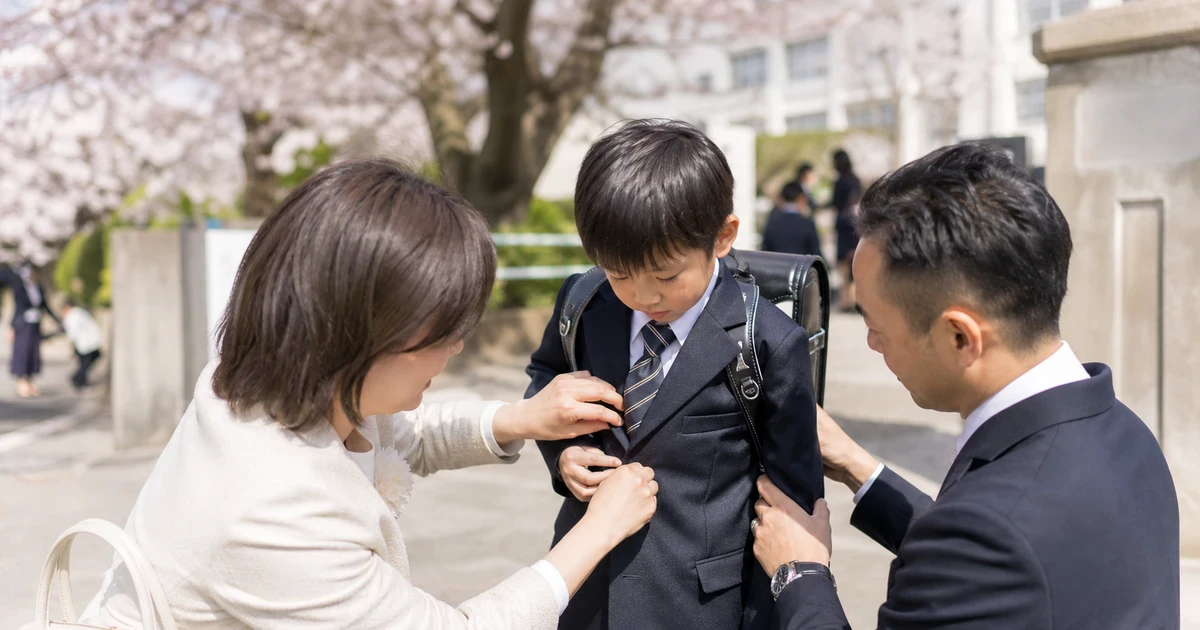
A Japanese school entrance ceremony, called 入学式 (nyūgakushiki, entrance ceremony), is a formal welcome for incoming students. It marks the beginning of a new stage at an elementary school, junior high school, high school, or university.
For many families, the ceremony is both a school event and a major personal milestone. Students may wear uniforms or formal clothing, sit with their new classmates, listen to speeches, and meet older students. Families often take photographs before and after the school ceremony.
What Happens at a Japanese School Entrance Ceremony
A Japanese school entrance ceremony usually takes place near the start of the academic year, often in April. The exact schedule differs depending on the school, education level, and area, so families should follow the respective school’s official instructions.
Students commonly gather in a gymnasium or another large hall. Incoming students are seated by class, while parents and guests sit in a separate section. The program may include:
- An entrance procession or student roll call
- Opening remarks from the principal
- A speech welcoming new students
- Greetings from older students
- A pledge or message from an incoming student
- School announcements
- Group photographs or class meetings afterward
At high schools and universities, the ceremony may be larger and more formal than at an elementary school. Some high schools welcome students from many different areas, while a smaller elementary school ceremony may feel more local and personal.
Participating 在校生 (zaikōsei, current student; enrolled student) are students who are already attending the school. They may be older students or upper-grade students at the ceremony, but 在校生 itself does not inherently mean “older student.”
The ceremony often starts promptly. Arriving early gives students time to find the correct entrance, classroom, or seating area without rushing. Attendees should avoid arriving late, speaking loudly during speeches, or taking photographs where photography is prohibited.
If you are searching from overseas, remember that “Japan school entrance ceremony” may refer to a ceremony held in Japan or to an overseas Japanese school. For example, Rochester Japanese School may follow its own calendar and procedures; do not assume that its dates or traditions match schools in Japan. Always check the official schedule for the respective school.
Clothing, Etiquette, and Family Customs
Students should wear the clothing requested by their school. Uniforms are common for junior high school and high schools, while elementary students may wear a school uniform, formal clothes, or another specified outfit. University students may choose a suit or other smart formal clothing, especially when the university provides detailed instructions.
Parents also commonly dress formally. A simple suit, dress, or neat business-style outfit is usually safer than very casual clothing. Since the ceremony may involve photographs, families often choose clothing that is respectful and comfortable.
During the ceremony, students are expected to remain seated, listen quietly, and follow instructions. A common ceremonial cue is 一同、礼 (ichidō, rei, everyone bow). When a speaker says 礼 (rei, bow), participants bow together. Students may also hear 起立 (kiritsu, stand) and 着席 (chakuseki, sit down).
Collective timing is an important cultural detail. Participants often stand, bow, and sit together rather than acting individually. Watching the people around you and following the staff’s cues is a practical way to participate confidently.
A short listening drill can make these commands easier:
- Hear 起立 (kiritsu, stand) and stand.
- Hear 礼 (rei, bow) and bow together.
- Hear 着席 (chakuseki, sit down) and sit.
- Repeat the sequence until you can identify each cue without translating every word.
Useful Japanese for the Day
These expressions help learners understand announcements and describe the event.
Japanese | Romaji | English meaning |
|---|---|---|
入学式 | nyūgakushiki | entrance ceremony |
新入生 | shinnyūsei | new student; incoming student |
在校生 | zaikōsei | current student; enrolled student |
上級生 | jōkyūsei | upper-grade student |
体育館 | taiikukan | gymnasium |
校長先生 | kōchō sensei | principal |
保護者 | hogosha | parent or guardian |
式が始まります | shiki ga hajimarimasu | The ceremony is starting |
ご入学おめでとうございます | go-nyūgaku omedetō gozaimasu | Congratulations on entering the school |
よろしくお願いします | yoroshiku onegai shimasu | I look forward to getting along with you; thank you in advance |
写真を撮ってもいいですか | shashin o totte mo ii desu ka | May I take a photograph? |
起立 | kiritsu | stand |
礼 | rei | bow |
着席 | chakuseki | sit down |
Learners often need feedback on register as well as vocabulary. The phrase おめでとうございます (omedetō gozaimasu, congratulations) is suitable for a formal school event. The ending ございます (gozaimasu) is the polite form that adds formality to おめでとう, rather than a separate English meaning such as “polite expression.”
A teacher can use a school notice, event schedule, map, or photograph as a speaking prompt in one-on-one lessons over LINE. A standard lesson is 25 minutes, giving learners focused practice with listening, polite responses, and the specific situation they expect to face.
入学式は体育館で行われます。
Nyūgakushiki wa taiikukan de okonawaremasu.
The entrance ceremony will be held in the gymnasium.
新入生は前に座ってください。
Shinnyūsei wa mae ni suwatte kudasai.
New students, please sit at the front.
校長先生のお話を聞きました。
Kōchō sensei no o-hanashi o kikimashita.
I listened to the principal’s speech.
式の後で家族と写真を撮りました。
Shiki no ato de kazoku to shashin o torimashita.
I took photographs with my family after the ceremony.
Common Mistakes and Practical Preparation
Learners often confuse the ceremony itself with the wider first day of school. 入学式 (nyūgakushiki, entrance ceremony) refers specifically to the formal event, while the first day may also include classroom guidance, club information, or meetings with teachers.
Another common problem is using casual language in a formal setting. Saying おめでとう (omedetō, congratulations) to a close friend is natural, but おめでとうございます (omedetō gozaimasu, congratulations) is more appropriate when addressing a principal, teacher, parent, or unfamiliar adult.
Learners also sometimes confuse 在校生 (zaikōsei, current or enrolled student) with 上級生 (jōkyūsei, upper-grade student). The first describes enrollment status; the second specifically describes a student in a higher grade.
Pronunciation can affect comprehension. The long vowel in 入学 (nyūgaku, entering school) should be held clearly, and the polite ending ございます (gozaimasu, polite form in this expression) should not be dropped in formal speech.
Before the ceremony, check the school’s official information for:
- Arrival time and entrance location
- Clothing requirements
- Seating instructions
- Required documents or belongings
- Photography restrictions
- Whether a class meeting takes place afterward
You can also prepare a few practical questions:
- Where should new students enter?
- Where should parents wait?
- Should students bring school documents?
- Is there a class meeting after the ceremony?
- When will photographs be taken?
A useful review workflow is simple:
- Learn the event vocabulary in the table.
- Read an official school message or event schedule.
- Practise identifying 起立 (kiritsu, stand), 礼 (rei, bow), and 着席 (chakuseki, sit down).
- Repeat the example sentences aloud.
- Prepare one short introduction and one question for school staff.
If you are comparing private support with a larger group setting, Private Japanese Tutor vs Language School: Which Fits? may help you choose a study format. Learners who prefer independent study can also explore Can You Learn Japanese by Yourself?, then add live practice when they need speaking feedback.
A standard Kind Japanese lesson can include a warm-up, a target speaking task about the ceremony, correction of pronunciation or register, and a learner-owned review note or question list. This structure lets you practise your own school situation rather than memorising unrelated dialogue.
Preparing for Your Own Experience
The best preparation combines cultural understanding with practical Japanese. Practise explaining your school, department, or grade, describing where you sat, and responding politely when speaking with school staff.
You do not need to memorise a long speech. Prepare your name, hometown, school or department, and one sentence about what you hope to study. For example, a teacher can help you adjust the level of formality depending on whether you are speaking with classmates, teachers, or parents.
A focused LINE lesson can also use a screenshot of a map, train route, school message, or ceremony schedule as a practice prompt. You can rehearse asking about the entrance, seating, documents, or photography rules while receiving immediate speaking feedback.
If you would like to practise before your event, book a Free Trial Lesson over LINE and bring one entrance-ceremony goal or question for focused speaking practice.
FAQ
When do Japanese school entrance ceremonies usually take place?
Most Japanese school entrance ceremonies take place in April, near the beginning of the academic year. Exact dates, start times, venues, clothing expectations, and programs vary by school, education level, and area. Overseas institutions, including Rochester Japanese School, may use different calendars, so attendees should confirm the official schedule directly.
What should students wear to an entrance ceremony?
Students should follow the clothing instructions provided by their school. Uniforms are common at many elementary, junior high, and high schools, while university students may wear formal clothing such as a suit. Parents and guests should also choose neat, respectful clothing unless the school gives different guidance.
Do families attend Japanese school entrance ceremonies?
Families commonly attend entrance ceremonies, particularly for elementary school and other important transitions. Parents may sit separately from students, listen to speeches, and take photographs before or after the event. Attendance rules, seating arrangements, and photography permissions depend on each school’s official instructions.
What Japanese should I learn for the ceremony?
Start with words for incoming students, current students, the principal, the gymnasium, seating, speeches, and photographs. Practise polite expressions such as ご入学おめでとうございます (go-nyūgaku omedetō gozaimasu, congratulations on entering the school) and よろしくお願いします (yoroshiku onegai shimasu, thank you in advance), especially when speaking with school staff.

