
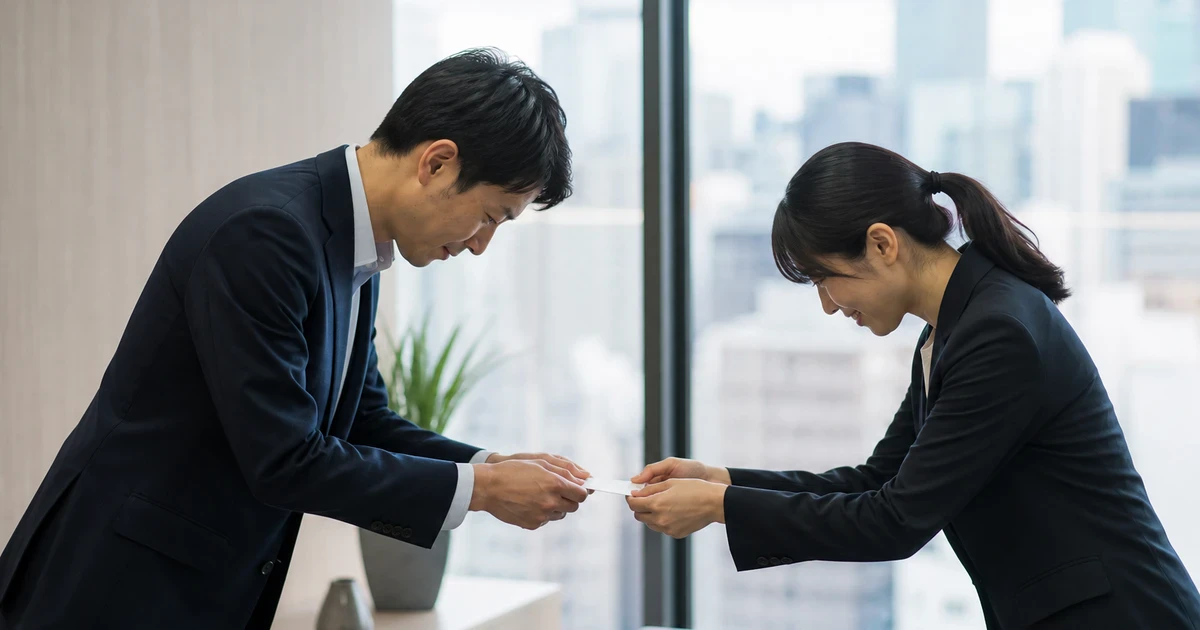
Japanese business card etiquette is about showing respect before the meeting really begins. In Japan, a business card is not treated as a quick contact detail. It represents the person, their company, and their role, so the way you give, receive, read, and place it sends important signs about your manners.
The Japanese word for business card is 名刺 (meishi). In Tokyo, Osaka, or any formal business setting, exchanging meishi is often one of the first actions after greetings and a bow. The rules are practical once you understand the logic: use both hands, keep the card facing the other person, read it carefully, and treat it respectfully throughout the conversation.
Why Meishi Etiquette Matters
Meishi etiquette matters because it shows that you respect the person’s professional identity. A Japanese business card usually includes the company name, department, title, name, address, and contact information. Before anyone explains their role in detail, the card has already given you context.
A received card should not be rushed into a pocket or bag. Instead, look at it briefly and sincerely. If you are seated at a table, place it in front of you, usually above your notebook or beside your card case, so you can refer to the person’s name and title during the meeting.
This is not empty ritual. It helps with hierarchy, seating, conversation flow, and remembering who is who. Guidance from established intercultural business sources, including Japan Intercultural Consulting and JETRO business culture materials, consistently treats meishi exchange as a core part of Japanese business manners.
In our online one-on-one lessons over LINE, learners often understand the words but feel unsure about the timing: when to bow, when to speak, which hand position feels natural, and how long to look at the card. Practising the small movements makes the language much easier to use in real public spaces.
How To Give And Receive A Business Card
Give and receive a Japanese business card with both hands, with the text facing the other person. If your card has a Japanese side and an English side, present the side that is easiest for the other person to read.
A standard flow looks like this:
- Stand up if possible.
- Hold your card by the upper corners with both hands.
- Turn the card so the other person can read it.
- Say your company and name clearly.
- Offer a slight bow as you hand it over.
- Receive the other person’s card with both hands.
- Read their name and title before putting it down or placing it in your card case.
If both people offer cards at the same time, the exchange can feel awkward at first. Keep your movements calm. It is normal to give with one hand while preparing to receive with the other, then return to holding the received card respectfully with both hands.
The safest advice is simple: slow down. Learners often make mistakes because they try to finish the exchange quickly, as they might in their own culture. In Japan, a slightly careful pace feels more polite than a rushed one.
Useful Japanese Phrases For Meishi Exchange
Use short, polite phrases during business card exchange. You do not need long speeches; clear pronunciation and respectful timing matter more.
Situation | Japanese, Romaji, English meaning |
|---|---|
Introducing yourself | はじめまして。田中と申します。 / Hajimemashite. Tanaka to mōshimasu. / Nice to meet you. My name is Tanaka. |
Giving your card | こちら、私の名刺でございます。 / Kochira, watashi no meishi de gozaimasu. / This is my business card. |
Receiving a card | 頂戴いたします。 / Chōdai itashimasu. / I humbly receive it. |
Confirming a name reading | お名前の読み方を教えていただけますでしょうか。 / O-namae no yomikata o oshiete itadakemasu deshō ka. / Could you please tell me how to read your name? |
Thanking someone | ありがとうございます。 / Arigatō gozaimasu. / Thank you very much. |
Referring to their company | 御社 / onsha / your company |
Referring to your company | 弊社 / heisha / our company |
Saying you look forward to working together | どうぞよろしくお願いいたします。 / Dōzo yoroshiku onegai itashimasu. / I look forward to working with you. |
こちら、私の名刺でございます。 Kochira, watashi no meishi de gozaimasu. This is my business card.
頂戴いたします。 Chōdai itashimasu. I humbly receive it.
お名前の読み方を教えていただけますでしょうか。 O-namae no yomikata o oshiete itadakemasu deshō ka. Could you please tell me how to read your name?
本日はどうぞよろしくお願いいたします。 Honjitsu wa dōzo yoroshiku onegai itashimasu. I look forward to working with you today.
Practice Flow For Online Lessons
A realistic meishi practice sequence should include movement, timing, and correction, not only vocabulary. In a Kind Japanese one-on-one lesson over LINE, a teacher can guide you through a role-play like this:
- You enter the meeting and greet the teacher.
- You give your name, company, or professional role.
- You present your meishi with both hands.
- You receive the teacher’s imaginary meishi.
- You read the name and title aloud.
- You ask for the name reading if needed.
- You place the card correctly based on the seating arrangement.
- You begin the meeting using the person’s name naturally.
A teacher-style correction might sound like this:
“Your phrase is correct, but your tone is too casual for a first meeting. Use 申します (mōshimasu) instead of です (desu) when introducing yourself formally.”
Or:
“Your Japanese sentence is fine, but wait half a second before putting the card down. Read the title first so the other person can see that you are treating it carefully.”
This type of practice is useful because business etiquette is physical as well as linguistic. You are training your hands, eyes, voice, and level of formality at the same time.
If you want to practise giving, receiving, reading, and placing meishi naturally, you can book a Free Trial lesson with Kind Japanese and role-play the exchange one-on-one over LINE.
Common Mistakes
Learners often put the card away too quickly. From a teacher’s perspective, this is one of the most common issues because the learner is trying to be tidy. In Japanese business culture, putting the card away immediately can look as if you are dismissing the person.
Learners often hold the card facing themselves. The card should be facing the receiver, not you. If the other person has to rotate it, the overall impression becomes less polished.
Learners often write notes directly on the card. Avoid doing this in front of the person. If you need notes, write them separately after the meeting.
Learners often use one hand too casually. In daily life, handing things with one hand is common, but meishi exchange is a formal business action. Use both hands when giving and receiving whenever possible.
Learners often confuse meishi etiquette with general travel manners. It is useful to know Japanese rules for chopsticks, dipping sushi, not sticking chopsticks into rice, removing shoes so your feet do not touch clean indoor spaces, and behaving quietly in public. But business card etiquette belongs to professional communication. Treat the card rather like you would treat the person’s role itself.
Learners often forget seating order. If you receive several cards, place them on the table in a way that matches where people are sitting. This helps you remember names and shows attention to the meeting structure.
FAQ
Do I really need business cards in Japan?
Yes, business cards are still useful for professional meetings in Japan, especially when meeting companies, clients, partners, or event contacts. Digital contact exchange exists, but meishi remain a familiar business custom. If you are visiting for work, prepare clean cards and carry them in a proper case.
Should my card be in Japanese or English?
A bilingual card is practical if you regularly meet Japanese speakers. One side can be in English and the other in Japanese, or both languages can appear clearly on one side. The key is readability. Your name, company, role, and contact details should be easy to understand without forcing the receiver to guess.
What should I do if I cannot read someone’s name?
Ask politely instead of guessing. Japanese names can have multiple readings, even when the kanji look familiar. A natural phrase is お名前の読み方を教えていただけますでしょうか。 This sounds respectful and practical. Asking correctly is much better than using the wrong name during the meeting.
Is bowing required when exchanging cards?
A small bow is expected in many formal business settings, but it does not need to be dramatic. Bow slightly as you greet the person, give your card, or receive theirs. The goal is respect, not performance. Match the situation and keep your movement calm, especially in first meetings.

