
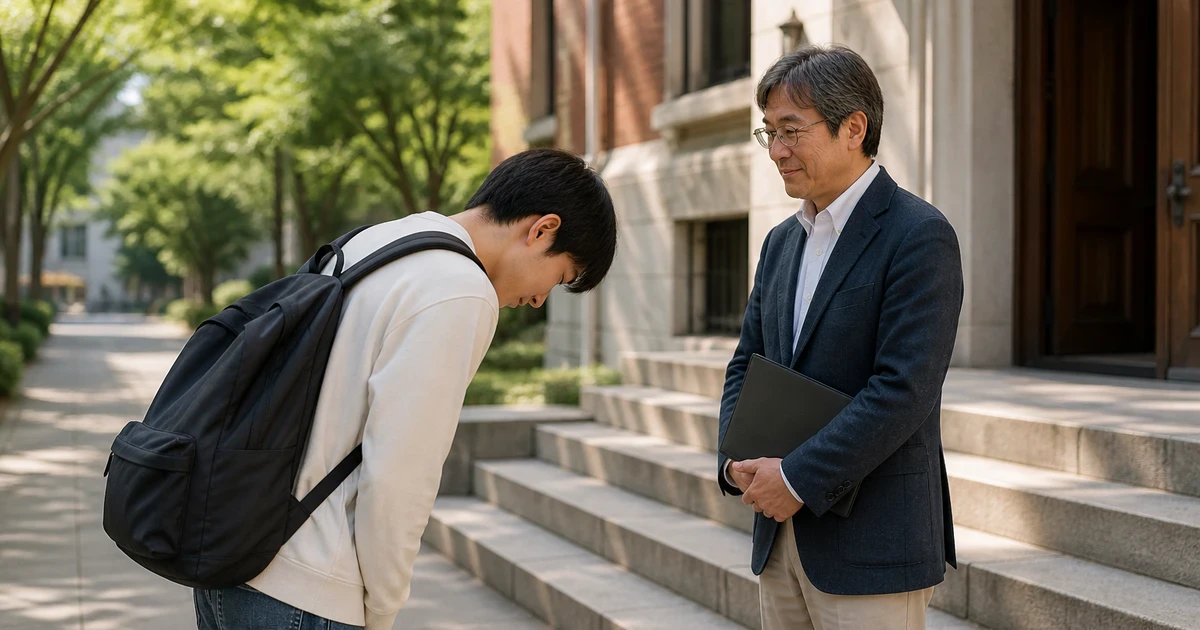
Look up "professor" in any dictionary and you get 教授 (kyōju, professor). That answer is correct — and it will still get you strange looks if you use it to speak to the person standing in front of you. Japanese separates the title you write from the word you say, and academic vocabulary is where that split is sharpest.
This guide sorts out which word does which job, what the kanji actually mean, and how to use the words in sentences you might really need at a university.
Professor in Japanese: One Word for Rank, One for Address
教授 (kyōju) is the noun for a full professor at a university. It names a rank, the way "Chief Financial Officer" names a rank in a company. The English noun professor maps onto it almost exactly.
先生 (sensei, teacher) is what you actually say to that person. Japanese students address faculty as surname + 先生, from the first-year lecturer to the department head. Using the rank word to someone's face — or worse, 教授さん (kyōju-san), which is not a standard form — sounds like reading a name card aloud.
A quick way to hold the two apart:
- Writing about someone (a CV, a paper, a programme, an introduction): use 教授.
- Writing or speaking to someone: use surname + 先生.
- Talking about your own supervisor to a third party: 指導教員 (shidō kyōin, academic supervisor) is the neutral term.
A search for professor economics will usually return 経済学の教授 (keizaigaku no kyōju, professor of economics): the subject comes first, then の (no, linking particle), then the title. The same frame builds any specialty — swap in the field and the title stays put.
Cultural note. 先生 stretches far beyond schools. Doctors, lawyers, politicians, and manga artists are all addressed as 先生, because the word marks someone whose expertise you are relying on, not someone who teaches a class. Japanese universities, meanwhile, list professors by rank in print and on websites, so both registers appear side by side in daily campus life.
Academic Titles and Related Words
The words below cover most of what appears on a faculty page, a syllabus, or an email signature.
Japanese | Romaji | English Meaning |
|---|---|---|
教授 | kyōju | professor (full professor) |
准教授 | junkyōju | associate professor |
助教 | jokyō | assistant professor (junior faculty) |
講師 | kōshi | lecturer; instructor |
名誉教授 | meiyo kyōju | professor emeritus |
先生 | sensei | teacher (used as a form of address) |
教員 | kyōin | teaching staff; faculty member |
指導教員 | shidō kyōin | academic supervisor; advisor |
学部 | gakubu | faculty; undergraduate school |
経済学 | keizaigaku | economics |
歴史学者 | rekishi gakusha | historian |
授業 | jugyō | class; lesson |
教える | oshieru | to teach |
報酬 | hōshū | remuneration; payment for services |
The kanji repay a moment's attention. 教 carries the sense of teaching and appears early in JLPT kanji study through familiar words such as 教える (oshieru, to teach) and 教室 (kyōshitsu, classroom). 授 means to grant or confer, and turns up in 授業 (jugyō, class). Put them together and 教授 means, quite literally, teaching that is handed over — an image worth keeping when you review.
One spelling note: you will see the word written online as kyouju. That is keyboard romaji, the way you type it to produce the kana. Standard Hepburn writes the long vowel with a macron: kyōju. Both point at the same word; only one belongs in a formal document.
Saying It in Real Sentences
Titles stick when they sit inside sentences you can imagine using. (Suzuki is used here as a placeholder surname, the way dictionary examples use common family names.)
鈴木教授は経済学を教えています。 Suzuki kyōju wa keizaigaku o oshiete imasu. Professor Suzuki teaches economics.
教授は明日、京都に戻ります。 Kyōju wa ashita, Kyōto ni modorimasu. The professor is going back to Kyoto tomorrow.
先生、この論文について質問してもよろしいでしょうか。 Sensei, kono ronbun ni tsuite shitsumon shite mo yoroshii deshō ka. Professor, may I ask a question about this paper?
その歴史学者は大学で日本史を教えています。 Sono rekishi gakusha wa daigaku de Nihonshi o oshiete imasu. That historian teaches Japanese history at the university.
Notice sentence three. The English translation says "Professor," but the Japanese says 先生. Translations between the two languages are rarely one-to-one here, and that mismatch is exactly what trips learners up when they move from a word list to a real conversation.
When the Noun Becomes a Verb: Teaching and Instruction
教授 also works as a verb: 教授する (kyōju suru, to teach; to give instruction). It is grammatically right, but it is formal, written, and slightly stiff — closer to "deliver instruction" than to everyday teaching. For anything you say out loud, 教える (oshieru, to teach) is the natural choice.
This is where older bilingual dictionaries can mislead. Their sample entries pair 教授 with vocabulary like instruction and remuneration, producing English such as the professor received reasonable remuneration for his instruction. Nothing is wrong with it; it simply belongs to a register almost nobody speaks in. If you are describing a job, 報酬 (hōshū, remuneration) fits a contract, while ordinary conversation about pay uses much plainer words.
The practical rule:
- Everyday speech and casual writing → 教える (oshieru, to teach).
- Course descriptions, academic profiles, formal prose → 教授する (kyōju suru, to give instruction).
Common Mistakes
Learners tend to slip in the same few places with academic vocabulary.
1. Attaching さん to a rank. 教授さん (kyōju-san) is a mistaken guess, not a polite upgrade. Ranks do not take さん (san, honorific suffix); surname + 先生 is the polite form.
2. Using 教授 as a form of address. Calling across a seminar room with the rank word sounds like reading from a directory. Learners often assume that the more precise word must be the more respectful one — in Japanese, the more relational word usually is.
3. Treating 講師 as "professor". 講師 (kōshi, lecturer) is a distinct position. Promoting someone in an email is awkward; demoting them is worse. When you are unsure of a rank, avoid the rank entirely and use 先生.
4. Assuming 先生 means "school teacher" only. It marks acknowledged expertise, which is why doctors and lawyers receive it too.
5. Freezing between the noun and the verb. Many learners can recognise 教授 on a page yet cannot produce a sentence about who teaches what. Recognition and production are separate skills, and only the second one gets tested in a live conversation.
A Simple Way to Practise These Titles Out Loud
Speaking practice is what converts a word list into usable Japanese, and academic vocabulary is easy to drill because the situations are so predictable. Try this loop on your own:
- Pick one real situation — introducing your supervisor, asking a question after class, explaining what you study.
- Say it aloud twice: once with the rank word in a descriptive sentence, once with 先生 in a direct address.
- Record yourself and check the long vowels; kyōju and jugyō both lose their meaning if the long sound collapses.
- Write down the one sentence that came out shakiest, and make it the first thing you say tomorrow.
If you study without a partner, How to Practice Speaking Japanese Alone walks through drills that work solo. The gap that solo work cannot close is feedback: whether your pitch, politeness level, and word choice actually land the way you intend. Learners often need someone to tell them that a sentence is grammatically fine but tonally off — a correction almost impossible to make on your own.
That is what a live teacher adds. In our one-on-one lessons over LINE, titles like these are easy to rehearse in context, and Kind Japanese's standard 25-minute one-on-one lessons are short enough to fit around a working or study schedule. If you want to arrive prepared, How to Prepare for a Japanese Free Trial Lesson suggests what to bring.
Ready to try it with a real conversation partner? Start with a Free Trial Lesson with Kind Japanese over LINE and bring one situation you actually need — an email to a supervisor, a self-introduction, or a question you have been putting off.
FAQ
What is the Japanese word for professor?
The standard noun is 教授 (kyōju), which means a full professor at a university. In everyday speech, though, students address faculty with a surname plus 先生 (sensei), so save the rank word for writing, introductions, and situations where academic position genuinely matters. Both words appear constantly in university email, so learning them together saves confusion.
How do you write professor in kanji?
It is written with two kanji: 教 (kyō, teach) and 授 (ju, grant or confer), giving 教授 — literally teaching that is handed over to students. The same 教 appears in 教える (oshieru, to teach) and 教室 (kyōshitsu, classroom), which many learners already know from beginner study. Handwriting both characters a few times makes the compound much easier to recall later.
Does the word for professor also mean to teach?
Yes. 教授する (kyōju suru) means to teach or give instruction, but it sounds formal and academic, closer to English deliver instruction than to everyday teaching. For daily conversation use 教える (oshieru), and keep the formal verb for lectures, course descriptions, and written profiles. Older bilingual dictionaries still favour that stiff register, which is why their translations often sound dated.
How do I address a professor in an email?
Open with the surname plus 先生 (sensei), not the rank word, and keep the rest polite. A greeting, a short reason for writing, your question, and your name and student number cover almost every case. Adding your department helps a busy reader place you quickly, especially in a large faculty.

