
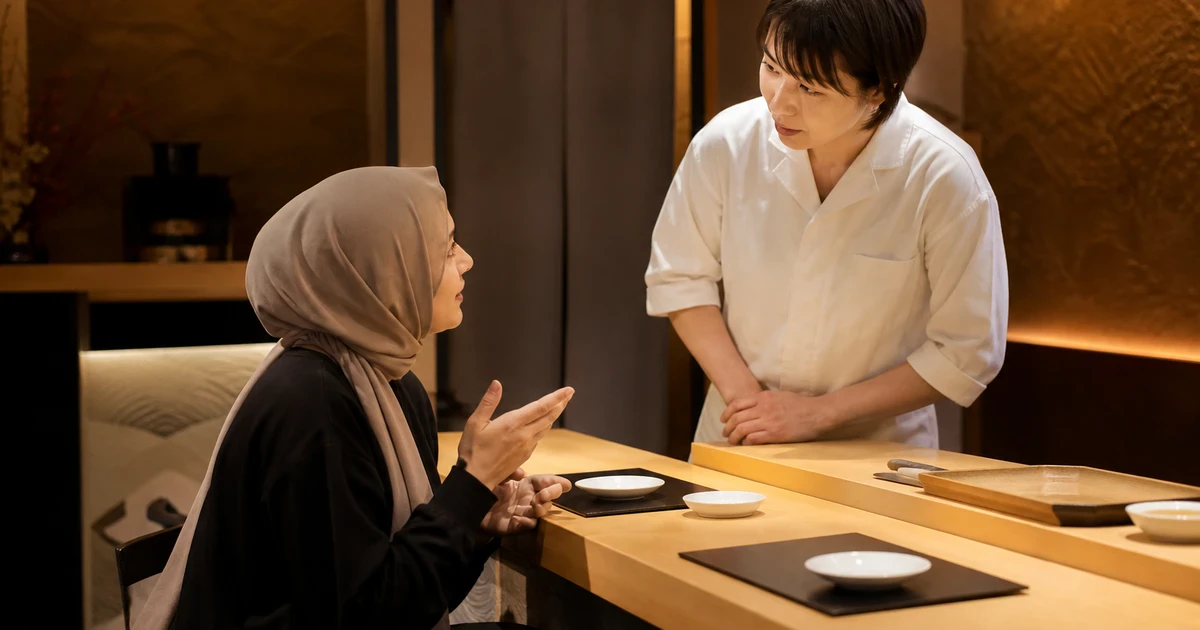
Why Halal Questions Need Their Own Vocabulary
Asking about halal food in Japan is a different skill from ordering food in general. You are not just choosing a dish — you are checking ingredients, cooking methods, and sometimes certification, often with a staff member who may not be familiar with halal requirements themselves.
That means the most useful Japanese here is not a long menu of vocabulary. It is a small set of clear, polite questions you can use confidently in any restaurant: confirming whether something is halal food, asking what is in a dish, and asking about pork, alcohol, or animal-based broths.
If you already know basic ordering phrases, this article builds on that foundation. For general phrases like asking for a table or requesting the check, our guide to Japanese Phrases for Ordering Food at a Restaurant covers the everyday basics that pair well with the halal-specific questions below.
Core Phrases for Asking About Halal Food
Most halal-related questions in a Japanese restaurant fall into three categories: confirming halal status, asking about specific ingredients, and asking about certification or alternatives.
A few starting points:
- Always open with すみません (sumimasen, excuse me) to politely get a staff member's attention.
- Use ~ですか (desu ka) to turn a statement into a simple, polite question.
- Use ~ていただけますか (~te itadakemasu ka) when you want a more formal, respectful request, such as asking someone to explain ingredients.
Here is a reference table of the core phrases:
Japanese | Romaji | English Meaning |
|---|---|---|
ハラール食品 | haraaru shokuhin | halal food |
ハラール認証 | haraaru ninshō | halal certification |
豚肉 | butaniku | pork |
アルコール | arukōru | alcohol |
材料 | zairyō | ingredients |
だし | dashi | Japanese soup stock (often fish or meat-based) |
ベジタリアン | bejitarian | vegetarian |
すみません | sumimasen | excuse me |
教えていただけますか | oshiete itadakemasu ka | could you tell me? |
Keep a copy of this table on your phone before you travel — it works as a quick checklist even without internet access, and it can double as a printable reference you keep in your notes app.
Example Sentences for Restaurant Situations
Short, complete sentences are more useful than isolated vocabulary because they show you exactly how the words connect in a polite question.
すみません、これはハラール食品ですか。 Sumimasen, kore wa haraaru shokuhin desu ka. Excuse me, is this halal food?
この料理に豚肉は入っていますか。 Kono ryōri ni butaniku wa haitte imasu ka. Does this dish contain pork?
材料を教えていただけますか。 Zairyō o oshiete itadakemasu ka. Could you tell me the ingredients?
アルコールを使った調味料はありますか。 Arukōru o tsukatta chōmiryō wa arimasu ka. Are there any seasonings made with alcohol?
ハラール対応のレストランを探しています。 Haraaru taiō no resutoran o sagashite imasu. I'm looking for a halal-friendly restaurant.
Notice that each question is built to get a specific, useful answer rather than a vague "it's probably fine." That specificity matters, since dashi (fish or meat-based stock) and small amounts of cooking alcohol are easy to miss if you only ask "Is this halal?"
Reading Katakana Correctly Under Pressure
Many of the words you need for this topic — ハラール (haraaru, halal), レストラン (resutoran, restaurant), アルコール (arukōru, alcohol) — are written in katakana, and katakana brings its own reading challenges.
In one-on-one lessons, a recurring pattern is that learners misread visually similar katakana characters, especially シ and ツ, or ソ, ン, and リ. These characters differ only in the direction or length of a small stroke, and mixing them up can turn a word like シ (shi) into ツ (tsu), changing how a question sounds when spoken aloud. A teacher who hears you read a menu term out loud can catch this instantly and walk through the stroke differences with you, which is much harder to notice from silent reading alone.
This is a small but real barrier when you are standing at a counter trying to read a halal-friendly restaurant sign or ask about ingredients with confidence.
Practical Travel Tips Beyond the Phrases
Language is only part of finding suitable food while traveling in Japan. A few practical habits help:
- Look for restaurants that display halal certification logos, but still ask a polite question to confirm, since certification standards vary by provider.
- In areas with many international visitors, some restaurants label halal, vegetarian, or pork-free options directly on the menu.
- If a restaurant seems unsure how to answer, it is reasonable to choose a simpler dish, such as plain rice or vegetables, and ask the ingredients question again.
- Carry a written note with your key questions in Japanese as a backup, in case pronunciation does not land clearly the first time.
For broader travel vocabulary — asking directions, checking train information, or general polite requests while out and about — our Japanese Travel Words & Phrases for Your Japan Trip guide is a useful companion to the restaurant-specific phrases here.
Common Mistakes
From a teacher's perspective, a few patterns come up repeatedly when learners prepare halal-related questions for travel.
Asking a yes/no question that's too broad. "Is this halal?" invites a quick, sometimes uncertain "yes" from a busy staff member. Asking about specific ingredients, like pork or alcohol, usually gets a more accurate answer.
Skipping the polite opener. Jumping straight into a question without すみません (sumimasen, excuse me) can sound abrupt in Japanese, even if the grammar is correct. A short opener signals politeness before the actual question.
Mixing up similar katakana. As noted above, confusing シ/ツ or ソ/ン/リ can change a word's sound entirely. Reading practice out loud, with feedback, is the fastest way to fix this.
Assuming one restaurant's answer applies everywhere. Ingredients and preparation methods vary restaurant by restaurant, even within the same chain, so the same polite question is worth repeating at each new place.
One-on-one practice helps here because a teacher can hear exactly how you pronounce these questions and correct small slips in real time — something a phrasebook alone cannot do. In a focused 25-minute one-on-one lesson over LINE, you might warm up with basic greetings, practice your halal-food questions as a target speaking task, get live correction on pronunciation or word order, and leave with a short list of questions you can refine before your trip.
If you want to test your pronunciation and get direct feedback before you travel, a Free Trial lesson with Kind Japanese is a low-pressure way to practice these exact restaurant questions with a live teacher over LINE.
FAQ
Is there a single Japanese word that means "halal food"?
Yes, ハラール食品 (haraaru shokuhin) is the standard term, borrowed from English. Some menus also use ハラール対応 (haraaru taiō), meaning "halal-friendly" or "accommodating halal needs." Staff familiarity with the term varies, so a follow-up question about ingredients is still worthwhile.
What if a restaurant doesn't understand my question?
Try simplifying to specific ingredients, such as asking about pork (豚肉, butaniku) or alcohol (アルコール, arukōru) directly, rather than the general concept of halal. Pointing at the menu while asking can also help clarify what you mean.
Can I trust halal certification logos in Japan?
Certification systems vary by provider and are not centrally standardized nationwide, so a logo is a helpful signal, not a guarantee. It is still worth asking staff directly about ingredients and preparation methods for full confidence, especially for meat-based dishes.
Is asking about dashi (soup stock) really necessary?
Yes. Dashi often uses fish, meat, or fish-based flakes and appears in many dishes that otherwise look plant-based, such as miso soup or simmered vegetables. Asking specifically about だし (dashi) can reveal ingredients that a general question might miss.

