
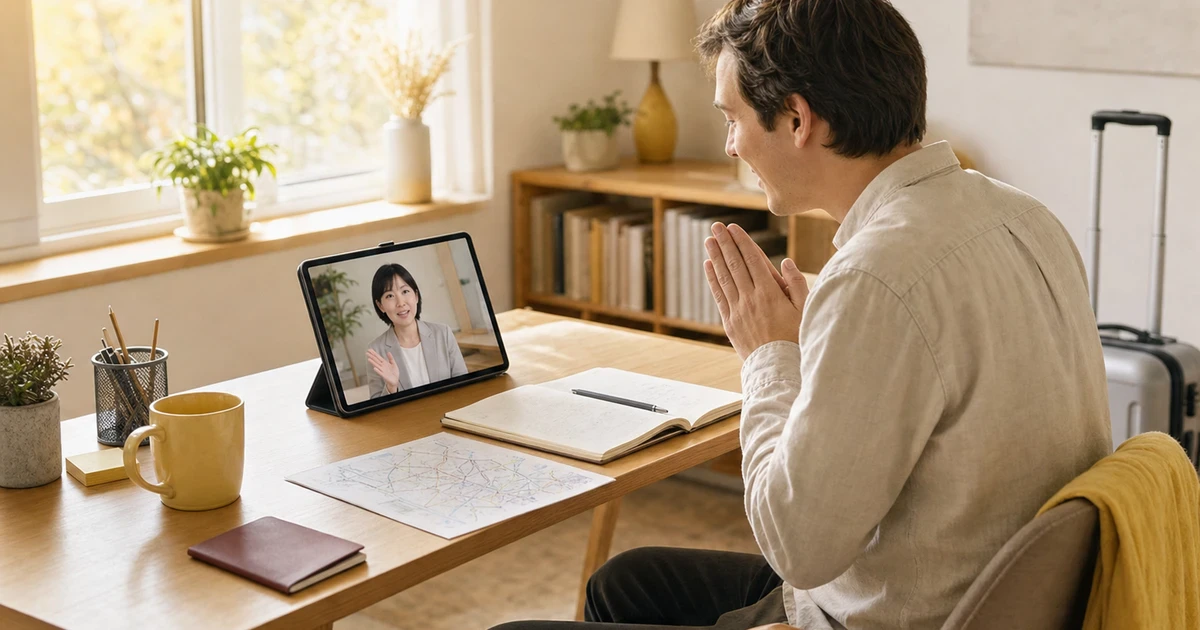
Online Japanese lessons for business travelers to Japan work best when they focus on the exact moments that create pressure: greeting a client, checking in at a hotel, asking for directions, apologising for a delay, or joining a meeting without sounding too blunt.
A one-on-one tutor can turn those moments into short role-play practice, live correction, and repeatable phrases in a LINE lesson. That is the fastest way to make your Japanese more useful before a trip.
Online Japanese Lessons for Business Travelers to Japan
The biggest advantage of online Japanese lessons for business travelers to Japan is focus. You do not need a broad textbook chapter when your real need is something specific, like a hotel check-in, a taxi conversation, or a short self-introduction before a meeting.
For many travelers, the problem is not complete silence. It is knowing a few phrases but not being able to produce them smoothly under time pressure. From a teacher's perspective, learners often know the polite sentence on paper but freeze when the situation changes slightly.
That is why short, live practice helps. A teacher can listen to your actual wording, adjust it for clarity and politeness, and then ask you to say it again in a more natural way.
If your trip includes meetings, it also helps to compare this topic with Business Japanese Meeting Agenda Phrases, especially when you need to open a meeting, confirm the topic, or close politely.
What to Practice Before You Land in Japan
Practice the phrases that connect directly to travel and work, not just isolated vocabulary. A small set of high-value expressions will carry you through many situations.
Japanese | Romaji | English meaning |
|---|---|---|
予約 | yoyaku | reservation |
受付 | uketsuke | reception / front desk |
会議 | kaigi | meeting |
遅れます | okuremasu | to be late / delayed |
確認したいです | kakunin shitai desu | I want to confirm |
〜していただけますか | ~ shite itadakemasu ka | Could you please ... ? |
A useful cultural note: in Japanese business settings, a brief apology before a request often sounds natural. It does not mean you are at fault; it is simply a polite way to frame the conversation.
Here are a few simple sentences to rehearse in context:
明日の会議は何時に始まりますか。 Ashita no kaigi wa nanji ni hajimarimasu ka. What time does tomorrow's meeting start?
ホテルへの行き方を教えてください。 Hoteru e no ikikata o oshiete kudasai. Please tell me how to get to the hotel.
少しゆっくり話していただけますか。 Sukoshi yukkuri hanashite itadakemasu ka. Could you speak a little more slowly?
申し訳ありません、電車が遅れました。 Mōshiwake arimasen, densha ga okuremashita. I'm sorry, the train was delayed.
会議の前に一度確認したいです。 Kaigi no mae ni ichido kakunin shitai desu. I would like to confirm it once before the meeting.
If you are comparing lesson formats, it helps to remember that spoken practice is not the same as reading practice. You need to hear the phrase, say it, get corrected, and say it again with the new wording.
A 25-Minute LINE Lesson Flow
Kind's standard one-on-one lessons are 25 minutes, which is enough time to handle one travel scene properly without drifting into unrelated topics.
A strong lesson flow for business travelers looks like this:
- Warm-up - Start with one sentence about your trip, your role, or the situation you expect. - Keep it short and practical.
- Target speaking task - Role-play one scene, such as a hotel check-in, a taxi ride, or a short meeting greeting. - Speak once without stopping so the teacher can hear the raw version.
- Teacher feedback - The teacher corrects the sentence for politeness, grammar, and natural timing. - This is where a direct request may become softer, or a phrase may become easier to say under pressure.
- Speak-correct-repeat - Say the corrected version again. - Repeat until it feels usable, not just understandable.
- Next-step advice - Leave with one clear focus for your next practice session. - For example: smoother requests, clearer self-introduction, or a more natural apology for lateness.
This kind of focused LINE lesson is especially useful when you need to sound calm and prepared in a short business exchange. You are not memorising a script for every possible situation. You are building a reliable response for the one that matters most.
Choosing a Lesson Window Across Time Zones
The easiest way to plan a lesson is to propose windows in your own time zone first. That reduces confusion and makes it easier to compare your schedule with Japan time later.
A practical message is simple: - “I’m available Monday evening in my local time.” - “I can also do early morning in my local time.” - “If needed, I can adjust by one or two hours.”
If you live in Europe and want a clearer way to phrase timing, Online Japanese Lessons Europe: Time-Zone Guide is a useful companion. It can help you think about local evening, Japan morning, and the overlap between them.
For business travelers, the best lesson window is usually the one that matches your actual trip rhythm. If you are preparing for a meeting on arrival day, choose a time that still leaves room to review before you fly. If your trip is later, choose a steady weekly slot so the phrases stay fresh.
Common Mistakes
From a teacher's perspective, learners often run into the same problems when they prepare for business travel.
- They memorise a full script but cannot adapt when the other person says something unexpected.
- They use requests that are too direct, such as a blunt “please do this” style, when a softer pattern would sound more appropriate.
- They borrow casual expressions from anime or internet Japanese and accidentally use them in business settings.
- They confuse small katakana contrasts such as ツ and シ, or ソ, ン, and リ, which can affect how loanwords and names are heard.
- They switch keigo styles mechanically instead of checking whether the situation needs a softer or more formal register.
The fix is usually not more theory. It is a short loop of hearing, speaking, correcting, and repeating. That is where one-on-one feedback is valuable, because a teacher can show which part of the sentence is working and which part needs to change.
FAQ
Do I need advanced Japanese before booking?
No. A business traveler can still benefit from focused online Japanese lessons at a basic or intermediate level. The lesson can start with survival phrases, polite requests, and one clear role-play scene. The goal is not to cover everything at once, but to make one important conversation safer and smoother.
What should I bring to a lesson?
Bring one real situation from your trip. A hotel check-in, airport question, train delay, meeting greeting, or restaurant reservation is enough. If you already have a message, screenshot, itinerary, or agenda, that context helps the teacher keep the practice practical and realistic.
Why is a 25-minute lesson useful for travelers?
A 25-minute lesson is short enough to stay focused and long enough to do warm-up, role-play, correction, and a second spoken attempt. For busy travelers, that structure is efficient because it trains one real situation instead of spreading attention across too many topics.
How should I choose a time if I live outside Japan?
Offer two or three windows in your own time zone, then compare them with Japan time only after that. This makes scheduling clearer and avoids confusion. If you are in Europe, the Online Japanese Lessons Europe: Time-Zone Guide can help you phrase the timing naturally.
If you want to practise your own travel and meeting phrases with live feedback, book a Free Trial lesson over LINE.

