
Why Spouses Moving to Japan Need a Different Kind of Japanese Study
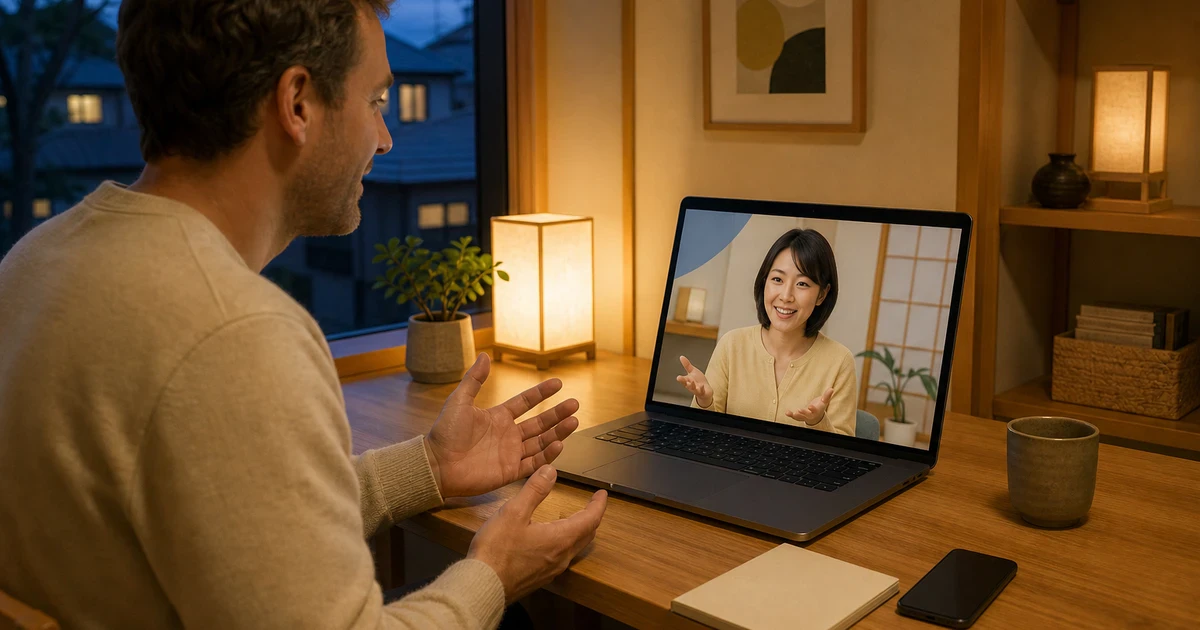
Online Japanese lessons for spouses moving to Japan need to look different from a typical beginner textbook course. You are not just learning grammar for a test — you are preparing to meet in-laws, register at city hall, talk to neighbors, and manage a household in a language you may have only studied casually before.
That means your study plan should prioritize spoken, situational Japanese over memorizing long vocabulary lists. Online Japanese lessons work well here because you can study from wherever you currently live, right up until your move, and continue afterward without switching providers or losing momentum.
A one-on-one format matters too. Group classes move at a fixed pace and rarely touch the specific situations a spouse will face — a private lesson can be redirected toward your actual life: your partner's family, your new neighborhood, your paperwork appointments.
What to Prioritize Before and After the Move
Before moving, focus on comprehension and confidence rather than perfection. You will likely be nervous the first time you introduce yourself to your partner's parents or speak to a city hall clerk, so the goal is to have a few solid, natural phrases ready rather than a large vocabulary you can't yet access under pressure.
Useful priorities, roughly in order:
- Self-introductions that sound natural, not textbook-stiff
- Polite phrases for meeting family and neighbors
- Basic city hall and administrative vocabulary (address changes, forms, appointment scheduling)
- Everyday household and shopping conversation
- Listening practice for the fast, casual speech you'll hear in daily life, which is very different from textbook audio
After the move, many spouses find their listening improves faster than their speaking, simply from daily exposure. This is exactly where a teacher helps — someone who can notice what you understand but still can't produce yourself, and push you to speak it out loud.
If you're studying from a different time zone before relocating, it also helps to think ahead about when lessons will fit your schedule. Proposing a specific window in your own time — for example, saying you'd like evening lessons on weekdays — is easier for both sides than leaving it vague, and it's a habit worth carrying into your post-move routine as well.
Building Speaking Practice That Matches Real Life
Speaking practice should mirror the actual conversations you'll have, not generic dialogue drills. A private teacher can role-play the specific people you'll be talking to: a partner's parent, a city hall staff member, a new neighbor, a delivery driver. This kind of rehearsal builds real confidence, because you're not guessing how a conversation might go — you've already said the words out loud once.
One cultural note worth knowing before you meet your partner's family: greetings in Japan tend to carry more social weight than casual Western introductions do. A short, humble self-introduction and a polite closing phrase are often expected even in a first meeting, and hesitating or apologizing for imperfect Japanese is generally seen as polite rather than awkward — it shows effort and respect for the relationship you're building.
Here are a few sentences worth practicing out loud with a teacher, adjusting the pronouns and details to your own situation:
パートナーの家族に会うのが楽しみです。 Pātonā no kazoku ni au no ga tanoshimi desu. I'm looking forward to meeting my partner's family.
市役所で住所変更の手続きをしました。 Shiyakusho de jūsho henkō no tetsuzuki o shimashita. I did the procedure to change my address at city hall.
義理の母にお世話になっております。 Giri no haha ni osewa ni natte orimasu. I am grateful for my mother-in-law's continued support.
近所の人に挨拶をしました。 Kinjo no hito ni aisatsu o shimashita. I greeted my neighbor.
今度、日本語で自己紹介の練習をしたいです。 Kondo, nihongo de jikoshōkai no renshū o shitai desu. Next time, I want to practice self-introductions in Japanese.
If you want a deeper look at how structured feedback builds spoken confidence over time, this guide on how to Build Speaking Confidence with a Japanese Tutor walks through the process in more detail.
A Sample 25-Minute Lesson Flow
Kind Japanese runs standard one-on-one lessons as 25-minute sessions over LINE, which is a practical length for focused, situation-based practice without feeling overwhelming. A typical lesson built around a spouse's needs might look like this:
- Warm-up (a few minutes): short small talk in Japanese to loosen up and check what came up in daily life since the last lesson
- Target speaking task: rehearsing one real situation, such as introducing yourself to a partner's relative or asking a question at a local office
- Correction: the teacher repeats back a more natural version of what you said, and you practice saying it again until it feels comfortable
- Review notes: you jot down the corrected phrases and one open question to bring to the next lesson
Because lessons happen over LINE, scheduling can be proposed directly in the chat — if you're studying from abroad before your move, suggesting a window in your own evening or morning time is usually simpler than trying to guess what might work.
Common Mistakes to Watch For
From a teacher's perspective, a few patterns come up again and again with learners preparing for a big transition like this.
Relying on textbook Japanese for casual conversation. Textbooks teach clean, complete sentences, but real neighbors and family members speak faster and drop words. Practicing listening to natural, slightly casual speech — not just textbook audio — closes this gap.
Mixing up register. Some learners use overly casual phrasing with in-laws or officials, or overly stiff phrasing with close family, because they picked up expressions from media rather than real conversation. A teacher listening in real time can flag this kind of mismatch as it happens, which is much harder to catch from self-study alone.
Confusing similar-sounding katakana or borrowed words. Learners sometimes pick up phrases from anime or games and assume they're standard, everyday Japanese, when they're actually fictional or highly informal. Getting quick, direct feedback on which expressions are genuinely natural — and which aren't — saves a lot of confusion in real conversations with family and neighbors.
Avoiding speaking practice until "ready." Waiting until your Japanese feels polished before speaking out loud usually backfires; speaking practice is what makes it polished in the first place.
For more on shifting from studying phrases to actually using them in conversation, see this piece on Japanese Conversation Practice Online: Speak Naturally.
A short reference table for a few of the phrases mentioned above:
Japanese | Romaji | English Meaning |
|---|---|---|
お世話になっております | Osewa ni natte orimasu | Thank you for your continued support (used with in-laws, neighbors, officials) |
よろしくお願いいたします | Yoroshiku onegai itashimasu | I appreciate your kindness / please treat me well (self-introduction closer) |
住所変更 | Jūsho henkō | Change of address (a common city hall procedure) |
近所付き合い | Kinjo-zukiai | Neighborly relations / getting along with neighbors |
自己紹介 | Jikoshōkai | Self-introduction |
FAQ
Do I need to be fluent before moving to Japan as a spouse?
No. Many spouses arrive with basic or intermediate Japanese and build fluency after moving through daily exposure and consistent practice. What helps most before you go is having a few natural, well-rehearsed phrases for family introductions and everyday situations, rather than trying to master the entire language in advance.
How is one-on-one online Japanese different from a group class for this situation?
A one-on-one lesson can be shaped entirely around your real circumstances — meeting a partner's family, city hall visits, neighborhood life — instead of following a fixed group curriculum. This makes speaking practice more relevant and lets a teacher give direct, personal correction rather than general class feedback.
Can I keep studying online Japanese after I move to Japan?
Yes. Online Japanese lessons over LINE work the same way whether you're still abroad or already living in Japan, so there's no need to switch methods or providers around the move itself. Many spouses actually find lessons more useful after arrival, once real conversations start happening daily.
What should I bring to a first lesson as a spouse moving to Japan?
Bring your current level, your goal (family conversation, paperwork, daily life), and one specific situation you're nervous about, such as a first meeting with in-laws. A teacher can build a focused speaking task and correction around that one scenario rather than starting from generic material.
If you're preparing for a move and want practice built around your real situation, online Japanese lessons for spouses moving to Japan through Kind Japanese focus on exactly this kind of one-on-one, LINE-based speaking practice. Try a Free Trial lesson with Kind Japanese and bring the one conversation you're most nervous about.

