
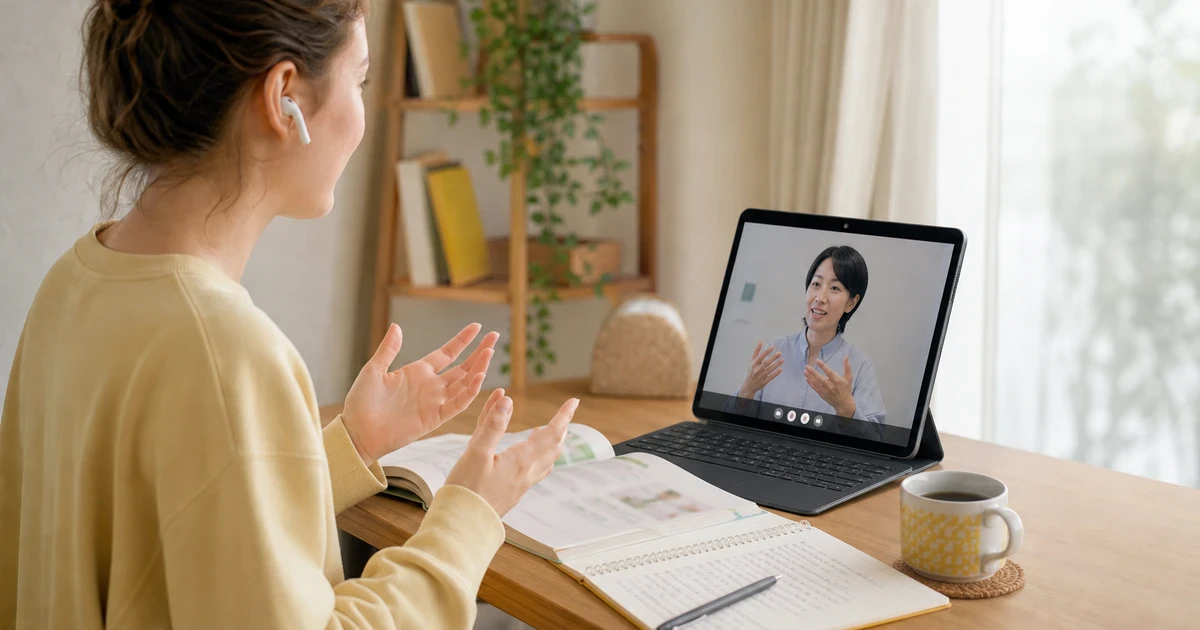
Online Japanese lessons for textbook learners needing conversation practice work best when the textbook is treated as a starting point, not the finish line. If you can read the chapter but still feel awkward speaking it aloud, that is exactly the gap a one-on-one tutor can help close.
A good LINE lesson gives you live speech practice, immediate teacher feedback, and a chance to turn “I understand this page” into “I can actually say this in conversation.” For learners outside Japan, that matters because the textbook alone rarely trains timing, response speed, or natural back-and-forth.
Online Japanese Lessons for Textbook Learners Needing Conversation Practice
Textbook learners usually do not need more information. They need more speaking turns.
From a teacher's perspective, the common problem is not that the grammar is wrong on the page. The problem is that learners know the pattern in theory, then freeze when the other person changes the wording, speaks faster, or asks a simple follow-up question.
That is why online Japanese lessons are useful here. A one-on-one tutor can take one chapter and turn it into:
- a short warm-up based on the chapter topic
- a role-play that makes the language feel real
- correction on wording, pronunciation, and timing
- one more attempt using the improved version
This is especially helpful if you have been studying alone and feel that your Japanese is “understood, but not usable.” A textbook gives you structure. Conversation practice gives you access.
A small cultural note also helps here: in Japanese, softer requests often sound more natural than blunt ones. For example, asking someone to repeat something politely usually feels better than forcing a hard direct command. That difference is easy to miss when you only study from a page.
What to Practice in a 25-Minute LINE Lesson
A focused 25-minute lesson is enough when the goal is clear.
In a LINE lesson, the best use of time is a simple speak-correct-repeat loop. You do not need to cover an entire textbook unit. You need one usable speaking situation that you can repeat with confidence.
A practical lesson flow looks like this:
- Warm-up
The teacher checks your current level with a few easy questions tied to your chapter or goal. - Target speaking task
You do one short role-play, such as introducing yourself, asking for clarification, or responding to a textbook dialogue in your own words. - Teacher feedback
The teacher points out the most useful corrections first: wording, word order, pronunciation, or a more natural phrase. - Repeat with improvement
You say the same idea again, this time using the corrected version. - One next step
You leave with a single thing to reuse in the next lesson or in self-study.
This works well for textbook learners because it stops the lesson from becoming passive review. You are not just reading model sentences. You are using them.
If you need help describing your availability across time zones, the Online Japanese Lessons Europe: Time-Zone Guide and Online Japanese Lessons for Adults in the US are useful examples of how to phrase your local lesson window clearly.
Phrases That Turn a Textbook Page into Speech
These are the kinds of phrases that help a lesson move from reading to speaking. They are simple, flexible, and useful in many textbook-based conversations.
Japanese | Romaji | English Meaning |
|---|---|---|
ちょっと質問があります | chotto shitsumon ga arimasu | I have a small question |
もう一度お願いします | mō ichido onegaishimasu | Please say it again |
この言い方は自然ですか | kono iikata wa shizen desu ka | Is this way of saying it natural? |
〜てもいいですか | ~te mo ii desu ka | May I ...? / Is it okay if I ...? |
もう少しゆっくりお願いします | mō sukoshi yukkuri onegaishimasu | Please speak a little more slowly |
These phrases are useful because they let you keep the conversation going instead of stopping at the first unknown word.
Example Sentences
日本語の教科書を使っています。
Nihongo no kyōkasho o tsukatte imasu.
I use a Japanese textbook.
この文を会話で言ってみたいです。
Kono bun o kaiwa de itte mitai desu.
I want to try saying this sentence in conversation.
もう一度ゆっくり言ってください。
Mō ichido yukkuri itte kudasai.
Please say it again slowly.
店で注文する場面を練習したいです。
Mise de chūmon suru baimen o renshū shitai desu.
I want to practice ordering in a store.
この表現は自然ですか。
Kono hyōgen wa shizen desu ka.
Is this expression natural?
Common Mistakes
From a teacher's perspective, learners often know the grammar but not the speaking habit that goes with it. That gap creates hesitation, even when the textbook page looked easy.
- Translating the textbook sentence too literally. The grammar may be correct, but the result can sound stiff or unnatural in real conversation.
- Stopping at every small mistake. In live speech, it is better to finish the thought first and then fix the most important points.
- Practising only recognition. Reading a dialogue is not the same as answering it out loud.
- Ignoring sound details that affect clarity. Small contrasts such as つ (tsu, the tsu sound) and し (shi, the shi sound), or long vowels, can matter more than learners expect.
- Using the same polite response everywhere. A line that fits one situation may feel too formal or too casual in another.
Our teachers also see that live feedback helps when learners want to check whether a sentence is understandable before they build speed. In a one-on-one setting, that is much easier to correct than by guessing alone.
Preparing for a Free Trial
A free trial is most useful when you bring one clear purpose.
For textbook learners needing conversation practice, the best preparation is simple:
- Current level: say which textbook, chapter, or grammar point you are studying.
- Goal: explain what kind of conversation you want to practice.
- One speaking situation: choose one scene, such as ordering, introducing yourself, asking a question, or reacting to a dialogue.
- One question: bring a phrase you want to say but do not trust yet.
- Teacher feedback: ask the teacher to focus on the most useful corrections first.
- Next-step advice: leave with one phrase or pattern to reuse after the lesson.
This keeps the trial focused and practical. It also helps the teacher see how to shape the lesson around your real speaking needs, not just your reading level.
If you want to test this approach, book a Free Trial lesson over LINE and bring one textbook page plus one real speaking goal.
FAQ
Do I need to finish my textbook before taking lessons?
No. You can start while you are still working through a chapter, because conversation practice helps you use what you already know. A teacher can turn one page into a speaking task, which is often more useful than waiting until you feel “ready.” The goal is usable Japanese, not perfect completion.
What should I bring to an online lesson?
Bring one textbook page, one question, and one speaking situation you want to practise. That is enough for a useful one-on-one lesson. If you are using LINE, keep the goal simple so the teacher can focus on your speech, your wording, and the one correction that matters most.
Is conversation practice still helpful if my grammar is weak?
Yes. Conversation practice is often the fastest way to see which grammar points you actually use and which ones still feel unclear. A teacher can slow the pace, correct your sentence, and then have you say it again. That repetition makes the grammar more active than reading alone.
How should I describe my lesson time if I live outside Japan?
Write your availability in your own local time zone and keep the wording clear, such as weekday mornings or evening hours in your area. Exact phrasing matters less than being understandable. If you need help wording that message, the time-zone guides linked above give practical examples.
Textbook study becomes much more effective when it is connected to real speech. With online Japanese lessons, you can keep the structure of your textbook and add the missing piece: live conversation practice with a teacher who helps you use it aloud.

