
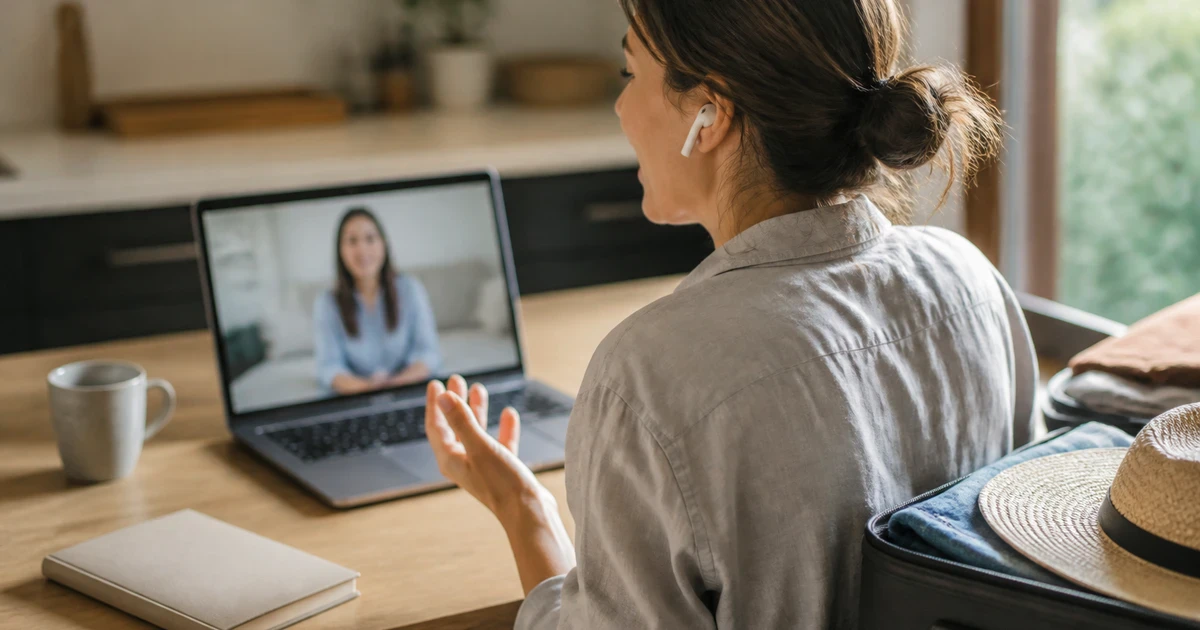
Searching "learn Japanese for travel" on YouTube is a smart first move. Free videos give you survival phrases, pronunciation models, and a feel for real conversations before you land in Japan. The challenge is that watching is passive. You can nod along to a video for weeks and still freeze when a station attendant asks a follow-up question.
This guide shows you how to use travel YouTube well, which phrases actually matter, and how to bridge the gap from listening to speaking so your trip goes smoothly.
How to Use Travel YouTube Without Wasting Time
Pick videos that match a real situation you will face, not generic "100 phrases" marathons. A focused clip on ordering food, buying train tickets, or checking into a hotel gives you phrases you can rehearse the same day.
Try this loop with any travel video:
- Watch once for the situation and overall meaning.
- Watch again and pause after each phrase to repeat aloud.
- Shadow the speaker — talk along at the same time to copy rhythm and pitch.
- Write down two or three phrases you will actually use.
- Test yourself the next day without the video.
Learners often find that recognition feels like mastery. You understand a phrase on screen, so you assume you can produce it. Real output — saying it first, unprompted, to a person — is a different skill, and it needs active practice.
A short cultural note: politeness markers carry a lot of weight in Japan. Adding すみません (sumimasen, excuse me) before a question instantly softens it and signals good manners, even if the rest of your sentence is simple.
The Travel Phrases That Matter Most
Prioritize phrases that solve problems: getting directions, ordering, paying, and asking someone to slow down. The table below is your core travel kit. Print or copy it and rehearse a few rows before each trip day.
Japanese | Romaji | English Meaning |
|---|---|---|
すみません | sumimasen | Excuse me / sorry (get attention) |
これをください | kore o kudasai | I'll have this one, please |
いくらですか | ikura desu ka | How much is it? |
英語のメニューはありますか | eigo no menyū wa arimasu ka | Do you have an English menu? |
駅はどこですか | eki wa doko desu ka | Where is the station? |
もう一度お願いします | mō ichido onegai shimasu | One more time, please |
ゆっくり話してください | yukkuri hanashite kudasai | Please speak slowly |
カードで払えますか | kādo de haraemasu ka | Can I pay by card? |
おすすめは何ですか | osusume wa nan desu ka | What do you recommend? |
ありがとうございます | arigatō gozaimasu | Thank you very much |
For a deeper themed list, this companion guide to Japanese Travel Words & Phrases for Your Japan Trip organizes vocabulary by situation so you can pack the right phrases for each part of your itinerary.
Example Sentences in Real Travel Moments
Seeing phrases inside full sentences helps you adapt them on the fly. Here are four situations you are likely to hit.
すみません、この電車は京都に行きますか。 Sumimasen, kono densha wa Kyōto ni ikimasu ka. Excuse me, does this train go to Kyoto?
おすすめは何ですか。カツカレーは好きです。 Osusume wa nan desu ka. Katsu karē wa suki desu. What do you recommend? I like katsu curry.
すみません、もう少しゆっくり話してください。 Sumimasen, mō sukoshi yukkuri hanashite kudasai. Excuse me, please speak a little more slowly.
これはカードで払えますか。 Kore wa kādo de haraemasu ka. Can I pay for this by card?
Notice how すみません (sumimasen) opens most requests. Leading with it buys you a moment and frames your Japanese as polite, even when the sentence that follows is short.
Common Mistakes Travel Learners Make
Memorizing questions but not answers. Learners often practice asking "Where is the station?" but not understanding the reply. Video comprehension helps, so spend equal time on listening for direction words like 右 (migi, right), 左 (hidari, left), and まっすぐ (massugu, straight ahead).
Overusing polite-but-stiff textbook lines. A long formal sentence you half-remember is riskier than a short, clear one. Keep it simple: これをください (kore o kudasai, I'll have this) works in almost any shop.
Confusing similar-sounding phrases. Learners mix up いくらですか (ikura desu ka, how much is it?) with いつですか (itsu desu ka, when is it?). One wrong vowel changes the meaning, which is why saying phrases aloud beats silent reading.
Freezing when the reply is faster than the video. Real speakers do not slow down like YouTube narrators. Practicing ゆっくり話してください (yukkuri hanashite kudasai, please speak slowly) as a reflex gives you a recovery tool for any conversation.
Turning YouTube Practice into Real Conversation
Video builds input; conversation builds output. The fastest bridge is speaking your travel phrases to a live person who can correct your pronunciation and answer back unpredictably — exactly what a real trip demands. That is where one-on-one practice complements free videos instead of replacing them.
Kind Japanese runs 25-minute one-on-one lessons over LINE, so you can rehearse the exact situations from your favorite travel videos with a live teacher. Learners often show that travelers understand phrases on screen but hesitate to start a sentence themselves; targeted speaking practice with feedback fixes that quickly.
If your trip is work-related, you might also compare notes with this piece on Online Japanese Lessons for Travel Agents, which looks at Japanese for hospitality and travel professionals.
Here is a simple way to prepare before you travel: note your current level, pick one goal (say, ordering food confidently), choose one speaking situation, write one question you want to ask, get teacher feedback on it, then decide your next step. You can try this in a free trial to see how speaking practice feels.
Ready to speak, not just watch? Book a Free Trial Lesson with Kind Japanese over LINE and rehearse your real travel scenarios with a live teacher.
FAQ
Can I learn enough Japanese for travel from YouTube alone?
YouTube is excellent for phrases, pronunciation models, and listening exposure, and many travelers get by with it. The gap is unscripted speaking, where real people reply faster and differently than videos. Pairing videos with live conversation practice closes that gap and builds genuine confidence for your trip.
How many phrases do I really need for a trip?
Around twenty to thirty core phrases cover most travel situations: greetings, ordering, prices, directions, and asking someone to slow down. Depth beats breadth, so rehearse a small set until they come out automatically. A short, confident phrase always serves you better than a long sentence you cannot finish.
What should I do if I do not understand the reply?
Use a recovery phrase like もう一度お願いします (mō ichido onegai shimasu, one more time, please) or ゆっくり話してください (yukkuri hanashite kudasai, please speak slowly). Practicing these as reflexes means a fast answer never stops your conversation. Gestures and a smile also help enormously in real situations.
Is one-on-one practice worth it for a short trip?
Yes, especially for output. Watching builds understanding, but speaking to a live teacher trains you to start sentences and react in real time. Even a focused trial conversation can reveal pronunciation habits to fix and give you tested phrases you can trust on your trip.

