
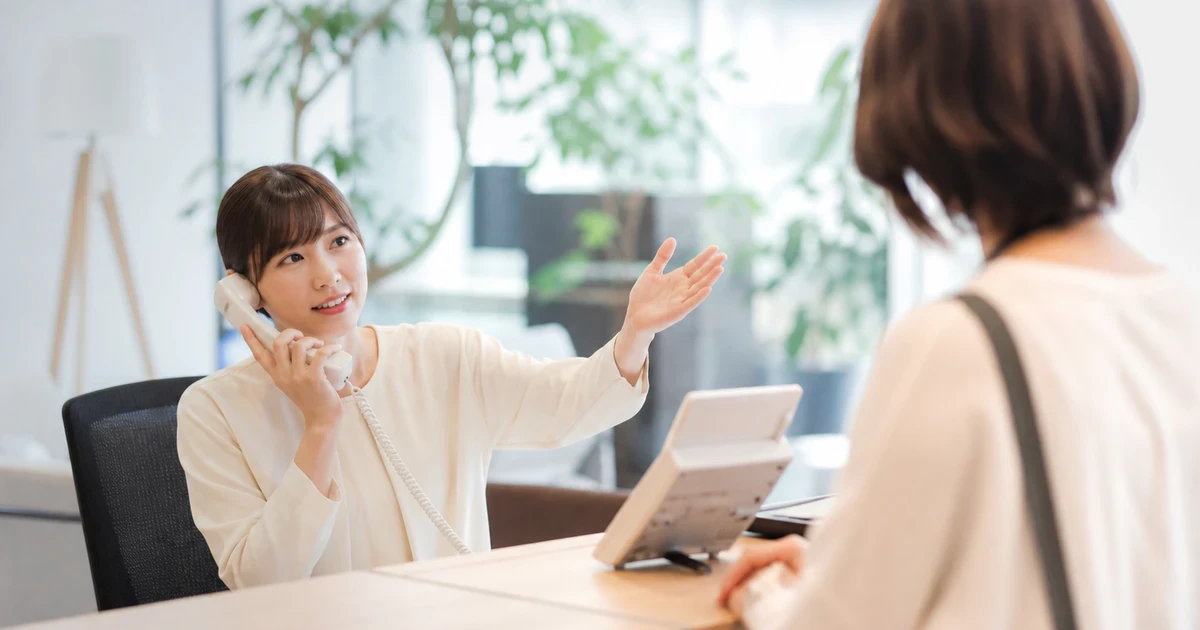
Japanese office phone calls require more than memorising polite phrases. You need to listen accurately, recognise names and phone numbers, respond quickly, and make your next action clear.
The challenge is especially noticeable when a caller gives several digits, asks for a colleague, or speaks before you are ready. This guide explains useful Japanese for answering phones, transferring calls, taking messages, and handling voicemail, along with practical number-format guidance.
Answering a Japanese Office Phone
Start with a clear greeting, identify the company or department, and listen carefully to the caller’s request.
お電話ありがとうございます。株式会社〇〇でございます。
O-denwa arigatō gozaimasu. Kabushiki-gaisha 〇〇 de gozaimasu.
Thank you for calling. This is 〇〇 Corporation.
If the caller immediately asks for someone, confirm the caller’s name before transferring the call.
恐れ入りますが、お名前を頂戴してもよろしいでしょうか。
Osoreirimasu ga, o-namae o chōdai shite mo yoroshii deshō ka.
I am sorry, but may I have your name?
恐れ入りますが (osoreirimasu ga, excuse me, but) introduces a polite request. It is professional without sounding excessively formal.
Repeat important information when the caller’s name contains unfamiliar sounds or the phone number contains several similar digits. Confirming aloud is safer than silently guessing.
Numbers, Area Codes, and Dialing
Japanese telephone numbers are commonly shown with hyphens, such as 03-1234-5678. Read the digits individually rather than treating the number as one large figure. A domestic landline number generally includes a leading zero and an area code, while mobile numbers usually begin with a different domestic prefix.
For international dialing, Japan’s country code is +81. When using +81, omit the leading zero from the domestic number: 03 becomes +81 3, and a domestic number beginning 090 becomes +81 90. The exact sequence for reaching an outside line depends on the individual office phone system, so confirm the company’s access code instead of assuming one.
These conventions are more useful than memorising equipment labels. Phones may be older analog landlines, digital landlines, or switchboards connected to a larger business system. Public phones may accept coins or cards, and prepaid options vary. NTT may appear in telephone-service information, but the number format still follows the same basic principles. International calls can be expensive, so check the destination and dialing method before calling.
When reading a number back, pause naturally around the hyphens and correct one digit at a time. Japanese phone numbers are not prices in yen, so do not group the digits as if they were amounts.
Taking Messages and Transferring Calls
Use different language for transferring a caller and taking a message. A transfer connects the caller; a message records information for someone who is unavailable.
あいにく、〇〇はただいま席を外しております。
Ainiku, 〇〇 wa tadaima seki o hazushite orimasu.
Unfortunately, 〇〇 is away from their desk at the moment.
担当者におつなぎいたしますので、少々お待ちください。
Tantōsha ni o-tsunagi itashimasu node, shōshō o-machi kudasai.
I will connect you to the person in charge, so please wait a moment.
The spelling 取り次ぎ (toritsugi, connecting or transferring a call) is the standard learner-friendly form. Do not use a phrase meaning “I will confirm the person in charge” when your actual action is transferring the caller.
If the person is unavailable, ask about the purpose of the call or offer to take a message. ご用件を承りましょうか (go-yōken o uketamawarimashō ka, may I ask what your call is regarding?) asks about the purpose of the call. 伝言を承りましょうか (dengon o uketamawarimashō ka, may I take a message?) is the clearer choice when you mean a message.
A practical message-taking sequence is:
- Ask for the caller’s name.
- Confirm the phone number, including the area code when relevant.
- Ask what the call concerns.
- Repeat the key information.
- Confirm whether the caller expects a return call.
Core Japanese Office Phone Phrases
These expressions cover the main stages of a business telephone call.
Japanese | Romaji | English meaning |
|---|---|---|
お電話ありがとうございます | O-denwa arigatō gozaimasu | Thank you for calling |
お名前を頂戴してもよろしいでしょうか | O-namae o chōdai shite mo yoroshii deshō ka | May I have your name? |
少々お待ちください | Shōshō o-machi kudasai | Please wait a moment |
席を外しております | Seki o hazushite orimasu | Is away from their desk |
ご用件を承りましょうか | Go-yōken o uketamawarimashō ka | May I ask what your call is regarding? |
伝言を承りましょうか | Dengon o uketamawarimashō ka | May I take a message? |
おつなぎいたします | O-tsunagi itashimasu | I will connect you |
お電話番号をお願いいたします | O-denwa bangō o onegai itashimasu | May I have your telephone number? |
もう一度お願いいたします | Mō ichido onegai itashimasu | Please say that once more |
復唱いたします | Fukushō itashimasu | I will repeat that back to confirm |
留守番電話にメッセージを残します | Rusuban denwa ni messēji o nokoshimasu | I will leave a message on voicemail |
Example sentences
お電話ありがとうございます。株式会社〇〇でございます。
O-denwa arigatō gozaimasu. Kabushiki-gaisha 〇〇 de gozaimasu.
Thank you for calling. This is 〇〇 Corporation.
お電話番号を、もう一度お願いいたします。
O-denwa bangō o, mō ichido onegai itashimasu.
Could you please repeat your telephone number?
復唱いたします。03の1234の5678でよろしいでしょうか。
Fukushō itashimasu. Zero san no ichi ni san yon no go roku nana hachi de yoroshii deshō ka.
I will repeat that back. Is it 03-1234-5678?
あいにく、担当者はただいま席を外しております。
Ainiku, tantōsha wa tadaima seki o hazushite orimasu.
Unfortunately, the person in charge is away from their desk at the moment.
Common Mistakes on Office Calls
Learners often confuse phrases that sound similar but perform different actions.
- Connecting versus confirming: おつなぎいたします (o-tsunagi itashimasu, I will connect you) transfers a call. 確認いたします (kakunin itashimasu, I will confirm or check) verifies information.
- Repeating versus asking again: 復唱いたします (fukushō itashimasu, I will repeat that back) shows that you are checking details. もう一度お願いいたします (mō ichido onegai itashimasu, please say that once more) asks the caller to repeat them.
- Purpose versus message: ご用件を承りましょうか asks what the call concerns. 伝言を承りましょうか offers to take a message.
- Numbers versus amounts: Phone numbers are read digit by digit, while 円 (en, yen) refers to money. Listen for whether the caller is giving contact information, an amount, or an area code.
A useful Japanese workplace point concerns how you refer to your own organisation when speaking with an external caller. Japanese business speech generally uses humble wording for one’s own company or colleagues and respectful wording for the other party. This distinction affects more than phone calls; it also appears in meetings and email.
For broader office preparation, Japanese Lessons for Office Administrators connects phone language with common administrative responsibilities. If you need wider professional communication practice, Business Japanese Course for Real Work offers a useful next direction.
Practising a Complete Call
A focused role-play should follow the order of a real call: greeting, name confirmation, number confirmation, transfer or message-taking, and a clear closing action.
In a 25-minute one-on-one lesson over LINE, practice can centre on one office situation. You might answer a simulated call, ask for an unfamiliar name, confirm a number digit by digit, transfer the caller using 取り次ぎ (toritsugi, call transfer), and repeat the exchange with more natural pauses.
A teacher can provide live feedback on pronunciation, listening, and whether your response matches the caller’s situation. Learners often understand office phrases while reading but lose confidence when several digits arrive quickly, so number repetition deserves deliberate practice.
Try this review method:
- Listen once without writing.
- Repeat the name or number aloud.
- Write the details using the hyphens shown by the caller.
- Read them back digit by digit.
- Identify the exact point that required correction.
If you want personalised practice for Japanese office phone situations, book a Free Trial Lesson over LINE. Bring one situation, such as transferring a call, confirming a number, or taking a message.
FAQ
How should I answer a Japanese office phone?
Begin with a polite greeting and identify your company or department. Listen for the caller’s request, then confirm names, phone numbers, and actions aloud when necessary. If you miss a detail, ask for repetition instead of guessing, because an incorrect digit or name can create a serious business misunderstanding.
How do I transfer a call in Japanese?
Use a phrase meaning “I will connect you,” then politely ask the caller to wait. If the requested colleague is unavailable, explain that the person is away from their desk and offer to ask about the call or take a message. Keep transfer language separate from confirmation language.
How can I leave a Japanese voicemail?
State your name and company, explain the reason for calling, and give your return number slowly and clearly. Repeat important digits if needed, then finish with a polite request for a callback. Recording yourself can reveal unclear pronunciation, rushed pauses, or a phone number that is difficult to understand.
Are Japanese office phones different from phones abroad?
The equipment may differ between analog landlines, digital systems, public phones, and office switchboards, but the communication principles remain familiar. You still need to greet the caller, identify the correct person, confirm names or digits, and explain what will happen next using an appropriate level of politeness.

