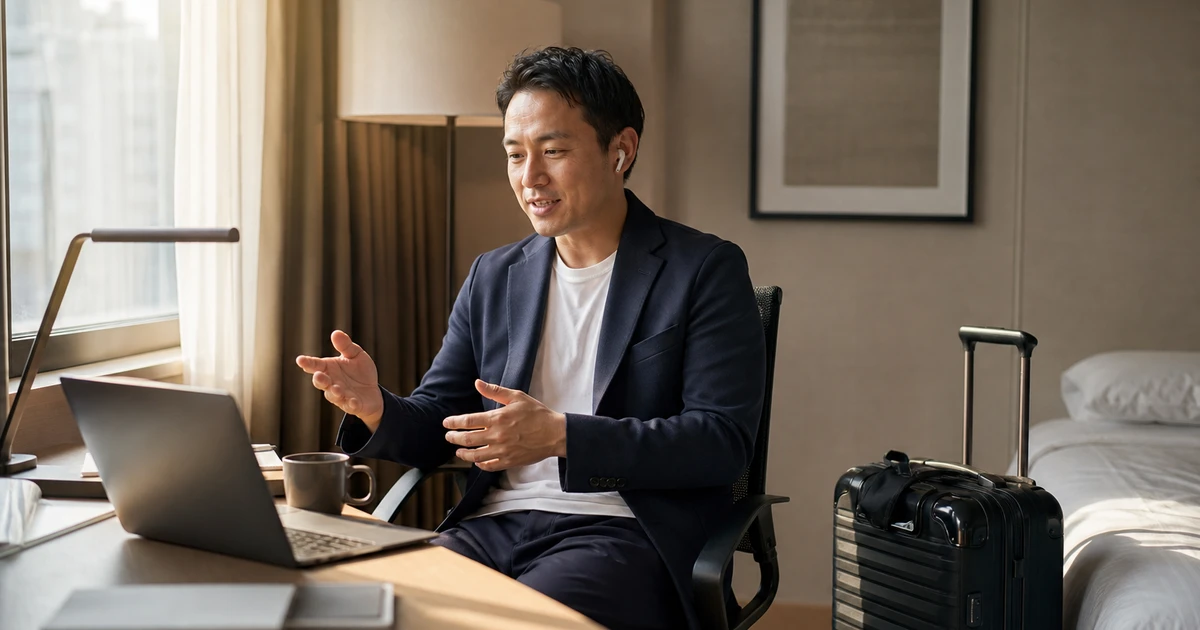
Online Japanese lessons for learners preparing for a business trip should focus less on memorising long phrase lists and more on live, practical speaking: greetings, meeting openings, hotel and taxi questions, polite requests, and quick recovery when you do not understand something.
A business trip is not the same as general travel. You may need to sound polite without becoming stiff, understand workplace rhythm, and respond in real time. That is where one-on-one speaking practice is especially useful: a teacher can hear your actual sentence, correct the level of politeness, and help you repeat it until it feels usable.
Kind Japanese offers online Japanese lessons over LINE, with standard one-on-one lessons lasting 25 minutes. For a busy learner abroad, that format works well because your practice can stay narrow: one airport situation, one meeting situation, one dinner situation, or one self-introduction.
Why Business Trip Japanese Needs Live Practice
Business-trip Japanese is practical communication under pressure. You are not trying to sound like a formal speech; you are trying to be clear, respectful, and calm when someone asks you a question.
For example, a textbook may teach a polite sentence, but a teacher can help you decide whether it sounds natural in context:
- Too casual for a client
- Too formal for a colleague at dinner
- Grammatically correct but slow to say
- Clear in writing but awkward in conversation
- Polite, but missing the main point
From a teacher’s perspective, learners often need feedback on register: when to use everyday polite Japanese, when to soften a request, and when a business phrase is appropriate. In allowed teacher feedback from our one-on-one lessons, a common pattern is that learners may use casual reaction phrases from ordinary conversation in business settings, then need help replacing them with more professional responses.
A short cultural note helps here: in Japanese business communication, the safest first move is often to acknowledge the other person before giving your own point. Even a simple phrase like “I understand” or “Thank you for explaining” can make your answer sound more cooperative.
Online Japanese Lessons for Learners Preparing for a Business Trip
Online Japanese lessons for learners preparing for a business trip should be built around the situations you will actually face, not an abstract “business Japanese” syllabus.
A focused plan might include:
- Introducing yourself to a host company
- Asking where a meeting room is
- Confirming the meeting agenda
- Asking someone to repeat or speak more slowly
- Explaining your schedule politely
- Ordering at a restaurant with colleagues
- Thanking a client after a meeting
If your trip includes meetings, you may also want to review Business Japanese Meeting Agenda Phrases before a speaking lesson. If you will interact with Japanese colleagues, Hōrensō (報連相) for Japanese workplace communication can help you understand the report-contact-consult style often used in workplaces.
The best speaking practice usually follows a simple cycle:
- Say the sentence naturally, even if imperfect.
- Get one or two corrections.
- Repeat the improved version aloud.
- Try the same idea in a slightly different situation.
- Write down your own question to practise next time.
In our one-on-one lessons, teachers may let a learner finish speaking before giving feedback, then point out patterns such as pronunciation habits, pitch, politeness level, or kana reading issues. For business-trip preparation, this matters because stopping every two words can make practice feel less like real conversation.
Core Phrases to Practise Before You Go
The phrases below are not a complete business Japanese course. They are a compact set for role-play, correction, and repetition with a teacher.
Japanese | Romaji | English Meaning |
|---|---|---|
本日はよろしくお願いいたします | Honjitsu wa yoroshiku onegai itashimasu | Thank you for meeting with me today / I look forward to working with you today |
会議室は何階ですか | Kaigishitsu wa nangai desu ka | What floor is the meeting room on? |
もう一度お願いできますか | Mō ichido onegai dekimasu ka | Could you say that one more time? |
少しゆっくり話していただけますか | Sukoshi yukkuri hanashite itadakemasu ka | Could you speak a little more slowly? |
確認してからご連絡します | Kakunin shite kara go-renraku shimasu | I will check and contact you |
勉強になります | Benkyō ni narimasu | I’m learning a lot / That is very helpful |
大変参考になりました | Taihen sankō ni narimashita | That was very informative |
本日はありがとうございました | Honjitsu wa arigatō gozaimashita | Thank you very much for today |
Practise these in short role-plays instead of simply reading them. For example, one teacher-led drill could be:
- You arrive at reception and ask for the meeting room.
- The teacher answers quickly.
- You ask for repetition politely.
- You confirm the floor and thank the person.
- You repeat the same scene with one changed detail.
Here are simple example sentences in context:
本日はよろしくお願いいたします。 Honjitsu wa yoroshiku onegai itashimasu. Thank you for meeting with me today.
会議室は何階ですか。 Kaigishitsu wa nangai desu ka. What floor is the meeting room on?
少しゆっくり話していただけますか。 Sukoshi yukkuri hanashite itadakemasu ka. Could you speak a little more slowly?
確認してからご連絡します。 Kakunin shite kara go-renraku shimasu. I will check and contact you.
大変参考になりました。 Taihen sankō ni narimashita. That was very informative.
A 25-Minute LINE Lesson Flow for Trip Prep
A standard Kind Japanese one-on-one lesson is 25 minutes, which is enough for a focused business-trip speaking task if you choose one clear scenario.
A practical lesson flow could look like this:
- Warm-up: Say where you are going, why you are travelling, and who you will meet.
- Target speaking task: Role-play one situation, such as arriving at reception or joining a meeting.
- Correction: Adjust pronunciation, word choice, sentence order, and politeness level.
- Speak-correct-repeat: Say the corrected version several times until it becomes smoother.
- Learner-owned review note: Write your own list of difficult phrases or questions to practise again.
For scheduling across time zones, propose lesson windows in your own local time and include your city or time zone clearly. For example, you can say that you are available in the evening US time, morning Central European Time, or another specific window. Avoid vague phrases like “my night” if the teacher may be in a different region.
LINE also makes it natural to keep the lesson focused on one concrete need: a screenshot of your itinerary, a meeting agenda you need to discuss, or a short self-introduction you want to practise saying aloud. Do not overload one session. Bring one main task and one backup question.
Common Mistakes
Business-trip mistakes are often small, but many of them are easy to notice and start correcting in a focused lesson.
Using casual reactions in business conversations.
Learners often rely on everyday phrases that sound friendly in normal conversation but too casual with clients or senior staff. More polished reactions such as “That is very helpful” or “I’m learning a lot” can sound better in a business setting.
Reading similar kana shapes too quickly.
In our one-on-one lessons, teachers have seen learners confuse visually similar kana such as the shape pairs ぬ and め, or ね and れ, when reading. These are reading and writing shape confusions, not pronunciation pairs. Katakana ツ and シ are also commonly mixed up because the stroke direction and angle are different.
Overusing direct requests.
A direct “Please do this” can sound too strong in a business setting. Softer request forms are often safer, especially when asking someone to repeat, explain, check, or wait.
Practising only the first sentence.
Many learners prepare a self-introduction but freeze when the other person asks a follow-up question. A teacher can help you practise the second and third turn of the conversation, which is where real speaking confidence is tested.
Trying to sound too advanced.
Clear, polite, simple Japanese is better than a complicated sentence you cannot say smoothly. For a business trip, your goal is not to impress with grammar; it is to complete the interaction respectfully.
FAQ
How much Japanese do I need for a business trip?
You do not need perfect Japanese for every business trip, but you should prepare greetings, polite requests, meeting basics, and recovery phrases. If your work will involve presentations, client dinners, or factory visits, practise those situations separately. Speaking practice helps you respond when the conversation does not follow your script.
Are online Japanese lessons enough if I live outside Japan?
Yes, online Japanese can be very effective when your goal is live speaking preparation. One-on-one lessons let you practise realistic scenes, receive immediate feedback, and adjust phrases to your trip. You should still listen to real Japanese audio, review vocabulary, and practise aloud between lessons.
Should I learn keigo before a short business trip?
You should learn practical polite expressions first, then add keigo gradually where needed. For a short trip, focus on greetings, requests, thanks, apologies, and meeting phrases. Deep keigo study can wait unless your role requires formal presentations, negotiation, or frequent communication with senior clients.
What should I bring to a trial lesson?
Bring your trip goal, your approximate Japanese level, one situation you expect to face, and one question you want to ask in Japanese. For example, prepare a reception scene, meeting opening, or dinner conversation. This gives the teacher a clear starting point for feedback and next-step advice.
If you are comparing online japanese lessons for learners preparing for a business trip, book a Free Trial lesson with Kind Japanese on LINE and practise one real situation before you travel.