
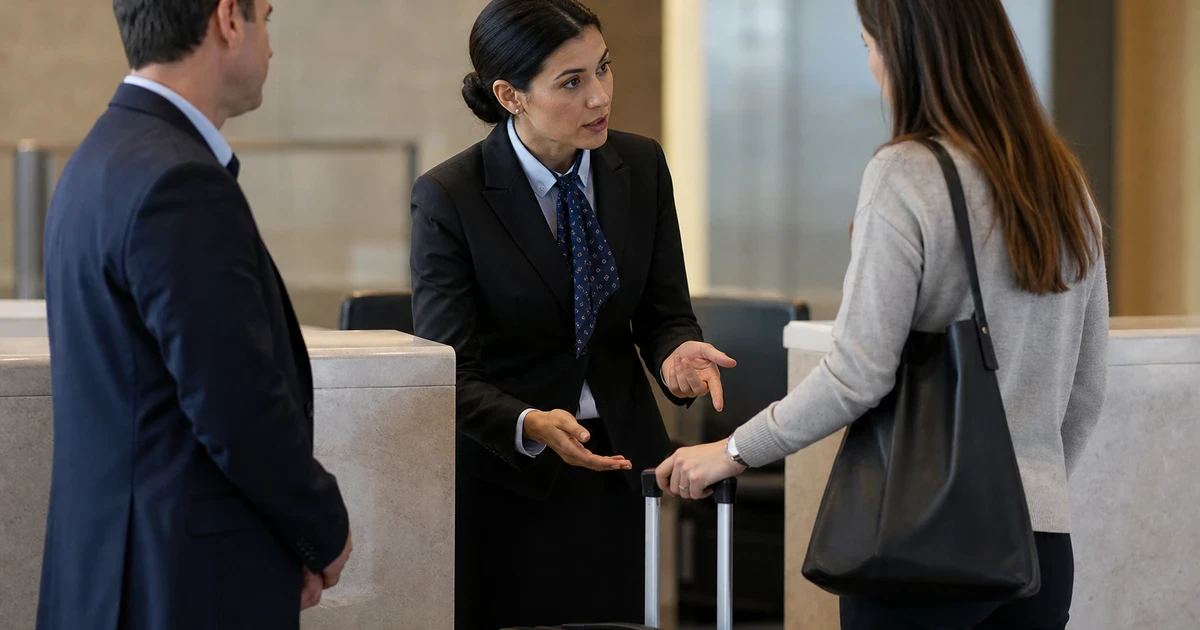
Airline staff need Japanese that works under pressure: short, polite, clear, and easy to repeat when a passenger is worried, late, confused, or upset. General Japanese study is useful, but airport work needs a different kind of practice: check-in questions, delay explanations, gate guidance, baggage help, and calm customer support.
Online Japanese lessons can be especially effective for airline staff because you can focus on the exact situations you face at work. In a one-on-one LINE lesson, you can practise speaking out loud, repeat a difficult phrase, adjust politeness, and receive teacher feedback in real time.
What Airline Staff Should Practise First
Airline Japanese should begin with predictable passenger interactions, not abstract grammar. The goal is not to sound fancy. The goal is to help the passenger understand what is happening and what they should do next.
The most useful first areas are:
- Check-in: passport, ticket, baggage, seat, boarding pass
- Directions: counters, gates, security, lounges, restrooms
- Delays: weather, aircraft preparation, new departure times
- Customer support: lost items, missed connections, special requests
- Polite reassurance: asking the passenger to wait, confirming information, apologising clearly
From a teacher's perspective, learners often know the vocabulary but struggle to produce the sentence quickly. For airline staff, that speed matters. A phrase you can say smoothly is more useful than a long sentence you can only understand on paper.
A cultural note: Japanese customer-facing language often softens direct instructions. Instead of sounding like “Show me your passport,” staff usually use a more polite request pattern. This does not mean every sentence must be extremely formal, but your tone should feel calm, respectful, and service-oriented.
Core Phrases for Airport Role-Play
Use this table as a compact starting point for online Japanese lessons. These phrases are original practice material, not official airline scripts, and they should be adapted to your workplace rules.
Japanese | Romaji | English Meaning |
|---|---|---|
パスポートを拝見してもよろしいですか | Pasupōto o haiken shite mo yoroshii desu ka | May I see your passport? |
搭乗券をお持ちですか | Tōjōken o o-mochi desu ka | Do you have your boarding pass? |
お荷物はいくつですか | O-nimotsu wa ikutsu desu ka | How many bags do you have? |
搭乗口は三十二番です | Tōjōguchi wa sanjūni-ban desu | The boarding gate is number 32. |
この便は遅れています | Kono bin wa okurete imasu | This flight is delayed. |
天候のため遅れています | Tenkō no tame okurete imasu | It is delayed because of the weather. |
少々お待ちください | Shōshō o-machi kudasai | Please wait a moment. |
確認いたします | Kakunin itashimasu | I will check. |
申し訳ございません | Mōshiwake gozaimasen | I sincerely apologize. |
お困りのことはございますか | O-komari no koto wa gozaimasu ka | Is there anything you need help with? |
These phrases are useful because they can be practised in role-play. A teacher can ask follow-up questions, change the passenger’s reaction, and help you choose a more natural level of politeness.
Example Sentences in Context
The best practice is not memorising isolated words. It is saying a complete line in a realistic moment, then adjusting your pronunciation, speed, and politeness.
パスポートを拝見してもよろしいですか。
Pasupōto o haiken shite mo yoroshii desu ka.
May I see your passport?
この便は天候のため遅れています。
Kono bin wa tenkō no tame okurete imasu.
This flight is delayed because of the weather.
搭乗口は三十二番です。
Tōjōguchi wa sanjūni-ban desu.
The boarding gate is number 32.
お困りのことはございますか。
O-komari no koto wa gozaimasu ka.
Is there anything you need help with?
In a lesson, do not only ask, “Is this sentence correct?” Also ask, “Would this sound natural at a check-in counter?” That question pushes your Japanese from textbook knowledge toward service communication.
If you are new to lessons, it may help to read Japanese Lessons for Adult Beginners Online before choosing your first speaking goals.
A 25-Minute LINE Lesson Flow
A focused 25-minute one-on-one LINE lesson for airline staff should be practical and speaking-heavy. You do not need to cover every airport situation in one session. It is better to practise one scenario until you can handle it smoothly.
A sample lesson flow could look like this:
- Warm-up: greet the teacher and explain your airline role in simple Japanese.
- Target situation: choose one scene, such as check-in, delays, or customer support.
- Role-play: the teacher acts as a passenger and changes the details.
- Correction: repeat key lines after feedback on grammar, pronunciation, and politeness.
- Review question: prepare one question you want to ask in your next lesson or trial conversation.
For time-zone planning, write your preferred lesson windows in your own local time and include the time zone clearly. For example, “weekday evenings in Central European Time” or “morning US Pacific Time.” If you want to say this in Japanese, アメリカ時間の夜 (Amerika jikan no yoru, evening US time) is clearer than a vague country-only phrase.
For a first conversation, Japanese Free Trial Lesson Questions to Ask can help you prepare a clear goal before speaking with a teacher.
Common Mistakes
Learners often make airline Japanese harder than it needs to be. From a teacher's perspective, the strongest progress usually comes from making short service phrases automatic before building longer explanations.
Using casual second-person words. Some learners pick up 君 (kimi, you), あんた (anta, you), or anime-style speech from entertainment. These are usually not appropriate for airline customer support. In service situations, it is often better to avoid saying “you” directly and use polite request patterns instead.
Explaining delays with too much grammar. A passenger needs the reason and the next action. Start with “This flight is delayed,” then add the cause. Long explanations can become unclear when the passenger is stressed.
Confusing katakana in names and flight details. Our teachers have seen learners mix up katakana such as ツ (tsu) and シ (shi), or ソ (so), ン (n), and リ (ri). For airline staff, this matters because names, destinations, and airline terms often appear in katakana. A teacher can help you notice the line direction and length in these characters.
Speaking too softly at the end of the sentence. Japanese politeness often sits in the ending: です (desu, is), ます (masu, polite verb ending), and ください (kudasai, please). If the ending disappears, the sentence can sound unfinished or uncertain.
Practising only perfect passengers. Real customer support includes confusion, repetition, and emotion. Role-play should include passengers who ask again, misunderstand the gate number, or need a slower explanation.
FAQ
Are online Japanese lessons useful for airline staff?
Yes, if the lessons are focused on spoken airport situations. Airline staff benefit from role-play around check-in, delays, directions, and customer support. A one-on-one tutor can adjust the passenger scenario, correct your wording, and help you repeat the same phrase until it becomes easier to say naturally.
Do I need advanced Japanese to start airport role-play?
No. Beginners can start with polite check-in questions, numbers, baggage words, and simple directions. Intermediate learners can add delay explanations and problem-solving language. Advanced learners can practise softer customer support language, formal apologies, and smoother transitions between English and Japanese when helping passengers.
What should I prepare before a LINE lesson?
Prepare one realistic work situation, such as “a passenger cannot find the gate” or “a flight is delayed because of weather.” Bring five words you want to use and one sentence you find difficult to say. This helps the teacher focus the lesson on speaking practice instead of general vocabulary review.
Can a teacher help with pronunciation for passenger service?
One-on-one feedback can help you hear whether your sentence is clear, polite, and easy to understand. For airline staff, useful pronunciation targets include long vowels, small っ (chiisai tsu, small pause marker), katakana accuracy, numbers, and sentence endings. The aim is clear customer communication, not theatrical perfection.
Start With One Work Scenario
The fastest way to improve is to choose one scene and practise it until you can handle small changes. For airline staff, a good first topic is check-in because it combines greetings, documents, baggage, seat questions, and polite requests. After that, add delays and customer support role-play.
Kind Japanese offers one-on-one online Japanese lessons over LINE, with standard lessons lasting 25 minutes. If you want to practise airline Japanese with a live teacher, book a Free Trial lesson with Kind Japanese and bring one airport situation you want to handle more confidently.

