
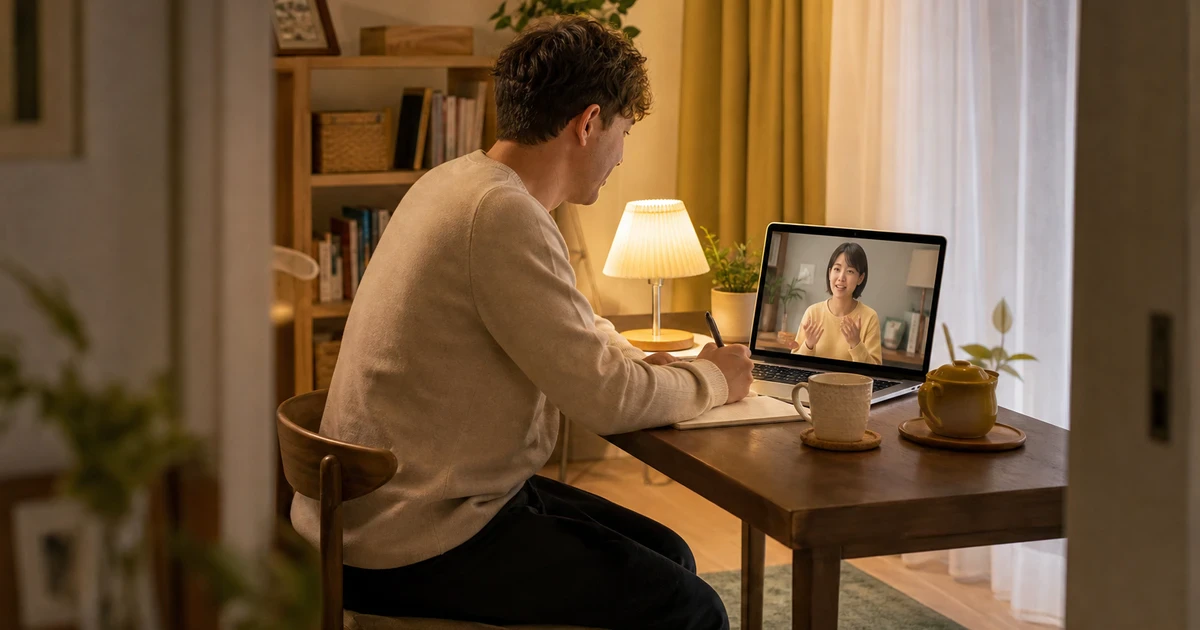
Short one-on-one Japanese lessons work well when you want focused practice instead of a long, unfocused study session. Kind Japanese’s standard one-on-one lessons are 25 minutes, which is long enough to warm up, speak, get correction, and leave with one clear next step.
This format is especially useful if you want live feedback on things that are hard to fix alone, such as pronunciation, pitch accent, or register switching. In our one-on-one lessons, our teachers can listen to your actual sentence in context and correct the part that matters most right away.
If you are still comparing teaching styles, Native Japanese Tutor Online: How to Choose One is a useful starting point. If nerves are part of the problem, One-on-One Japanese Lessons for Shy Beginners may help you decide what kind of support feels manageable.
Why Short Lessons Work
Short lessons work because they force clarity. When time is limited, you cannot hide behind broad goals like “I want to improve my Japanese.” You need one target: a speaking situation, a grammar pattern, a pronunciation point, or a workplace phrase.
That is good for learners who are busy, tired, or easily overwhelmed. A short lesson gives you a clear beginning and end, so the session feels usable instead of heavy.
From a teacher’s perspective, a shorter session also makes it easier to keep feedback precise. Learners often improve faster when the correction is narrow enough to remember and repeat. A live teacher can catch a pronunciation habit, adjust a sentence, and then ask you to say it again immediately.
A small cultural note: in Japanese conversation, a little context usually helps. A short explanation of what you want to do, who you will speak to, or what kind of tone you need makes the lesson more natural and more useful.
What To Prepare First
The best preparation is simple. Before the lesson, decide on one goal, one situation, and one thing you want corrected. That is usually enough for a short, productive session.
Japanese | Romaji | English Meaning |
|---|---|---|
目的 | mokuteki | goal; purpose |
候補 | kōho | option; candidate |
修正 | shūsei | correction; revision |
発音 | hatsuon | pronunciation |
タイムゾーン | taimu zōn | time zone |
Here are four short sentences you can use when planning a lesson:
自分のタイムゾーンで、レッスン時間の候補を二つ送りたいです。 Jibun no taimu zōn de, ressun jikan no kōho o futatsu okuritai desu. I want to send two lesson-time options in my own time zone.
このレッスンでは、発音を直したいです。 Kono ressun de wa, hatsuon o naoshitai desu. In this lesson, I want to fix my pronunciation.
一つの話題を深く練習したいです。 Hitotsu no wadai o fukaku renshū shitai desu. I want to practice one topic deeply.
レッスンのあとにもう一度話します。 Ressun no ato ni mō ichido hanashimasu. I will speak again after the lesson.
If you can say something like this before class, the teacher can design the session around your real need instead of guessing. That is one reason short lessons are effective: they reward preparation.
A Simple 25-Minute Lesson Flow
A strong 25-minute lesson is usually built around one speaking loop: warm up, speak, correct, repeat. That structure keeps the lesson active and prevents the session from becoming a long explanation.
A practical flow looks like this:
- Warm-up and goal check. Say what you want to practice in one sentence. This tells the teacher where to start.
- Target speaking task. Speak about one situation, such as introducing yourself, explaining your schedule, or answering a work-related question.
- Live correction. The teacher focuses on the biggest issue first. In our one-on-one lessons, that may be pronunciation, pitch accent, word choice, or register.
- Repeat with improvement. You say the sentence again with the correction applied. This is where short lessons become effective, because the correction and reuse happen close together.
- Wrap-up and next step. End with one clear thing to review later and one situation to prepare for next time.
This kind of session is useful because it does not try to solve everything at once. A short lesson should feel like a precise training set, not a general lecture.
If your main concern is speaking out loud, the teacher can let you finish first and then give focused feedback. That matters because many learners speak more naturally when they are not interrupted too early. After that, a smaller correction is easier to absorb and repeat.
Common Mistakes
From a teacher’s perspective, learners often make short lessons less effective by bringing too many goals into one session. If you want pronunciation feedback, a conversation warm-up, and grammar explanation all at once, 25 minutes disappears quickly.
Another common mistake is treating the lesson like passive listening. Short lessons work best when you speak enough for the teacher to hear your actual problem. Without real speech, the correction stays abstract.
A third mistake is choosing a topic that is too broad. “Improve my Japanese” is too large for one short lesson. “Practice introducing my job and asking one follow-up question” is much better.
Learners also sometimes worry that pronunciation issues are too small to spend time on. That is usually not true. In live conversation, pronunciation, vowel length, and pitch pattern can change how understandable a sentence feels. Our teachers can address those issues directly because they are easiest to hear in real time.
Finally, some learners do not say what kind of correction they want. If you want gentle correction, say so. If you want direct correction, say so. A short lesson becomes much more useful when the feedback style matches your goal.
Self-Check
A short lesson is a good fit if you can answer these questions before class.
- Can I name one goal for this lesson?
- Can I describe one real situation I want to practice?
- Am I ready to speak enough for the teacher to hear my mistakes?
- Do I know whether I want pronunciation, grammar, or politeness feedback?
If the answer to most of these is yes, a short one-on-one lesson is probably a strong choice. If not, spend a few minutes narrowing your goal before you book.
It also helps to think about your own time zone early. Instead of waiting until the last minute, send two possible lesson windows in your own time zone. That makes it easier to find a slot that fits your routine and keeps the lesson realistic for your schedule.
FAQ
Are short Japanese lessons enough for progress?
Yes, if the lesson has a clear target. Short lessons are effective when you use them for one speaking task, one correction theme, or one review point. Progress comes from repeated focused practice, not from trying to cover every skill in one session.
What should I prepare before a short one-on-one lesson?
Prepare one goal, one situation, and one sentence or topic you want to practice. If possible, also decide what kind of feedback you want most, such as pronunciation, grammar, or polite language. That gives the teacher a clear starting point and saves time.
Why choose one-on-one lessons instead of self-study alone?
Self-study is useful for review, but live one-on-one lessons show you what happens when you actually speak. A teacher can catch problems in pronunciation, pitch accent, and register that are easy to miss when you study alone. That makes short lessons especially efficient.
How do I know if 25 minutes is the right length?
25 minutes is a good fit if you want focused practice without a long time commitment. It is usually enough for a warm-up, one main task, correction, and a final repeat. If you need broad, unfocused study, the format may feel too tight.
If you want to see whether this style fits your goals, book a Free Trial lesson via LINE.
Keep Learning
If short practice feels right for you, you may also enjoy this guide to private Japanese lessons for short, focusful study. To make your online practice smoother, read about learning Japanese well over LINE and how an online Japanese tutor can give one-on-one feedback.
This guide is part of Kind Japanese's beginner curriculum for online Japanese lessons.

