
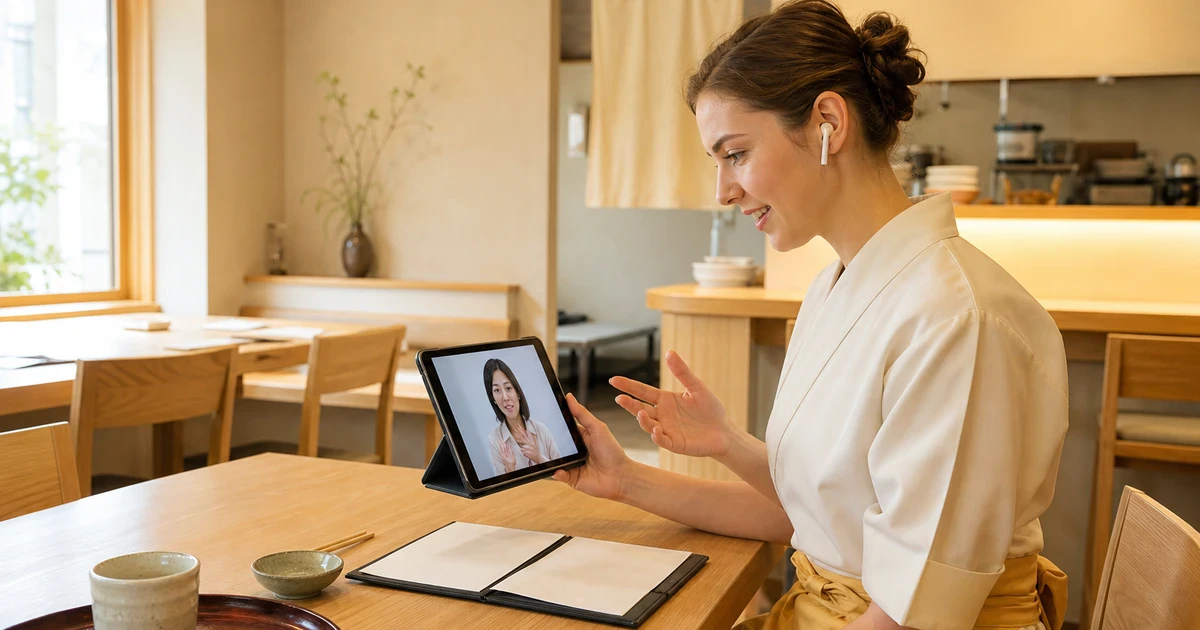
For online japanese lessons for restaurant staff serving japanese guests, the best starting point is not broad grammar. It is the small set of phrases that help you greet, guide, confirm, and recover smoothly while a guest is standing in front of you.
The most useful training is practical and repeatable. You want language that works at the counter, at the table, and during a quick apology. That is where one-on-one online lessons over LINE are especially helpful: the practice can stay focused on the exact lines you need, with speaking practice that matches real service situations.
What Restaurant Staff Need First
The first goal is to sound clear, polite, and fast enough for service. In a restaurant, the most useful language usually falls into three groups.
- Greeting and welcoming.
- Confirming details such as size, quantity, or location.
- Handling problems calmly with apology and a short solution.
A useful cultural note: いらっしゃいませ (irasshaimase, welcome) is a set greeting staff say when customers enter, so the guest usually does not need to answer directly. That is normal in Japanese service language.
From a teacher's perspective, learners often do best when they practise the whole service line instead of isolated words. A short sentence that is slightly less perfect is often better than a long sentence that sounds hesitant.
If your role also includes staff handovers or short internal messages, Hou Ren Sou for Japanese Workplace Communication and Business Japanese Meeting Agenda Phrases are useful complements for the back-of-house side of the job.
Core Phrases for Guest Service
These phrases cover the most common moments in a restaurant interaction. They are a strong base for online japanese lessons for restaurant staff serving japanese guests.
Japanese | Romaji | English Meaning |
|---|---|---|
いらっしゃいませ | irasshaimase | Welcome; greeting to entering customers |
こちらへどうぞ | kochira e dōzo | This way, please |
ご案内します | go-annai shimasu | I will guide you |
少々お待ちください | shōshō omachi kudasai | Please wait a moment |
こちらでよろしいですか | kochira de yoroshii desu ka | Is this okay? |
エルサイズでよろしいですか | eru saizu de yoroshii desu ka | Is L size okay? |
申し訳ありません | mōshiwake arimasen | I’m very sorry |
売り切れです | uri-kire desu | It is sold out |
お手伝いできますか | otetsudai dekimasu ka | Can I help you? |
Here are a few simple example sentences in context.
いらっしゃいませ。こちらへどうぞ。 Irasshaimase. Kochira e dōzo. Welcome. This way, please.
エルサイズでよろしいですか。 Eru saizu de yoroshii desu ka. Is L size okay?
少々お待ちください。 Shōshō omachi kudasai. Please wait a moment.
申し訳ありません。売り切れです。 Mōshiwake arimasen. Uri-kire desu. I’m sorry. It is sold out.
The letter L in Japanese is read エル (eru, the letter L), so saying エルサイズ (eru saizu, L size) is more natural than trying to spell it as English letters.
Common Mistakes
From a teacher's perspective, learners often struggle less with vocabulary than with tone, script, and timing. That is why short, direct feedback matters.
- Learners often confuse ツ (tsu, katakana “tsu”) and シ (shi, katakana “shi”), or ソ (so, katakana “so”), ン (n, katakana “n”), and リ (ri, katakana “ri”). A teacher can slow the word down and compare the shape and stroke direction.
- Learners sometimes pick 君 (kimi, you; too casual/direct for guests) or そなた (sonata, archaic/literary “you”) because they have seen them in anime or historical stories. Those are not natural choices for restaurant service.
- Learners may translate too literally and produce a sentence that is grammatical but too stiff or too weak for the moment. In service Japanese, the full phrase matters more than a single keyword.
- Learners sometimes stop after the first word they know. A better habit is to say the whole line once, then improve it after feedback.
A teacher can also use ひらがな (hiragana, syllabary) and カタカナ (katakana, syllabary) cards when a learner keeps mixing similar sounds and shapes. In live speaking practice, that kind of visual correction is often quicker than explaining the rule in English.
How a 25-Minute LINE Lesson Can Help
A focused LINE lesson flow works well when the goal is restaurant speaking, not textbook review. Kind Japanese’s standard one-on-one lessons are 25 minutes, which is enough time to practise one situation well.
A practical 25-minute flow for restaurant staff can look like this:
- Warm-up: say what kind of guest interaction you want to practise, such as greeting, seating, ordering, or apology.
- Target speaking task: role-play one short service scene using a menu item, a size confirmation, or a sold-out notice.
- Correction: speak the line first, then get feedback after the full attempt so the flow stays natural.
- Review note: write your own short question list or correction note to reuse later.
This style is useful because restaurant language is situational. You do not need twenty phrases at once. You need a few accurate lines that you can say without freezing.
Because lessons happen online over LINE, you can keep the conversation in the same app used for the lesson, and you can ask about lesson times that may fit around your shifts. If you want to focus on the exact words a guest will hear, bring a photo of your menu, a mock order, or a sample customer message.
FAQ
What should restaurant staff practise first?
Start with the phrases you will actually say out loud: greeting, seating, confirmation, and apology. These are the lines that keep service moving. Once those feel stable, add menu-related words, size confirmation, and a short recovery phrase for when something is unavailable.
Can beginners use online Japanese lessons for this topic?
Yes. Beginners often benefit the most because restaurant Japanese uses repeated patterns. A one-on-one lesson can keep the practice narrow: one greeting, one confirmation, one response. That makes the speaking practice manageable even if your vocabulary is still small.
Is it better to memorise phrases or practise them in a role-play?
Role-play is usually better. Memorising a phrase helps, but restaurant work is fast, and the line has to come out at the right time. Practising the phrase in a short situation helps you remember the tone, the timing, and the follow-up sentence.
How should I prepare for a lesson over LINE?
Bring one real situation and one question. For example, you can choose a greeting, a size confirmation, or a sold-out apology. If you have a menu screen, order slip, or customer message, that gives the teacher a concrete scene to work with.
If you want one-on-one speaking practice over LINE, try a Free Trial.

