
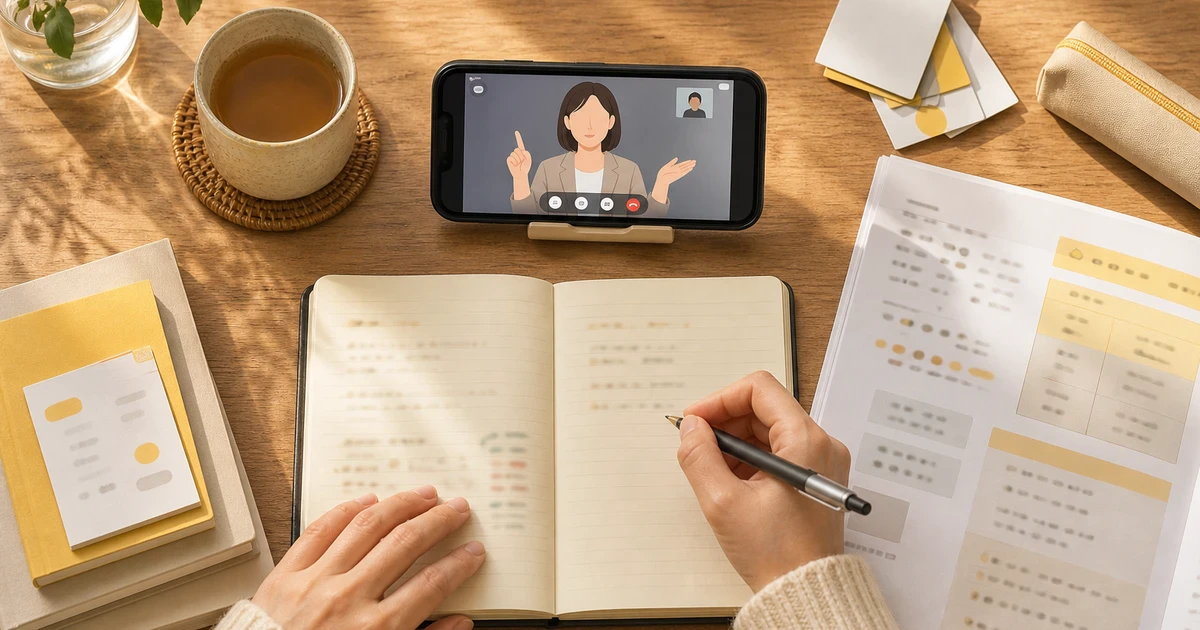
Japanese tutor support for keigo basics is most useful when you need more than a rule list. You need to know which polite forms fit the situation, which safe alternatives sound natural on LINE, and how to fix a sentence before it becomes awkward.
From a teacher's perspective, learners usually do not struggle because they know nothing about keigo. They struggle because they know a few forms, but cannot yet choose the right level of politeness for the person, the medium, and the purpose. That is exactly where one-on-one lesson feedback helps.
Kind Japanese offers online one-on-one lessons over LINE, and the standard lesson length is 25 minutes. That format is ideal for short, focused practice on one request, one reply, or one message thread at a time.
What Keigo Basics Really Mean
Keigo basics are not just “being polite.” They are about choosing a form that matches the relationship and the action.
A tutor usually starts with three questions:
- Who is speaking?
- Who is receiving the message?
- Who is doing the action?
That last question matters a lot. In keigo, the action owner changes the grammar choice. A sentence can be polite but still sound off if the wrong person is doing the main action.
A useful way to think about keigo is this:
- Polite forms make the sentence softer and safer.
- Respectful forms raise the other person's position.
- Humble forms lower your own position when appropriate.
- Safe alternatives keep the sentence natural, especially in chat or email.
A Japanese tutor for keigo basics does not try to teach every possible honorific at once. The goal is to help you say one clear thing in a way that fits real life.
Japanese | Romaji | English Meaning |
|---|---|---|
失礼します | shitsurei shimasu | Excuse me; pardon me |
お願いします | onegai shimasu | Please; I ask for your help |
ご確認ください | go kakunin kudasai | Please check it |
ご確認いただけますか | go kakunin itadakemasu ka | Could you please check it? |
ご確認のほど、よろしくお願いいたします | go kakunin no hodo, yoroshiku onegai itashimasu | I would appreciate your confirmation |
資料を送らせていただきます | shiryō o okurasete itadakimasu | I will send the materials |
承知しました | shōchi shimashita | Understood |
A small cultural note helps here: in Japanese work communication, the same request can feel normal in email but too heavy or too soft in chat. The medium matters almost as much as the grammar.
How a Tutor Gives Feedback
Teacher feedback is most valuable when it points to the exact problem: too direct, too stiff, or unclear about who does what.
A tutor can help by asking diagnostic questions like these:
- Who is doing the action?
- What is the object, and which particle marks it?
- Why did you choose the te-form here?
- What did the sentence end with: a request, a report, or a soft suggestion?
- Does this sound natural in LINE, or does it sound like a written announcement?
Those questions are practical because they move you from memorising to speaking.
Here are four correction patterns a tutor might use in a one-on-one lesson.
Speaker: learner. Listener: colleague or client. Action owner: the listener. Register: polite request, not a command. Natural LINE-safe alternative: a short, direct request that still sounds respectful.
この資料を確認してください。 Kono shiryō o kakunin shite kudasai. Please check this document.
Speaker: learner. Listener: business contact. Action owner: the listener. Register: very formal written request, which may feel stiff in LINE. Natural LINE-safe alternative: a shorter request with clearer everyday tone.
ご確認のほど、よろしくお願いいたします。 Go kakunin no hodo, yoroshiku onegai itashimasu. I would appreciate your confirmation.
Speaker: learner. Listener: teacher, colleague, or support contact. Action owner: the listener. Register: polite request pattern. Natural LINE-safe alternative: the same meaning with a cleaner, easier sentence.
この資料をご確認いただけますか。 Kono shiryō o go kakunin itadakemasu ka. Could you please check this document?
Speaker: learner. Listener: client or supervisor. Action owner: the speaker. Register: humble action report. Natural LINE-safe alternative: a polite update that says what you will do.
資料を送らせていただきます。 Shiryō o okurasete itadakimasu. I will send the materials.
A tutor's job is not only to correct the sentence. It is to explain why one version sounds too direct, why another version sounds too stiff, and why a third version is safer for real communication.
Common Mistakes
Learners often make the same keigo mistakes because they are trying to be polite without checking the full sentence shape.
- Using one polite phrase for every situation. Politeness level is not one-size-fits-all.
- Overusing very formal wording in chat. A LINE message often works better when it is shorter and clearer.
- Mixing up who owns the action. This is where requests, offers, and reports start to sound strange.
- Forgetting the sentence ending. In Japanese, the last phrase can change the whole feel of the message.
- Translating directly from English. Literal politeness often becomes unnatural politeness.
From a teacher's perspective, the fastest improvement comes from comparing two or three versions of the same idea. You see the difference between a command, a respectful request, and a natural LINE-ready line much more clearly that way.
If your keigo also appears in meetings, Business Japanese Meeting Agenda Phrases can help you connect requests, updates, and transitions in a smoother way. For shorter written exchanges, Business Japanese Chat Messages for Slack at Work is useful because the tone in chat often needs to be polite without sounding heavy.
What a 25-Minute One-on-One Lesson Can Cover
A focused 25-minute one-on-one lesson works well for keigo basics because you can stay on one real situation instead of jumping between too many forms.
A practical lesson flow looks like this:
- Warm-up: describe the situation in simple English or Japanese.
- Target speaking task: say the request, reply, or update you actually need.
- Correction: the teacher gives feedback on politeness level, particles, te-forms, and sentence endings.
- Review note: you write one safe alternative and one question you still have.
That structure is useful whether you are preparing a work message, a message to a teacher, or a short follow-up after a meeting.
If you want to book over LINE, send two or three possible lesson windows in your own time zone. State your time zone clearly, then add whether you need help with business email, chat, or speaking. That makes it easier to match the lesson to your goal without wasting time on setup.
For example, a learner in Europe or the United States can simply give options in local time and mention the situation. The important part is clarity, not perfect wording. A tutor can help you polish the phrasing during the lesson.
A useful keigo goal for one lesson is very specific:
- Turn one too-direct sentence into a safe alternative.
- Turn one too-stiff sentence into a natural LINE message.
- Turn one vague sentence into a clear request or reply.
That is small enough to finish in one lesson, but concrete enough to improve your real communication immediately.
FAQ
Do I need to learn all keigo before speaking?
No. Start with the forms you actually need for your daily life or work. A tutor can help you choose a small set of safe alternatives first, then expand gradually. That is usually easier than trying to memorise every possible honorific form at once.
Is keigo only for business Japanese?
No. Keigo also appears when you speak to teachers, service staff, new contacts, and people you want to treat carefully. Business settings need it often, but everyday communication uses it too. The key is to match the level of politeness to the relationship.
What should I bring to a lesson?
Bring one real sentence, message, or situation. A tutor can work with a LINE draft, a work request, or a short reply you need to send. The more specific the context, the better the teacher feedback will be, because the sentence can be corrected for actual use.
Can a free trial help with keigo basics?
Yes. A free trial is a good place to test whether the lesson style fits your goal. Bring one polite request, one reply, and one situation where you are unsure about tone. That gives the teacher enough material to show you a clear path forward.
If you want a Japanese tutor who can help you turn keigo basics into practical speaking, book a Free Trial lesson over LINE and bring one sentence you want to make safer, clearer, or more natural.

