
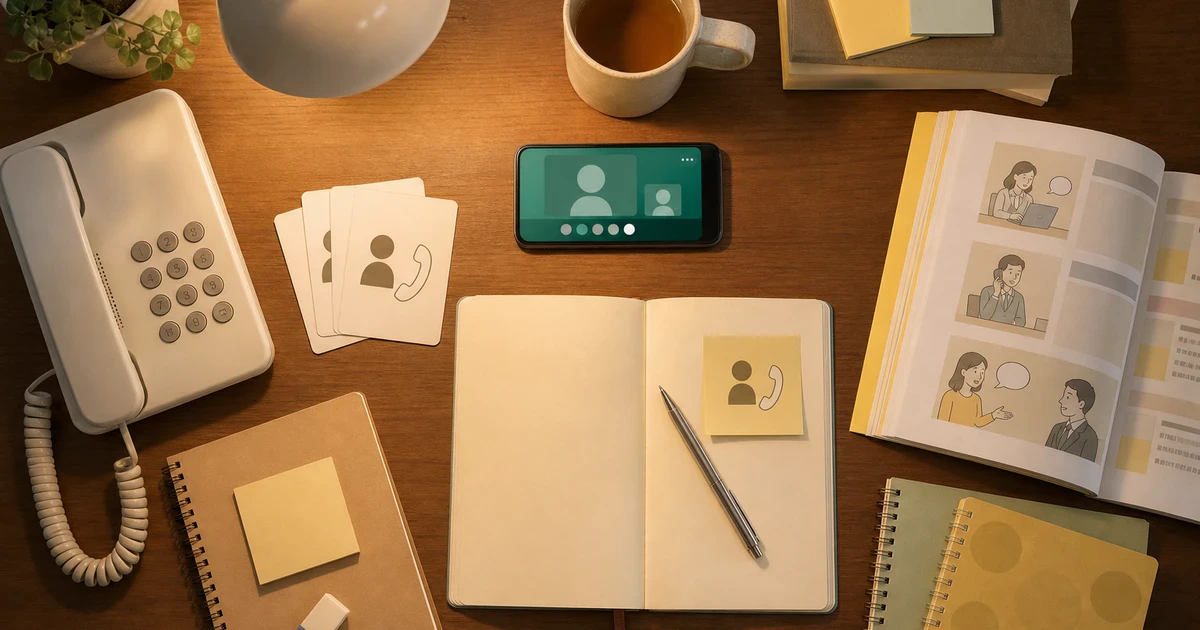
A japanese tutor for workplace phone call practice is most useful when you already know some Japanese but freeze the moment a client calls, a department name is unclear, or a callback number is spoken too quickly. The goal is not to sound fancy. The goal is to answer cleanly, confirm the details, transfer the caller, and close the call without panic.
Kind Japanese offers one-on-one online lessons over LINE, so you can practise the exact call path you need with live correction. If you want the phrase side first, see Japanese Phone Call Phrases for Work: Business Scripts. If your main issue is politeness level, pair this with Business Japanese Keigo Practice for Work.
What a Tutor Should Fix First
A good tutor should focus on the one phone-call pattern you actually use at work. If you answer calls from clients and often need to transfer them to accounting, that is the script to practise first.
The most useful correction usually comes from four points:
- Greeting clearly
- Confirming names, departments, and numbers
- Putting the caller on hold politely
- Transferring the call or taking a message
From a teacher's perspective, learners often know polite formulas but cannot hear enough detail the first time. That is why name and number confirmation drills matter more than memorising long phrases.
A small cultural note helps here: in many Japanese workplaces, callers expect a short, efficient response. A calm transfer is usually better than a long explanation.
What to Practise in a 25-Minute LINE Lesson
A 25-minute lesson is enough if the target is narrow. In Kind Japanese one-on-one lessons, the best use of time is a single workplace call pattern, not a general business conversation.
A practical lesson flow looks like this:
- Warm-up: tell the teacher your role and the call type you handle most often
- Target speaking task: role-play one real call, such as a client asking for accounting
- Correction: fix wording, politeness, pronunciation, and timing
- Repeat: say the same lines again more naturally
- LINE follow-up: keep a short note of the questions you still want to ask next time
That loop works better than passively reviewing phrases. You say the line once, get corrected, say it again, then try it at a more natural speed.
If you are proposing a lesson time, send your local time window and the work situation you need to practise. A useful message is simple: “I can meet in my local evening, and I need to practise client calls that often transfer to accounting.” That gives the teacher enough context to prepare a focused lesson.
Core Phrases to Drill First
Start with short lines that solve real call breakdowns. The phrases below cover greetings, repetition, holding, and transfer. If you are also working on more formal register, the keigo article above will help you connect these lines to broader workplace speech.
Japanese | Romaji | Meaning |
|---|---|---|
お電話ありがとうございます | O-denwa arigatō gozaimasu | Thank you for calling |
恐れ入りますが | Osoreirimasu ga | Excuse me, but... |
少々お待ちください | Shōshō omachi kudasai | Please hold for a moment |
おつなぎします | O-tsunagi shimasu | I will transfer you |
折り返し | Orikaeshi | Return call / callback |
担当部署 | Tantō busho | Responsible department |
Use them in context like this:
お電話ありがとうございます。 O-denwa arigatō gozaimasu. Thank you for calling.
会社名をもう一度お願いいたします。 Kaisha-mei o mō ichido onegai itashimasu. May I have the company name again?
少々お待ちください。 Shōshō omachi kudasai. Please hold for a moment.
経理におつなぎします。 Keiri ni otsunagi shimasu. I will transfer you to accounting.
仕事の電話で少し緊張します。 Shigoto no denwa de sukoshi kinchō shimasu. I feel a little nervous about work calls.
A Better Way to Rehearse One Call
The best drill is one realistic call path, not dozens of random phrases. A teacher can turn one workplace problem into a short speak-correct-repeat loop.
Try this sequence:
- The caller asks for a person or department.
- You miss the name or department and ask for it again.
- You confirm the callback number.
- You place the caller on hold.
- You transfer the call or explain that you will pass the message on.
A strong tutor will also test the weak points inside that flow, such as unclear department names, fast numbers, and sudden changes in politeness level.
A simple before-and-after correction is often enough to unlock progress. For example, a blunt hold request can be replaced with a more polite hold line, and a vague transfer line can be tightened into a clear workplace sentence. The point is not memorising more words. The point is making the same call sound safer and more natural.
Common Mistakes
From a teacher's perspective, learners often make the same few mistakes in workplace phone calls.
- They memorise polite phrases but cannot ask someone to repeat a name naturally.
- They say too much before placing the caller on hold.
- They forget to repeat back a number or department name for confirmation.
- They switch into very formal language halfway through a simple internal transfer.
The fix is to keep one script for one job. If your daily task is transferring clients to accounting, practise that one path until it feels automatic. Then add a second path only after the first one is stable.
FAQ
Do I need advanced Japanese before booking a lesson?
No. You can start with a simple call pattern even if your Japanese is still basic. A tutor can help you build one usable script for greeting, confirmation, holding, and transfer. That is often more practical than waiting until you feel “ready.”
What should I prepare before a workplace phone-call lesson?
Prepare one real situation you want to handle, such as transferring a client to accounting or asking for a callback number again. Also bring the exact words you already use, even if they feel awkward. A tutor can correct the wording and make the script easier to say.
Is this useful if I already know business Japanese?
Yes. Knowing business Japanese in reading or email form is not the same as answering a live phone call. Phone work adds speed, interruptions, missing names, and number confirmation. A one-on-one lesson helps you practise those pressure points, not just polite vocabulary.
Can I practise the same script again after correction?
Yes, and you should. The most effective method is repeat correction on one short script until it sounds natural. That is why one-on-one speaking practice over LINE is helpful: you can fix the exact line you need, then say it again with better timing and confidence.
If you want a japanese tutor for workplace phone call practice, bring your real call script and practise the exact transfer line you use at work. Book a Free Trial lesson on LINE.
Keep Learning
Build your confidence with Japanese for customer calls, then practise smoother workplace conversations with a Japanese tutor for workplace small talk. If lessons need to fit around your job, explore online Japanese tutoring for busy professionals.
This guide is part of Kind Japanese's beginner curriculum for online Japanese lessons.

