
When founders entering Japan need to speak Japanese, the hard part is rarely a single grammar point. The real challenge is saying the right business message clearly, quickly, and in a way that sounds natural in a pitch, a networking introduction, or a partner meeting.
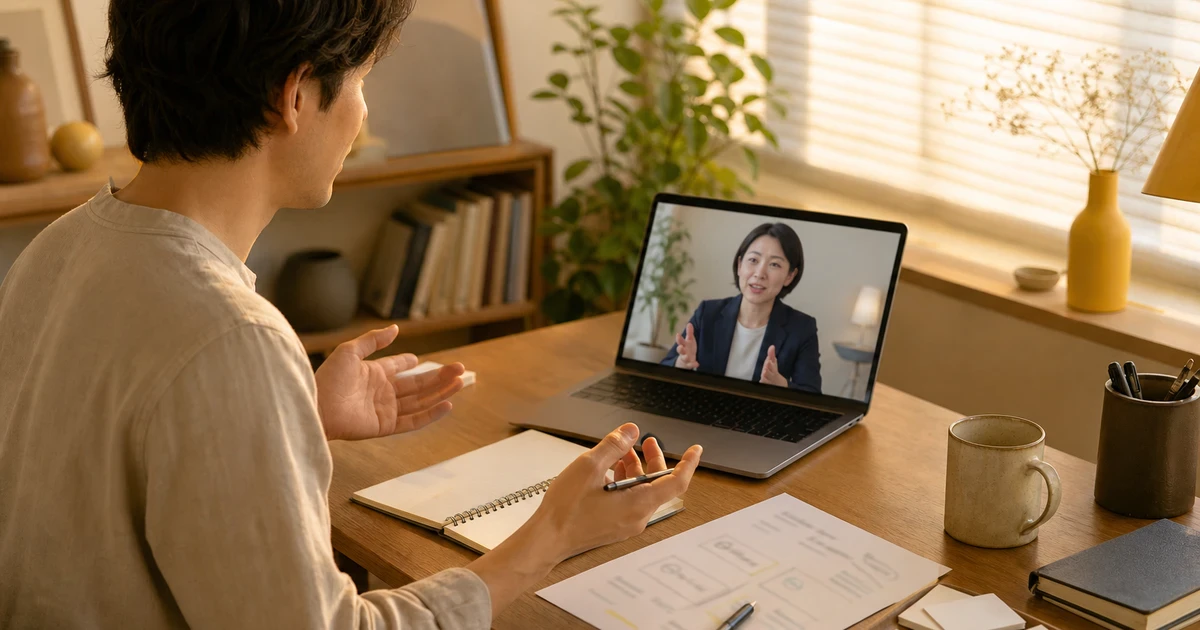
That is where online Japanese lessons become practical. A one-on-one tutor can hear the exact sentence you plan to use, then give teacher feedback on wording, sound, and timing before the real conversation happens.
Why Spoken Japanese Matters for Founders
Spoken Japanese matters because business conversations move fast. A deck can be polished later, but a live introduction needs to work in the moment.
From a teacher's perspective, learners often improve most when they stop trying to translate every English idea and instead practice one short Japanese message at a time. For founders, that usually means three core scenes:
- a brief self-introduction
- a short company or product pitch
- a clear next-step question
There is also a useful cultural note here. In Japan, a short greeting and a little context before the business point often make the conversation smoother. That does not mean speaking indirectly forever. It means opening the door politely before moving into the main point.
Kind Japanese fits this kind of practice well because lessons happen over LINE, and standard one-on-one lessons are 25 minutes. That is long enough for one focused speaking scene, but short enough to keep the pressure manageable.
What to Practice in a 25-Minute LINE Lesson
A strong LINE lesson for founders should be small, specific, and reusable. One long class about “business Japanese” is usually less useful than one tight conversation about the meeting you actually need next.
A practical 25-minute flow looks like this:
- Warm-up: You explain your current situation in simple English or Japanese and name the one speaking scene you want to practice.
- Target speaking task: You deliver one pitch, networking introduction, or partner-meeting opening.
- Teacher feedback: The teacher points out wording, rhythm, sentence endings, and any sound issues that change clarity.
- Review note: You write down your own corrected line or a short question list so you can reuse it in the next conversation.
Before the lesson, it helps to send two possible windows in your own time zone and say what you want to rehearse. For example, say whether the session should focus on pitches, networking, or partner meetings. That makes the lesson easier to shape around your real goal.
Because the lesson happens on LINE, you can also bring a slide screenshot, a meeting agenda, or a business card draft. You are not asking for general study advice. You are giving the teacher something concrete to react to.
Phrases for Pitches, Networking, and Partner Meetings
A founder does not need dozens of fixed phrases. A small set of reusable lines is more useful, especially if you can change the wording depending on whether you are presenting, introducing yourself, or closing a meeting.
If you want more meeting structure, Business Japanese Meeting Agenda Phrases is a useful companion. For question-and-answer moments after a pitch, Business Japanese Presentation Q&A Phrases helps you prepare short replies.
Japanese | Romaji | English Meaning |
|---|---|---|
はじめまして | hajimemashite | Nice to meet you |
私は共同創業者です | watashi wa kyōdō sōgyōsha desu | I am a co-founder |
私たちは新しいサービスを提供しています | watashitachi wa atarashii sābisu o teikyō shite imasu | We provide a new service |
事業内容を一分でご説明します | jigyō naiyō o ippun de go-setsumei shimasu | I will explain the business in one minute |
業務提携についてご相談したいです | gyōmu teikei ni tsuite gosōdan shitai desu | I would like to discuss a business partnership |
名刺交換のあとで少し質問してもよろしいですか | meishi kōkan no ato de sukoshi shitsumon shite mo yoroshii desu ka | May I ask a few questions after exchanging business cards? |
次の打ち合わせの進め方を確認したいです | tsugi no uchiawase no susume kata o kakunin shitai desu | I want to confirm the next meeting flow |
本日はありがとうございました | honjitsu wa arigatō gozaimashita | Thank you for today |
A useful coaching move is to turn a long English pitch into a shorter Japanese meeting sentence. Instead of trying to reproduce every detail, start with who you are, what you do, and what you want next. That is usually easier to deliver cleanly in real time.
Example lines
今日は、短く事業内容を説明したいです。
Kyō wa, mijikaku jigyō naiyō o setsumei shitai desu.
Today, I want to explain the business briefly.
はじめまして、私は共同創業者です。
Hajimemashite, watashi wa kyōdō sōgyōsha desu.
Nice to meet you, I am a co-founder.
名刺交換のあとで少し質問してもよろしいですか。
Meishi kōkan no ato de sukoshi shitsumon shite mo yoroshii desu ka.
May I ask a few questions after exchanging business cards?
では、次の打ち合わせの進め方を確認したいです。
Dewa, tsugi no uchiawase no susume kata o kakunin shitai desu.
Then, I would like to confirm the next meeting flow.
Role-Play That Fits a Founder Meeting
Role-play is the fastest way to make business Japanese feel usable instead of theoretical. For founders entering Japan, the best role-play is not a generic textbook conversation. It is a version of the exact meeting you expect to have.
A practical sequence is:
- You open with a greeting and a short self-introduction.
- The teacher plays a potential partner and asks one unexpected question.
- You answer once at normal speed without stopping yourself too early.
- The teacher gives feedback on wording, sound, and sentence ending.
- You repeat the same line once more with the correction in place.
That speak-correct-repeat loop is especially useful for pitches, networking, and partner meetings. It helps you hear the difference between “technically correct” and “easy to say under pressure.”
A founder-specific example is a partner-meeting opening. You can practice moving from a long English-style explanation to a shorter Japanese meeting sentence. For instance, the goal is not to say everything on your slide. The goal is to give a concise opening, then invite the other side into the conversation.
In a 25-minute LINE lesson, a teacher can also focus on the exact sentence endings that matter in business. A line that sounds fine on paper may feel too abrupt, too soft, or too long when spoken aloud. Short correction plus immediate repetition is usually the fastest path.
Common Mistakes
From a teacher's perspective, founders often make the same few mistakes when they prepare for Japanese business conversations.
- They try to say too much in one breath. A shorter pitch is usually easier to understand and easier to remember.
- They stop themselves halfway through a sentence. It is often better to finish the full attempt, then get feedback, then repeat the corrected version.
- They sound too casual for the setting. Anime-style pronouns or playful expressions can sound out of place in a partner meeting.
- They mix up sound pairs that matter for clarity, such as ツ (tsu, katakana "tsu") and シ (shi, katakana "shi"), or ソ (so, katakana "so"), ン (n, syllabic consonant), and リ (ri, katakana "ri").
- They also confuse ぬ (nu, hiragana "nu") and め (me, hiragana "me"), or ね (ne, hiragana "ne") and れ (re, hiragana "re").
- They hesitate on irregular number readings when they need to state quantities, dates, or timing.
A teacher can help by listening for long vowels, the timing of small っ, the difference between つ, す, and し, and whether the sentence ending sounds too sharp or too flat. That kind of feedback is more useful after a full attempt than during it.
If you want a simple rule, use this: speak once, correct once, repeat once. For founder conversations, that rhythm is often more useful than memorising a large list of phrases.
FAQ
Do I need advanced Japanese before trying online Japanese lessons?
No. A one-on-one tutor can start from one small scene, such as a self-introduction, a pitch opening, or a partner-meeting closing. The goal is not to cover everything at once. The goal is to make one real business conversation clearer and easier to say.
What should I bring to a LINE lesson?
Bring one goal, one speaking scene, and one piece of real material if you have it. A slide screenshot, a meeting agenda, or a business card draft is enough. Concrete material gives the teacher something specific to respond to, which makes the lesson more practical.
How does a free trial help founders entering Japan?
A free trial lets you test whether the lesson format matches your needs. You can bring one pitch, networking introduction, or partner-meeting question and see how the teacher feedback feels in real time. That is a good way to check fit before continuing.
Is a 25-minute lesson enough for business Japanese?
Yes, if the lesson stays focused. One 25-minute session is enough for one pitch, one networking introduction, or one follow-up question after a meeting. The value comes from a clear attempt, targeted correction, and one improved repeat rather than from covering many topics.
If you want to test a focused trial conversation over LINE, Book a Free Trial lesson with Kind Japanese.

