
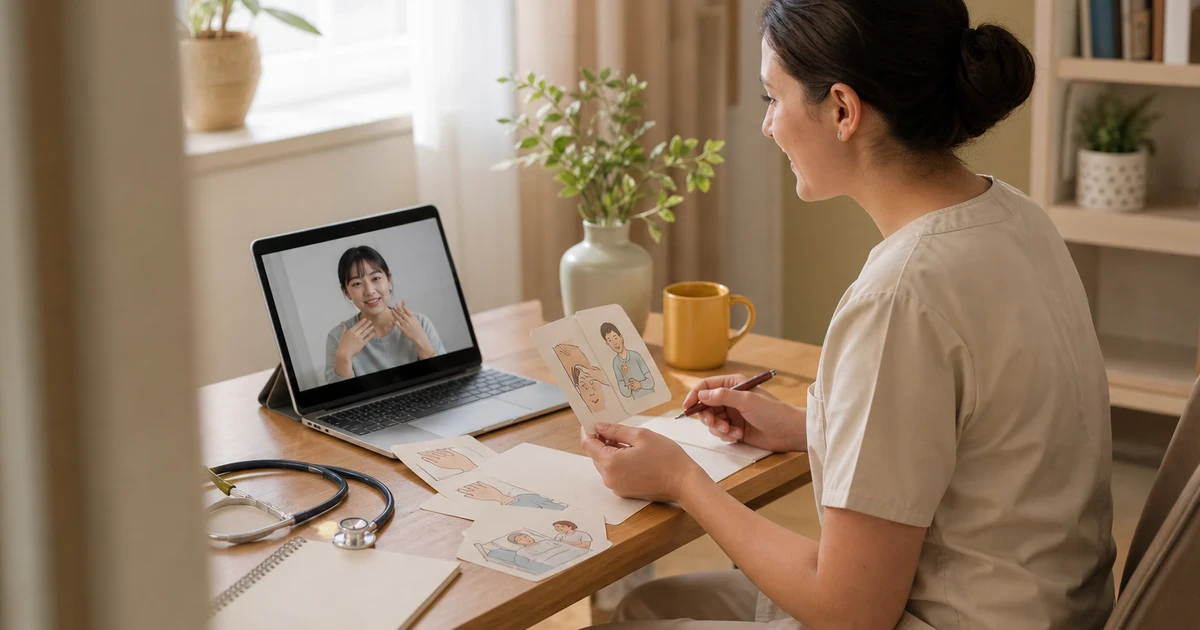
If you are looking for online Japanese lessons for nurses working with Japanese patients, the most useful lessons are the ones that focus on live speech, not just memorising vocabulary. A one-on-one Japanese tutor can help you practise symptom questions, reassurance, and handoff phrases in the polite, clear register you actually need on shift.
The tone is close to business Japanese, but the goal is different: you need speed, clarity, and calm communication. That is why a LINE lesson works well. You can practise a real patient scenario, get teacher feedback right away, and repeat the phrase until it sounds natural enough to use.
Why Live Practice Matters
Self-study can teach you words, but it cannot tell you whether your question sounds too blunt, too vague, or too formal for the moment.
Nurses working with Japanese patients usually need to move quickly between three tasks:
- asking symptom questions
- offering reassurance
- passing information to the next staff member
That is exactly where role-play practice helps. You are not trying to become poetic. You are trying to sound clear, calm, and accurate under pressure.
From a teacher’s perspective, learners often know the grammar but freeze when the patient gives an unexpected answer. In one-on-one lessons, a teacher can let you finish the whole sentence first, then give light correction and revisit the weak point once more. If similar sounds keep getting mixed up, simple kana review can help with pairs that learners often confuse, such as tsu/shi or so/n/ri.
A short cultural note matters here: in Japanese care settings, a brief calm reassurance often feels better than a long explanation. A short phrase can lower anxiety without sounding rushed.
If you also want broader workplace wording, Business Japanese Meeting Agenda Phrases and Business Japanese Chat Messages for Slack at Work are useful next reads for coordination beyond bedside conversation.
Core Phrases to Start With
These phrases cover the most useful first steps for nurses working with Japanese patients. Learn the question, the reassurance line, and the handoff phrase together so you can move through a conversation without stopping to translate every word.
Japanese | Romaji | English Meaning |
|---|---|---|
痛みはどのくらいですか | Itami wa dono kurai desu ka | How strong is the pain? |
いつからですか | Itsu kara desu ka | Since when? / When did it start? |
息苦しいですか | Ikigurushii desu ka | Are you having trouble breathing? |
大丈夫ですよ | Daijōbu desu yo | It’s okay / You’re okay |
少しお待ちください | Sukoshi omachi kudasai | Please wait a moment |
これから確認します | Kore kara kakunin shimasu | I will check now |
次の担当に引き継ぎます | Tsugi no tantō ni hikitsugimasu | I will hand this over to the next staff member/person in charge |
Use the questions for symptom questions, the reassurance line when a patient looks anxious, and the handoff phrase when responsibility moves to someone else.
A teacher can also help you choose the right level of politeness. In hospital language, “polite enough” is not the same as “too long.” A short phrase that is easy to hear can be better than a beautifully formal sentence that nobody catches in time.
What a 25-Minute LINE Lesson Looks Like
Kind’s standard one-on-one lessons are 25 minutes, which is enough time for one focused nursing scenario.
A practical flow looks like this:
- Warm-up: say what kind of patient or shift situation you want to practise
- Target speaking task: ask one symptom question, give one reassurance line, or hand off one update
- Role-play practice: speak once naturally, then speak again after correction
- Teacher feedback: fix the wording, sound, and speed
- Learner-owned review note: write down one sentence and one question to revisit later
The key is not volume. The key is repetition with purpose.
Here are three mini role-play scenarios that work especially well:
- Pain check: the teacher checks whether the question is short enough and whether you can follow up with intensity or timing.
- Breathing difficulty: the teacher checks urgency, pacing, and whether your reassurance comes before or after the next question.
- Handoff: the teacher checks whether the next staff member/person in charge is clearly named and whether you only include the needed facts.
A useful pattern is speak, correct, repeat. Say the sentence once, hear the fix, then say it again in a cleaner version. That cycle is often more valuable than reading ten extra phrases.
If you want the lesson to stay focused, bring one real situation and one sentence you already know. That gives the teacher a clear starting point and keeps the 25-minute lesson practical.
Example Sentences for Real Shifts
These example sentences show how the phrases work in real nursing contexts. Keep them simple first; natural speed can come later.
痛みはどのくらいですか。
Itami wa dono kurai desu ka.
How strong is the pain?
いつからですか。
Itsu kara desu ka.
Since when?
大丈夫ですよ。ゆっくり話してください。
Daijōbu desu yo. Yukkuri hanashite kudasai.
It’s okay. Please speak slowly.
息苦しいですか。
Ikigurushii desu ka.
Are you having trouble breathing?
次の担当に引き継ぎます。
Tsugi no tantō ni hikitsugimasu.
I will hand this over to the next staff member/person in charge.
These are the kinds of lines that become more useful after one-on-one correction, because a small change in intonation or wording can make the sentence sound much more natural in a patient-care setting.
Common Mistakes
From a teacher’s perspective, learners often make the same mistakes when they move from textbook Japanese to real patient communication.
- They translate directly from English and make the question too long.
- They give reassurance, but forget the next question, so the conversation stops too early.
- They use a handoff phrase that is polite but vague, which makes responsibility unclear.
- They practise reading, but not speaking, so they cannot keep the pace when the patient answers.
A better approach is to practise the exact exchange you need. For example: ask about pain, add reassurance, then hand the case to the next person if needed. That chain is easier to remember than isolated vocabulary.
In our one-on-one lessons, teachers can let you finish the full answer first, then give light feedback and help you retry the sentence in a cleaner form. That is especially useful when you know the words but need help making them usable in a real conversation.
If you also need broader workplace phrases, think of this as the bedside version of business Japanese: short, polite, and efficient.
FAQ
Do I need advanced Japanese before starting?
No. Basic Japanese is enough if you want to practise the most useful bedside phrases first. A teacher can build from short symptom questions, reassurance, and handoff language, then help you make each line clearer and easier to say under pressure.
Is this more like conversation practice or business Japanese?
It is both, but the emphasis is practical speaking. The politeness level is close to business Japanese, while the content is clinical and immediate. You are learning how to ask, reassure, and pass information clearly when time and attention are limited.
What should I prepare for a free trial?
Bring one real situation, such as a pain check or handoff, plus one sentence you already know and one line you want to improve. A free trial works best when the teacher can hear your current level, your goal, and your biggest hesitation.
Can online Japanese lessons help if I only have a little time?
Yes. A short lesson format keeps the practice narrow: one goal, one correction cycle, one retry. That is often enough for busy learners because you leave with a phrase you can try again on your next shift and notice what still feels difficult.
If you want focused help with the exact words you need on shift, book a Free Trial and practise with a live teacher over LINE.

