
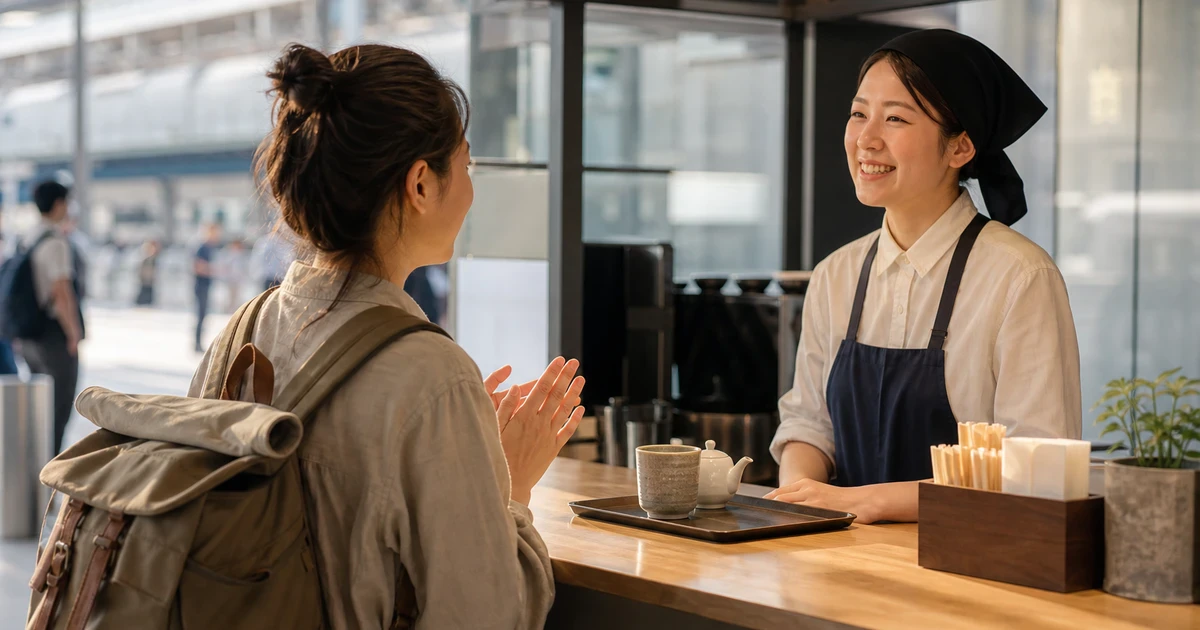
Learning common Japanese phrases is the fastest way to handle simple conversations before you understand every grammar rule. Useful expressions help you greet people, request something, navigate a train journey, enjoy a meal, and recover when you do not understand.
Japanese changes according to context and how close you are to the listener. The phrases below prioritize polite, widely useful language while explaining when a casual version may be more natural.
Essential Japanese Phrases for Beginners
Start with reusable expressions for greetings, introductions, requests, clarification, food, travel, and closing a conversation. Treat each situation as a small chapter in your personal phrasebook rather than trying to memorize everything at once.
Japanese | Romaji | English meaning |
|---|---|---|
こんにちは | konnichiwa | Hello / good afternoon |
はじめまして | hajimemashite | Nice to meet you |
お会いできてうれしいです | oai dekite ureshii desu | I’m glad to meet you |
よろしくお願いします | yoroshiku onegai shimasu | I look forward to knowing or working with you / Thank you in advance |
ありがとうございます | arigatō gozaimasu | Thank you |
すみません | sumimasen | Excuse me / I’m sorry |
お願いします | onegai shimasu | Please / I request your help |
わかりません | wakarimasen | I don’t understand |
もう一度お願いします | mō ichido onegai shimasu | One more time, please |
ゆっくり話していただけますか | yukkuri hanashite itadakemasu ka | Could you speak slowly, please? |
英語を話せますか | eigo o hanasemasu ka | Can you speak English? |
これは何ですか | kore wa nan desu ka | What is this? |
駅はどこですか | eki wa doko desu ka | Where is the station? |
この電車は京都に行きますか | kono densha wa Kyōto ni ikimasu ka | Does this train go to Kyoto? |
切符売り場はどこですか | kippu uriba wa doko desu ka | Where is the ticket counter? |
これをください | kore o kudasai | This one, please |
これにします | kore ni shimasu | I’ll take this / I’ll choose this |
いただきます | itadakimasu | Said before eating to express appreciation |
ごちそうさまでした | gochisōsama deshita | Thank you for the meal |
日本料理が好きです | Nihon ryōri ga suki desu | I like Japanese food |
では、また | dewa, mata | Well then, see you again; polite |
じゃあ、また | jā, mata | Well then, see you; casual |
What desu means depends on the sentence. The ending です (desu, polite sentence ending) may correspond to “is,” “am,” or “are,” but sometimes it primarily adds politeness.
For example, 好きです (suki desu, I like it) is more useful as a complete expression than as a word-for-word translation. Saying the whole pattern helps you express a preference naturally.
Using the Phrases in Real Situations
Short phrases work best when you connect them to a specific moment. Practise an introduction, a train question, and a shop request aloud instead of reading the phrases silently.
お会いできてうれしいです。
Oai dekite ureshii desu.
I’m glad to meet you.
すみません、この電車は京都に行きますか。
Sumimasen, kono densha wa Kyōto ni ikimasu ka.
Excuse me, does this train go to Kyoto?
Learner draft: これがほしい。
Learner draft: Kore ga hoshii.
Learner draft meaning: I want this.
Polite shop version: これをください。
Polite shop version: Kore o kudasai.
Polite shop version: This one, please.
The learner draft is understandable, but it can sound direct when addressing shop staff. The corrected version turns the idea into a clear request. With a close friend, the direct statement may fit; with a stranger or staff member, the polite request is safer.
Meal, Travel, and Social Expressions
いただきます (itadakimasu, said before eating) and ごちそうさまでした (gochisōsama deshita, thank you for the meal) are the two essential meal expressions. The first is used before eating, while the second acknowledges the food and effort after finishing.
Cultural note: Neither expression is an exact equivalent of “bon appétit.” They reflect appreciation for receiving the meal, the ingredients, and the work involved. Their social function matters more than a literal English translation.
For travel, begin with a location question or ask whether a train goes to your destination. Starting with すみません (sumimasen, excuse me) softens the approach, while a clarification request keeps the conversation moving if you miss the answer.
Introductions often combine a first-meeting greeting with a positive closing expression. If you will be staying with local people, Japanese Phrases for a Homestay Host Family provides more language for meals and household situations.
Japanese also handles groups differently from English. 達 (tachi, pluralizing suffix for people) can mark a group, but it is not added to every plural noun. Subjects and pronouns are often omitted when the context already makes them clear.
Common Mistakes with Japanese Phrases
Learners often make phrases less natural by translating every English word. Japanese usually leaves out information that both speakers already understand, so shorter can be better.
Overusing “you.” あなた (anata, you) is not automatically impolite, but repeating it may sound distant or pointed. Use the person’s name when appropriate, or omit the subject when the listener is obvious.
Using one version everywhere. では (dewa, well then or in that case) suits more formal transitions, while じゃあ (jā, well then) is common in casual conversation. Choosing based on the relationship improves politeness without changing the basic message.
Treating “please” as one fixed word. お願いします (onegai shimasu, please or I request your help) works in many requests, but other patterns may be more precise. A request to speak slowly, for example, benefits from a complete polite question.
Memorizing without speaking. Recognizing an expression is different from producing it under pressure. Learners often need feedback on pronunciation, omitted particles, directness, and whether a saying fits the relationship.
For job-related situations, Japanese Phrases for Part-Time Job Work explains useful expressions for colleagues, customers, and workplace requests.
Practising Phrases in a LINE Lesson
A speak-correct-repeat loop turns memorized phrases into usable conversation. In our 1-on-1 lessons over LINE, a standard 25-minute lesson can include a warm-up, one target speaking task, correction, repetition, and a learner-owned review note or question list.
For a concrete mini-drill, the learner can role-play ordering an item with the direct draft shown earlier. A teacher can identify the more suitable shop version, explain how the relationship changes the level of politeness, and ask the learner to repeat it with a different item.
A practical review cycle is:
- Choose one real situation, such as meeting someone or asking about a train.
- Say the target phrase without reading it.
- Receive a correction and repeat the improved version.
- Change one detail while keeping the same pattern.
- Record the correction and one question in your own review notes.
This approach keeps practice focused on something you may genuinely need to say. To work on everyday expressions with personalized feedback, book a Free Trial Lesson over LINE.
FAQ
What Japanese phrase should I learn first?
Start with greetings, thanks, apologies, and one clarification request. These give you a practical way to open a conversation, respond politely, and recover when you miss something. Add phrases for your next real situation, such as a meal or train trip, instead of memorizing a random chapter of expressions.
What does desu mean in Japanese?
です (desu, polite sentence ending) may correspond to “is,” “am,” or “are,” but it does not always have a separate English translation. In 好きです (suki desu, I like it), the ending helps make the description polite. Learn the complete expression and its situation rather than forcing a word-for-word match.
Is anata a polite way to say “you”?
あなた (anata, you) is not automatically rude, but Japanese often omits “you” when the listener is already clear. Repeating it can sound distant or pointed, especially with someone whose name or title you know. Notice how real conversations avoid the pronoun, and use names or omission when the context allows.
How can I remember common Japanese phrases?
Attach each phrase to a specific action: greeting someone, requesting help, beginning a meal, or checking a train. Say it aloud, recall it without English, and reuse it in a short role-play. Keep one learner-owned note with the correction, context, and politeness level you want to practise again.

