
Japanese business meeting customs are shaped by preparation, hierarchy, politeness, and relationships. A meeting in Japan may feel quiet or formal at first, but participants often aim to build trust and consensus rather than force an immediate decision.
You do not need perfect Japanese to contribute confidently. You do need to understand when to listen, how to acknowledge another person’s point, and how to express disagreement without sounding unnecessarily direct.
Before the Meeting: Preparation and First Impressions
Preparation matters because important information may be shared before people enter the meeting room. Read the agenda, learn the names and roles of attendees, and prepare a short self-introduction if you are meeting someone for the first time.
For an important meeting, bring enough business cards for everyone. Exchange a card respectfully with both hands, read the other person’s card briefly, and place it neatly on the table during the meeting. Never write notes on a card while the person is still present.
Punctuality is generally important. If you are visiting a firm, arrive early, be ready for the scheduled start, and wait calmly if the host causes a delay. Bring a notebook and review your key points rather than appearing impatient.
A simple greeting can be polite and formal without being complicated:
はじめまして。よろしくお願いいたします。
Hajimemashite. Yoroshiku onegai itashimasu.
Nice to meet you. I look forward to working with you.
Learn the family names and professional titles of the people attending. Using given names too quickly can feel overly familiar unless the person invites you to do so.
Seating, Hierarchy, and Meeting Etiquette
Seating can reflect hierarchy. In a traditional meeting room, the most senior guest usually sits in the place of honour, often farthest from the door. The host or more junior participants may sit nearer the entrance.
In modern offices, the arrangement may be less strict, so follow the host’s guidance rather than choosing a seat immediately. If you are unsure, wait until someone indicates where you should sit.
During the discussion:
- Listen fully before responding.
- Avoid interrupting, even when you have an important point.
- Take brief notes and show that you are following the conversation.
- Use a measured tone instead of speaking dramatically.
- Present criticism as a concern or question before stating your preferred solution.
A restrained acknowledgement is often safer than an enthusiastic social reaction. Learners often need feedback on register: a phrase that sounds friendly among friends may feel too casual when speaking with executives or senior colleagues.
For more agenda-focused language, see Business Japanese Meeting Agenda Phrases. Practising openings, transitions, questions, and closings together helps you manage the entire meeting more naturally.
Consensus, Decisions, and Useful Meeting Phrases
Japanese meetings may confirm alignment rather than introduce a surprising decision for the first time. Informal conversations before the meeting can allow people to raise concerns, adjust proposals, and build support. This process is often called nemawashi, or advance groundwork for consensus.
That does not mean every meeting is slow or that nobody disagrees. Disagreement is often expressed carefully, perhaps by asking whether a risk has been considered instead of saying that a proposal is wrong.
Japanese | Romaji | English meaning |
|---|---|---|
承知しました | shōchi shimashita | Understood / acknowledged |
勉強になります | benkyō ni narimasu | That is very informative |
一度持ち帰って検討します | ichido mochikaette kentō shimasu | I will take this back for consideration |
ご意見を伺ってもよろしいですか | go-iken o ukagatte mo yoroshii desu ka | May I ask for your opinion? |
検討させていただきます | kentō sasete itadakimasu | I will consider it |
こちらの点を確認してもよろしいですか | kochira no ten o kakunin shite mo yoroshii desu ka | May I confirm this point? |
ご確認いただけますか | go-kakunin itadakemasu ka | Could you please confirm it? |
These phrases do not all have the same force. “I will consider it” does not necessarily mean yes; it may mean that the speaker needs internal discussion before committing. “I will take this back for consideration” similarly signals that the decision belongs to a wider group.
Listen for the next action: confirmation, internal review, another meeting, or a request for documents.
Examples in context
会議の前に、資料を確認しておきます。
Kaigi no mae ni, shiryō o kakunin shite okimasu.
I will review the materials before the meeting.
こちらの点について、もう少し詳しく説明していただけますか。
Kochira no ten ni tsuite, mō sukoshi kuwashiku setsumei shite itadakemasu ka.
Could you explain this point in a little more detail?
その提案については、一度持ち帰って検討します。
Sono teian ni tsuite wa, ichido mochikaette kentō shimasu.
Regarding that proposal, I will take it back for consideration.
本日の決定事項を、後ほどメールでお送りします。
Honjitsu no kettei jikō o, nochihodo mēru de o-okuri shimasu.
I will send today’s decisions by email later.
Common Mistakes in Japanese Business Meetings
Learners often carry everyday reactions into formal meetings. Responses such as そうなんですか (sō nan desu ka, is that so?) and すごいですね (sugoi desu ne, that is impressive) may sound natural socially, but they can seem too casual or emotionally strong in a serious business discussion.
Teachers have observed that live practice is especially useful for changing register while speaking. A restrained response such as 承知しました (shōchi shimashita, understood) or 勉強になります (benkyō ni narimasu, that is very informative) is often more suitable.
Another difficulty is choosing among levels of politeness. いいですか (ii desu ka, is it okay?) is common and direct, よろしいですか (yoroshii desu ka, is it acceptable?) is more formal, and よろしいでしょうか (yoroshii deshō ka, would it be acceptable?) can sound more cautious. The best choice depends on the situation, relationship, and request.
Avoid interrupting yourself to correct every small error. In live one-on-one practice, a teacher can let you complete your point, then use feedback to address pronunciation, pitch accent, and register-switching patterns that are difficult to notice while speaking.
Gifts, Relationships, and Follow-Up
Gifts can be appropriate when visiting a company, meeting a business partner after a long separation, or thanking someone for hospitality. A modest, neatly presented gift is generally safer than something expensive or highly personal.
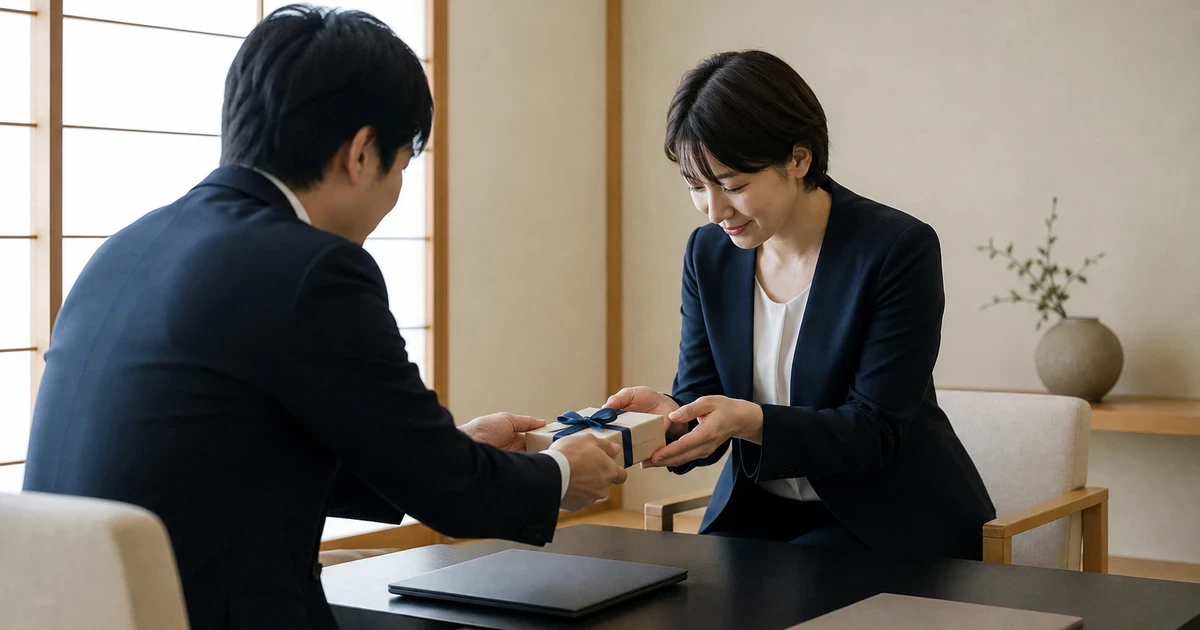
Consider local customs, company rules, and whether the recipient can share it with colleagues or family. The purpose is relationship-building, not payment or influence. Offer a gift with both hands at a natural point, often near the end of a visit.
If you receive a gift, thank the person graciously even if you do not open it immediately. A short expression of thanks is enough; the important point is to acknowledge the gesture respectfully.
After the meeting, send concise follow-up notes recording the main decisions, open questions, and next actions. Meeting minutes do not need to reproduce every sentence. They should make responsibilities and deadlines clear.
A useful review workflow is:
- Write down three phrases you heard.
- Mark one moment when you were unsure how formal to sound.
- Rewrite one direct sentence in a more considerate form.
- Prepare one question for your next practice session.
For additional workplace messaging practice, see Business Japanese Chat Messages for Slack at Work. Meeting etiquette and chat etiquette overlap, especially when you acknowledge a request or ask someone to review a document.
Kind Japanese offers standard 25-minute one-on-one lessons over LINE. A lesson can focus on a realistic meeting situation, including a warm-up, target speaking task, live correction, and a learner-owned review note or question list.
FAQ
Do I need to bow deeply in every Japanese business meeting?
No. A brief, polite bow is usually enough, and the appropriate depth depends on the situation and relationship. Follow the other person’s level of formality, greet them clearly, and avoid exaggerated movements that may appear theatrical or uncomfortable. Your calm voice, punctuality, and respectful attention usually matter more than performing a perfect bow.
Should I speak Japanese throughout a meeting in Japan?
Use as much Japanese as you can handle accurately, but do not sacrifice clarity on important decisions. Prepare key vocabulary, listen for confirmation, and ask for repetition when necessary. If the discussion becomes complex, concise English or another shared language may be more responsible than pretending you understood everything.
Are gifts expected at Japanese business meetings?
No, gifts are not required for every meeting. They can be suitable for visits, important introductions, or expressions of thanks, but company policies and personal circumstances differ. Choose something modest and shareable, present it respectfully, and focus primarily on building a genuine professional relationship rather than creating an obligation.
How can I practise Japanese meeting customs before attending one?
Choose one realistic scenario, such as presenting a proposal or asking for clarification, and practise it aloud. A Free Trial Lesson over LINE can help you identify pronunciation, vocabulary, and register priorities, then turn those observations into a focused study plan for future business conversations.

