
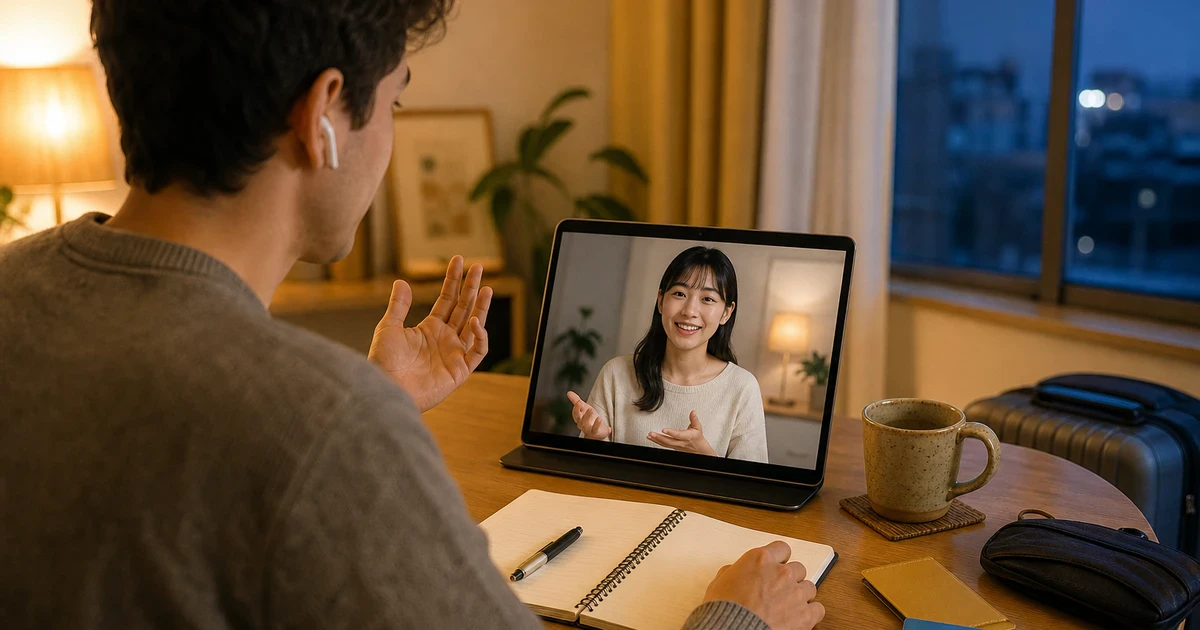
For frequent travelers to japan, online Japanese lessons for frequent travelers to japan work best when they focus on the short exchanges you repeat on every trip: train changes, hotel check-in, restaurant questions, and quick problem-solving.
Kind Japanese fits that need well because the lessons are one-on-one, online, and run over LINE. That makes it easier to practise the exact words you will use in real travel situations, with live teacher feedback instead of passive memorisation.
If you also need help planning around your location, Online Japanese Lessons Europe: Time-Zone Guide is a useful companion read. If confidence is the main issue, Build Speaking Confidence with a Japanese Tutor is also worth a look.
Why Frequent Travelers Need Focused Japanese
Frequent travelers do not usually need every possible Japanese expression. They need a small set of phrases they can say clearly, politely, and without freezing.
From a teacher's perspective, learners progress faster when they practise the same travel patterns in several variations: - asking where to go - confirming a reservation - checking a platform, gate, or exit - explaining that they are lost - asking for a slower repetition - handling a simple problem at a hotel or restaurant
That is why a one-on-one tutor is useful. A phrase list can teach you the words, but a teacher can help you turn those words into a sentence you can actually say under pressure.
A short cultural note matters here: in Japanese service settings, a brief opener such as すみません (sumimasen, excuse me) usually sounds smoother than jumping straight into the request. It is a small habit, but it helps your question land politely.
Online Japanese Lessons for Frequent Travelers to Japan
The best online Japanese lessons for frequent travelers to Japan are the ones that treat travel as a speaking skill, not a vocabulary quiz.
That means your lesson should connect three things: - the situation you will face - the exact sentence you want to say - the pronunciation or grammar point that may block you
A LINE lesson works especially well for this because the format stays close to everyday communication. You can bring a screenshot of a map, a train route, a hotel message, or a menu and turn it into a real conversation. The goal is not to collect perfect notes; the goal is to say the sentence smoothly when it matters.
Here are the core phrases that come up again and again in travel Japanese:
Japanese | Romaji | English Meaning |
|---|---|---|
乗り換え | norikae | transfer; changing trains |
予約 | yoyaku | reservation; booking |
改札 | kaisatsu | ticket gate |
道に迷いました | michi ni mayoimashita | I got lost |
もう一度お願いします | mō ichido onegai shimasu | Please say it one more time |
ゆっくりお願いします | yukkuri onegai shimasu | Please speak slowly |
どのくらいかかりますか | dono kurai kakarimasu ka | How long does it take? |
この予約は確認できますか | kono yoyaku wa kakunin dekimasu ka | Can you confirm this reservation? |
Example 1
すみません、乗り換えはどこですか。 Sumimasen, norikae wa doko desu ka. Excuse me, where is the transfer?
Example 2
この予約は確認できますか。 Kono yoyaku wa kakunin dekimasu ka. Can you confirm this reservation?
Example 3
もう一度、ゆっくりお願いします。 Mō ichido, yukkuri onegai shimasu. Please say it one more time, slowly.
Example 4
ホテルまでどのくらいかかりますか。 Hoteru made dono kurai kakarimasu ka. How long does it take to get to the hotel?
What a 25-Minute LINE Lesson Can Cover
A 25-minute lesson is enough if the topic is narrow. For travel Japanese, that often means one situation, one correction goal, and one speaking task.
A simple lesson flow looks like this: 1. Warm-up: name the next trip, city, or place you expect to visit. 2. Target speaking task: role-play one scene, such as asking for directions, checking in, or ordering food. 3. Teacher feedback: correct the sentence, word order, politeness level, and pronunciation. 4. Speak again: repeat the corrected version until it feels more natural. 5. Final check: ask one or two last questions about the phrase you want to reuse.
That speak-correct-repeat loop is where the value is. A teacher can help you notice whether the sentence is too direct, too long, or too stiff. If you want another angle on that kind of practice, Build Speaking Confidence with a Japanese Tutor explains the mindset clearly.
For time-zone planning, keep your request practical. Instead of asking for “any time,” say what works in your own time zone: - weekday evenings in Europe - early mornings in US time - a weekend window after travel - a fixed slot that still works when you are moving between airports or cities
If you travel across regions, describe the time window in your local time zone first. That makes it much easier to line up a lesson without confusion.
Common Mistakes
Travel learners often know more words than they can use in the moment. The problem is usually not knowledge; it is retrieval, pronunciation, or sentence shape.
From a teacher's perspective, these are the most common issues: - Learners memorise a phrase but cannot adapt it when the station, hotel, or restaurant changes. - Learners use a word-for-word translation that sounds heavy in Japanese. - Learners ask one long question when a shorter request would be clearer. - Learners hesitate on politeness and end up sounding either too blunt or too cautious. - Learners mix up look-alike katakana such as ツ (tsu, katakana “tsu”) and シ (shi, katakana “shi”), or ソ (so, katakana “so”), ン (n, katakana “n”), and リ (ri, katakana “ri”). - Learners bring anime-style second-person words into real travel speech, even when a simpler form or no pronoun at all would sound more natural.
The first fix is usually not more vocabulary. It is better pronunciation and a cleaner sentence frame. A live teacher can help you hear the difference between the sentence you intended and the sentence you actually produced.
A useful diagnostic checklist for travel speech is: - long vowels - small っ timing - つ / す / し contrast - sentence-ending intonation - whether the request sounds polite enough for the situation
If you can check those five points in one short lesson, your travel Japanese becomes much more dependable.
FAQ
Do I need advanced Japanese to benefit from travel lessons?
No. Travel lessons are often most useful when your Japanese is still simple, because you can focus on the exact sentences you will repeat in real life. A teacher can help you make a short request clear, polite, and pronounceable without turning the lesson into a grammar lecture.
What should I bring to a lesson?
Bring one real travel situation and one sentence you want to say. A map screenshot, a train route, a hotel message, or a restaurant example is enough. Then ask the teacher to help you make that line sound natural and easy to speak.
How should I choose a lesson time if I travel a lot?
State your local time zone and give a realistic window that fits your life, such as weekday evenings or weekend mornings. If your schedule changes during trips, choose a window that still works when you are moving between flights, stations, and hotels.
Is a one-on-one LINE lesson better than self-study for travel Japanese?
Self-study helps you collect phrases, but one-on-one practice helps you use them. In a LINE lesson, a teacher can correct the sentence you actually plan to say, adjust the politeness level, and help you repeat it until it feels natural under pressure.
If you want to test this approach with your own travel situations, book a Free Trial Lesson over LINE.

