
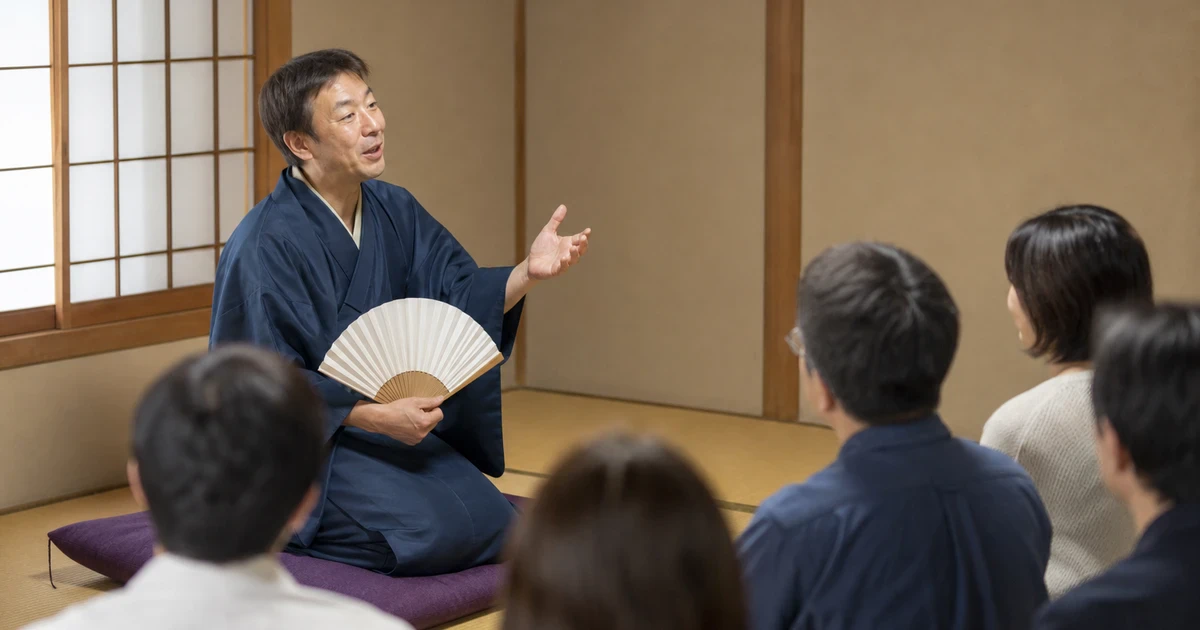
Japanese storytelling combines language, performance, visual culture, and narrative structure. Its stories may include humor, conflict, surprising reversals, quiet emotional changes, or themes about responsibility and relationships.
For learners, the cultural forms matter because they show how Japanese speakers guide attention. Stories can signal a change, reveal a character’s viewpoint, or leave a subject unstated when the context is clear. Speaking practice becomes more meaningful when you understand the performance tradition behind the words.
What Japanese Storytelling Includes
Japanese storytelling is not one single genre. It includes spoken performances, visual narratives, historical recitations, folktales, children’s stories, and everyday personal anecdotes.
The most useful traditional forms for cultural learning include:
Japanese | Romaji | English meaning | Format | Defining technique | Learner use |
|---|---|---|---|---|---|
落語 | rakugo | comic storytelling | One seated performer before an audience | Character switching through voice, posture, a fan, and a hand towel; ends with 落ち (ochi, punchline) | Practise dialogue, timing, implication, and humor |
紙芝居 | kamishibai | paper theater | Narration with picture cards or sheets of paper | Revealing images one at a time to control suspense | Practise description, prediction, sequence, and retelling |
講談 | kōdan | historical narrative performance | One narrator presents historical or dramatic episodes | Formal delivery, rhythmic phrasing, and heightened narration | Practise listening for chronology, detail, and register |
起承転結 | kishōtenketsu | introduction, development, turn, conclusion | A four-part narrative structure | A turn or new perspective changes the direction before the ending | Organize anecdotes, explanations, and short presentations |
落語 (rakugo, comic storytelling) and 講談 (kōdan, historical narrative performance) are primarily spoken forms. 紙芝居 (kamishibai, paper theater) uses images to support spoken narration, while 起承転結 (kishōtenketsu, introduction-development-turn-conclusion) describes a narrative structure rather than a performance genre.
These traditions have been enjoyed in different settings, from popular street entertainment to libraries, schools, museums, and educational programs. They also reveal differences between Japanese storytelling and some Western story models, especially models that depend on an obvious villain, battle, or escalating conflict.
Rakugo: Dialogue, Props, and the Punchline
Rakugo is performed by one 落語家 (rakugoka, rakugo storyteller), usually while seated. The rakugoka uses changes in voice, gaze, posture, and timing to represent several characters without changing costume.
Two traditional props are especially important:
- 扇子 (sensu, folding fan) may become chopsticks, a sword, or a writing brush.
- 手ぬぐい (tenugui, hand towel) may suggest a book, letter, or other small object.
The audience understands each transformation through context and gesture. A fan held at a particular angle can suggest an object even though the performer is holding only a small prop. This economy of movement makes the listener’s imagination part of the theater.
A rakugo performance often begins with a familiar situation, then develops through repeated dialogue, misunderstanding, and increasingly precise timing. The final 落ち (ochi, punchline) changes how the audience interprets what came before. For learners, listen first for who is speaking and what assumption causes the problem; the wordplay can come later.
Rakugo became popular during the 江戸時代 (Edo jidai, Edo period). Two broad traditions are often discussed: 江戸落語 (Edo rakugo, Tokyo-area rakugo) and 上方落語 (Kamigata rakugo, Osaka and Kyoto-area rakugo). Their repertoire, humor, delivery, and cultural references may differ, so regional variation can make an authentic performance challenging.
A beginner-friendly clip or short excerpt is still useful. Listen once for the situation, again for repeated phrases, and finally for the character switch and punchline. Japanese speech also depends on mora timing, vowel length, and sentence-final intonation. Prioritize clarity in full phrases over isolated perfection, and remember that regional pronunciation and rhythm vary.
Kamishibai, Kōdan, and Visual Storytelling
Kamishibai uses a sequence of illustrated cards or sheets of paper. A narrator shows one picture, tells part of the story, and reveals the next image at a chosen moment. Historically, this paper theater was strongly associated with street performances; today, its methods also appear in libraries, schools, museums, and other educational settings.
The picture cards make the narrative structure visible. A learner can describe the setting, predict the next event, identify a character’s emotion, and retell the story without memorizing every sentence. This is different from reading a picture book silently: kamishibai is theater storytelling, with spoken narration, pauses, audience attention, and suspense created by controlled reveals.
Kōdan offers a different performance style. The 講談師 (kōdanshi, kōdan narrator) presents historical figures, battles, journeys, or dramatic conflicts through formal language and rhythmic delivery. Compared with rakugo’s comic dialogue, kōdan often emphasizes historical atmosphere, chronology, and the suspense of a serious episode.
You can adapt either form for Japanese practice:
- Draw four simple scenes on separate pieces of paper.
- Give each scene one clear purpose: setting, development, turn, or result.
- Tell the story while looking at the pictures rather than reading a complete script.
- Repeat it with one added emotion, reason, or line of dialogue.
- Ask a listener which event or relationship was easiest to understand.
A familiar Western story can work well as source material, but avoid translating every sentence literally. Japanese may leave the subject unstated when context makes it obvious, and the most natural sentence order may differ from the original.
Kishōtenketsu: A Japanese Narrative Structure
Kishōtenketsu organizes a story into four movements. It does not require a villain or direct fight, so it differs from conflict-centered story models often taught through Western narratives.
- 起 (ki, introduction) establishes the setting, people, or situation.
- 承 (shō, development) adds detail and develops the initial situation.
- 転 (ten, turn) introduces an unexpected change, contrast, or new perspective.
- 結 (ketsu, conclusion) connects the parts and gives the listener a final result or reflection.
The 転 (ten, turn) does not need to be dramatic. It might reveal that an ordinary object has a different purpose, or that a character misunderstood the situation.
春、私は新しい町に引っ越しました。
Haru, watashi wa atarashii machi ni hikkoshimashita.
In spring, I moved to a new town.
毎朝、近所の公園で同じ猫を見かけました。
Maiasa, kinjo no kōen de onaji neko o mikakemashita.
Every morning, I saw the same cat in the nearby park.
ところが、その猫は公園の猫ではなく、パン屋の看板でした。
Tokoro ga, sono neko wa kōen no neko de wa naku, pan'ya no kanban deshita.
However, that cat was not a park cat; it was a bakery sign.
それ以来、そのパン屋の看板を見るのが楽しみになりました。
Sore irai, sono pan'ya no kanban o miru no ga tanoshimi ni narimashita.
Since then, I have looked forward to seeing the bakery’s sign.
This miniature story uses a setting, repeated observation, an unexpected turn, and a concluding reaction. The same structure can organize a personal anecdote, presentation, visual story, or explanation. The point is not to force every Japanese narrative into four exact boxes, but to notice how a change in perspective can create interest without a conventional battle.
Practising Japanese Storytelling Clearly
Learners often confuse listing events with telling a story. Grammatically correct sentences may still feel flat if they lack a reason, reaction, change, or ending. A clear story with familiar vocabulary is usually more effective than an ambitious story that the listener cannot follow.
Common mistakes in Japanese storytelling include:
- using transitions without showing the relationship between events
- changing from polite to casual speech without a character or situation change
- translating Western dialogue word for word
- adding too many details before explaining the main problem
- focusing on perfect pronunciation of isolated words instead of clear full phrases
- using a dramatic 転 (ten, turn) that does not connect to the earlier setting
A useful vocabulary set includes words that signal sequence and contrast. まず (mazu, first), それから (sore kara, after that), ところが (tokoro ga, however or unexpectedly), and 最後に (saigo ni, finally) help listeners follow the movement of a story. Use them to show a relationship between ideas, not simply to decorate every sentence.
A teacher can give focused feedback when a learner needs help with narrative connectors, register, timing, or the clarity of a final point. In our one-on-one lessons over LINE, a learner can bring one storytelling goal to a standard 25-minute lesson. A practical flow can include a warm-up, one target speaking task, correction of the most important errors, and a learner-owned review note or question list.
Prepare five keywords rather than a complete script. Tell the story once, identify one weak connection, then retell it with a clearer turn or ending. This approach lets you practise spontaneous speaking while keeping the cultural structure visible.
For guidance on choosing private online study, read One-on-One Japanese Lessons Online: Choose Wisely. To understand how a trial can support a specific learning goal, see Japanese Trial Lesson: What Happens and What to Expect. If you want focused guidance on Japanese storytelling, book a Free Trial Lesson over LINE.
FAQ
Is rakugo suitable for Japanese beginners?
Rakugo is culturally valuable, but authentic performances can be difficult because they may include rapid speech, wordplay, historical references, and regional expressions. Beginners can start with a short summary or visual explanation, focusing on the setting, character changes, repeated misunderstanding, and final punchline before attempting every line. This builds useful listening habits without making comprehension feel overwhelming.
What is the difference between kamishibai and a picture book?
Kamishibai is paper theater: a narrator presents picture cards in sequence while telling the story aloud. A picture book normally combines text and illustrations on pages for individual reading, whereas kamishibai emphasizes performance, timing, audience reaction, spoken narration, and suspense created by revealing each image. Learners can use this contrast to practise both reading and speaking.
What does kishōtenketsu mean in Japanese storytelling?
Kishōtenketsu is a four-part structure: introduction, development, turn, and conclusion. The turn adds a new perspective or unexpected change, but it does not require a direct battle or villain, making the structure useful for anecdotes, explanations, visual stories, and narratives built around discovery. Its value is organization, not a rigid formula for every story.
How can I practise Japanese storytelling without advanced grammar?
Start with a familiar event and four short parts: where it began, what developed, what changed, and how it ended. Use simple vocabulary, five keywords, and one reaction sentence, then retell the story aloud; feedback can help you improve connections, register, pronunciation, and listener clarity. A teacher can also help you choose natural phrases for your level.

