
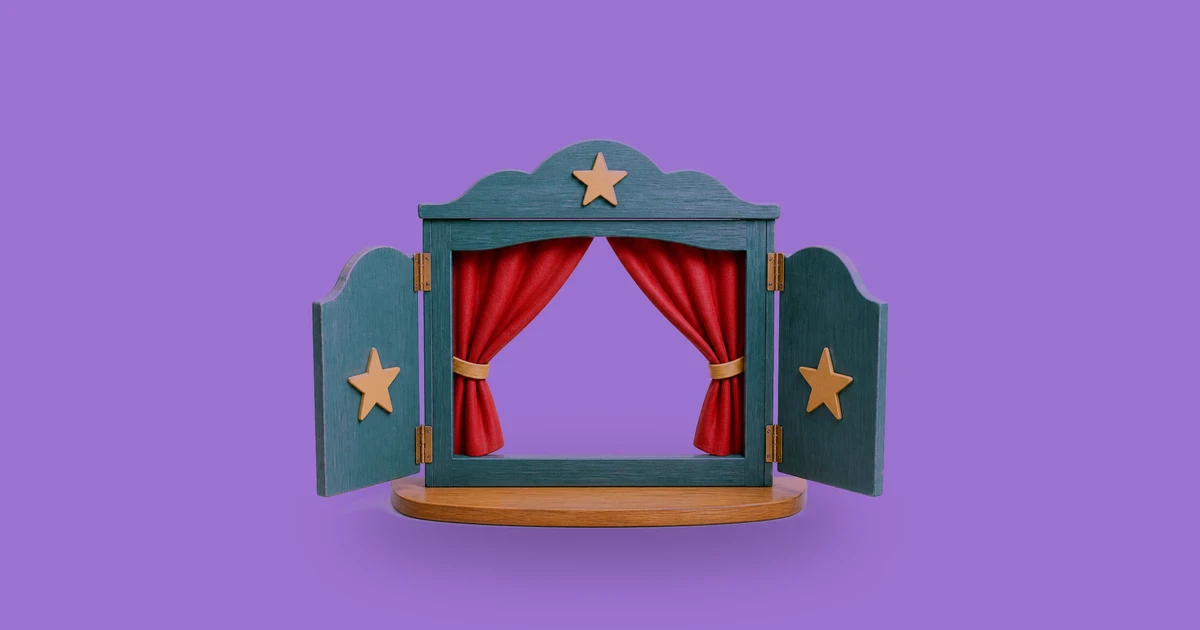
Kamishibai is a traditional Japanese storytelling format that combines spoken performance with illustrated paper cards. A performer places the cards in a portable wooden stage, reveals them one by one, and tells stories aloud for an audience.
The format is visual, dramatic, and useful for Japanese learners. It connects vocabulary, grammar, pronunciation, pacing, and cultural context through a sequence of images rather than isolated sentences.
What Is Kamishibai?
Kamishibai means “paper theater,” but the traditional stage itself is normally wooden. The performer stands behind or beside the small stage, places illustrated cards inside it, and slides or pulls each card out at an important moment.
Classic street kamishibai became popular in Japan during the early twentieth century. A street performer travelled with a portable stage, attracted children and families, and presented short stories with expressive narration. The relationship between performer and audience was central: pauses, gestures, facial expressions, voice changes, and eye contact helped create kyōkan, a shared emotional connection.
Kamishibai stories can be funny, educational, historical, mysterious, or frightening. The illustrations do not show every detail. The performer’s voice supplies the characters’ dialogue, descriptions, and emotional tone.
The format also has modern uses. Libraries, schools, museums, festivals, and community groups may use kamishibai for language education, cultural activities, and storytelling events. Some modern performances use projected slides or digital images, but the card-and-stage tradition remains an important part of its identity.
How a Kamishibai Performance Works
A kamishibai performance usually follows a clear visual sequence:
- The performer introduces the setting and characters.
- The first sheet establishes the situation.
- Each new sheet advances the action or reveals information.
- The performer changes the card at a carefully chosen moment.
- The final sheet gives the story a conclusion, emotional reaction, or lesson.
The transition matters as much as the illustration. A performer may pause before revealing a ghost, lower their voice during a dangerous scene, or speed up during an exciting chase. Story choices can also change with the season: a July event might feature a summer festival, while another program may use autumn nature, winter travel, or spring celebrations.
Ghost stories are especially associated with summer in Japan because traditional customs connected the season with ancestors, spirits, and the Buddhist observance of Obon. Summer heat, evening storytelling, and the idea of cooling down through fear also helped make frightening stories a familiar seasonal choice. A ghost story can work well in kamishibai because suspense builds while the audience waits for the next illustration.
Kamishibai should not be confused with an animated television program about Japanese folklore. A television series may have aired over several seasons, but live kamishibai depends on a performer, physical cards, timing, and direct contact with the audience. The two forms can share old stories without being the same medium.
Here are useful expressions for discussing a performance:
Japanese | Romaji | English meaning |
|---|---|---|
紙芝居 | kamishibai | paper theater; kamishibai storytelling |
語り手 | katarite | storyteller; narrator |
観客 | kankyaku | audience |
絵 | e | picture; illustration |
紙 | kami | paper |
物語 | monogatari | story; tale |
怖い話 | kowai hanashi | scary story |
昔話 | mukashibanashi | folktale; old story |
季節 | kisetsu | season |
めくる | mekuru | to turn or flip a page |
絵を抜く | e o nuku | to slide or pull out a picture card |
共感 | kyōkan | empathy; shared emotional understanding |
Learn Japanese Through Kamishibai
Kamishibai helps learners practise both comprehension and output. The image gives you context, while the spoken story requires you to choose natural sentence endings, describe action, and communicate emotion.
Learners often need feedback on details that are difficult to judge alone: whether a pause supports the meaning, whether pronunciation is clear, whether narration and dialogue sound different enough, and whether a word fits the audience. A teacher can help you examine these choices during live one-on-one practice.
Try this original four-sheet activity:
- Sheet one: describe the setting and introduce one character.
- Sheet two: add a problem or surprising discovery.
- Sheet three: write two lines of dialogue and mark one pause.
- Sheet four: give the character a decision, result, or lesson.
Before practising, mark the places where you will change the sheet. Then check four points: pronunciation, sentence endings, pause length, and whether the audience can understand the action from the words and image together.
Here are four simple example sentences to read aloud:
主人公は古い森の中を歩いていました。
Shujinkō wa furui mori no naka o aruite imashita.
The main character was walking through an old forest.
次の絵を見て、何が起こるか考えてください。
Tsugi no e o mite, nani ga okoru ka kangaete kudasai.
Look at the next picture and think about what will happen.
語り手は声を小さくして、観客を緊張させました。
Katarite wa koe o chiisaku shite, kankyaku o kinchō sasemashita.
The storyteller lowered their voice and made the audience feel tense.
この物語には、夏の夜に現れる幽霊が登場します。
Kono monogatari ni wa, natsu no yoru ni arawareru yūrei ga tōjō shimasu.
This story features a ghost that appears on summer nights.
Kind Japanese offers standard 25-minute one-on-one lessons over LINE. You can bring your four sheets, a short story idea, or even a single difficult sentence for focused practice. A teacher can review meaning, politeness, naturalness, pronunciation, and storytelling context while you keep your own review note.
You may also find it useful to read Japanese Trial Lesson: What Happens and What to Expect or compare learning formats in One-on-One Japanese Lessons Online: Choose Wisely.
Common Mistakes
Learners often treat kamishibai as simple picture reading, but effective storytelling requires timing and audience awareness.
Reading every line at the same speed. A constant rhythm can make an exciting story sound flat. Slow down before an important reveal and leave a short pause after changing a sheet.
Using difficult vocabulary without visual support. Choose words that match the audience’s level. If an unfamiliar word is essential, support it with the illustration, a gesture, or a short explanation.
Confusing narration with dialogue. Narration explains what is happening, while dialogue gives a character a voice. Practise a small change in tone, but avoid exaggerated acting that makes the Japanese unnatural.
Using めくる (mekuru, to turn or flip a page) for every card movement. This verb is useful for pages, but a performance-specific expression such as 絵を抜く (e o nuku, to slide or pull out a picture card) can describe removing a kamishibai card more precisely.
Translating cultural details too literally. A ghost story, festival, or old folktale may contain assumptions familiar in Japan but unfamiliar elsewhere. Add a brief explanation when the cultural background is necessary for understanding.
Focusing only on grammar accuracy. Correct grammar matters, but storytelling also depends on clarity, emotion, pronunciation, and pacing. One-on-one feedback can help you balance these skills.
FAQ
Is kamishibai still popular in Japan?
Kamishibai is less common as everyday street entertainment than it was in the past, but it still appears in schools, libraries, museums, festivals, and community programs. Modern performers and educators adapt the format for children, language learning, cultural events, and introductions to Japanese folklore, while preserving its visual storytelling foundation.
Is kamishibai suitable for beginner Japanese learners?
Yes, because illustrations provide context and the narration can remain short, repetitive, and concrete. Beginners can start by naming people, colors, places, and actions, then gradually add past tense, reasons, feelings, and simple dialogue as their confidence grows through guided practice.
What stories work well for kamishibai practice?
Short stories with a clear setting, few characters, and a visible change between scenes are easiest to perform. Folktales, seasonal events, everyday surprises, and gentle ghost stories can all work when the vocabulary matches the audience and the ending is easy to understand.
Can I practise kamishibai without owning a wooden stage?
Yes, you can use numbered drawings, printed sheets, or presentation slides and reveal them one at a time. The essential elements are a visual sequence, spoken narration, and well-timed transitions, so learners can practise the storytelling technique before obtaining a traditional portable stage.
Bring one storytelling goal to a Free Trial Lesson over LINE.

