
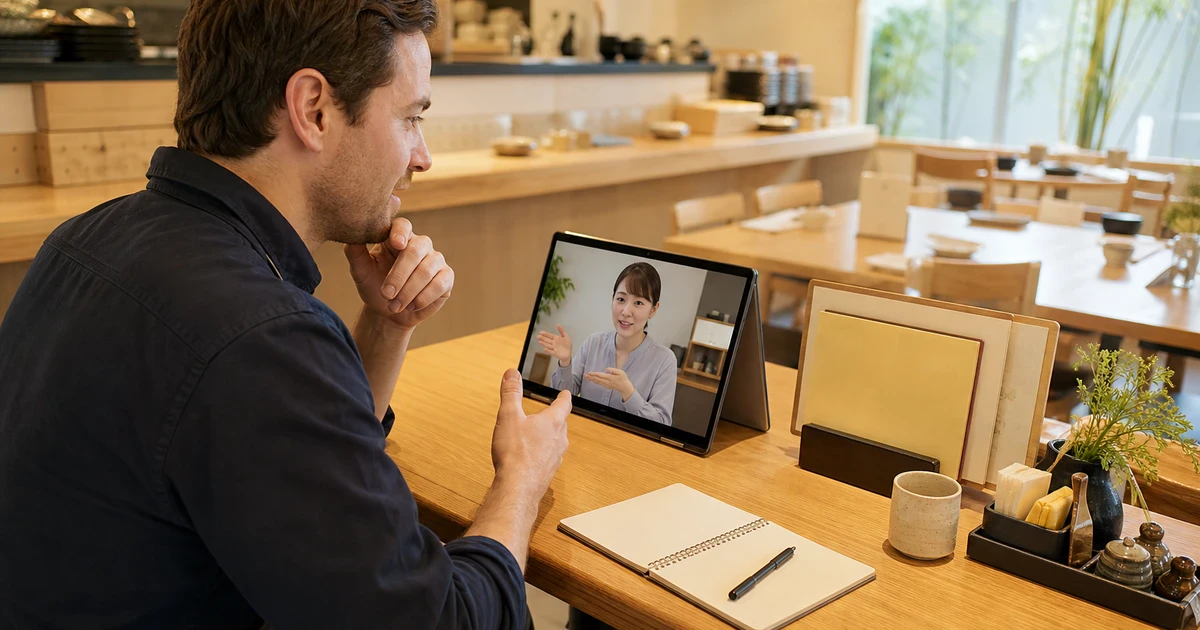
Restaurant managers in Japan need Japanese that works under pressure: checking reservations, giving staff instructions, responding to customer issues, and sounding calm when the dining room is busy. General study helps, but restaurant Japanese is a live-performance skill. You need to speak, receive correction, and try again.
That is where online japanese lessons for restaurant managers in japan can be especially useful. With a one-on-one Japanese tutor, you can practise the exact situations you face at work instead of memorising phrases that never quite match your restaurant.
Kind Japanese offers one-on-one online Japanese lessons over LINE. Standard one-on-one lessons are 25 minutes, which is long enough to focus on one real task without overloading your schedule.
What Restaurant Managers Need to Say Clearly
Restaurant managers in japan usually need three kinds of business Japanese: customer-facing politeness, clear team communication, and calm problem-solving language. The goal is not to sound like a textbook. The goal is to be accurate, polite, and easy to understand.
Useful practice areas include:
- Reservations: names, times, party size, seating requests, allergies, changes, cancellations
- Staff instructions: who does what, when to prepare, how to report problems
- Customer issues: waiting time, wrong orders, unavailable items, payment questions, complaints
- Internal coordination: short updates before service, after-service notes, and manager handovers
If you already use Japanese at work, your lesson should not start from random vocabulary. Bring one real situation, such as “a customer wants to change a booking” or “I need to tell staff to check table 5.” A teacher can help you make that sentence more natural, then practise it until it comes out smoothly.
For wider workplace phrasing beyond restaurants, you may also find Business Japanese Meeting Agenda Phrases useful when preparing staff briefings or manager meetings.
Core Phrases for Restaurant Management
These phrases are not a script for every situation. Use them as practice targets, then adjust the formality, speed, and wording with teacher feedback.
Japanese | Romaji | English meaning |
|---|---|---|
ご予約のお名前 | go-yoyaku no o-namae | the name on the reservation |
何名様ですか | nanmei-sama desu ka | How many people are in your party? |
アレルギーをお持ちですか | arerugī o o-mochi desu ka | Do you have any allergies? |
少々お待ちください | shōshō o-machi kudasai | Please wait a moment |
確認いたします | kakunin itashimasu | I will check |
本日のおすすめ | honjitsu no osusume | today’s recommendation |
満席でございます | manseki de gozaimasu | We are fully booked / all seats are taken |
申し訳ございません | mōshiwake gozaimasen | I sincerely apologize |
こちらを優先してください | kochira o yūsen shite kudasai | Please prioritize this |
すぐに対応します | sugu ni taiō shimasu | I will handle it right away |
ご予約のお名前を伺ってもよろしいですか。 Go-yoyaku no o-namae o ukagatte mo yoroshii desu ka. May I ask the name on the reservation?
アレルギーをお持ちですか。 Arerugī o o-mochi desu ka. Do you have any allergies?
こちらを先に確認してください。 Kochira o saki ni kakunin shite kudasai. Please check this first.
お料理が遅れており、申し訳ございません。 O-ryōri ga okurete ori, mōshiwake gozaimasen. I apologize that the food is delayed.
Cultural note: in Japanese restaurants, even direct problem-solving often begins with acknowledgement. A short apology or confirmation before the solution can make the interaction feel smoother and more professional.
Why Self-Study Often Gets Stuck
Self-study is good for vocabulary, but restaurant management Japanese depends on timing, tone, and fast correction. A phrase may be grammatically correct but too casual for a guest, too vague for staff, or too long for a busy service moment.
Learners often get stuck in these ways:
- They know polite forms but cannot produce them quickly.
- They understand customer Japanese but freeze when replying.
- They translate staff instructions too directly from English.
- They overuse casual language from anime, dramas, or friends.
- They avoid difficult customer issues because they fear sounding rude.
From a teacher’s perspective, learners often need feedback on the difference between a correct sentence and a sentence that fits the role. Restaurant managers speak upward, downward, and outward: to owners, staff, customers, delivery drivers, and vendors. Each relationship changes the wording.
In our 1-on-1 lessons, our teachers have also seen learners confuse visually similar kana such as ツ (tsu, katakana “tsu”) and シ (shi, katakana “shi”), especially when reading menus, names, or quick notes. For restaurant work, that small reading mistake can slow down a reservation check or order confirmation.
A 25-Minute LINE Lesson Flow for Managers
A focused LINE lesson works best when you bring one situation, not ten. A 25-minute lesson can follow a simple speak-correct-repeat structure.
A practical flow could look like this:
- Warm-up: explain your restaurant role and today’s situation in simple Japanese.
- Target speaking task: role-play one scene, such as a reservation change or a customer complaint.
- Correction: receive teacher feedback on grammar, politeness, pronunciation, and word choice.
- Retry: say the improved version again until it feels more usable.
- Learner-owned review: write down one corrected phrase and one question to practise next time.
For example, a manager might practise:
- Confirming a reservation by name and time
- Telling staff to prepare a table quickly
- Explaining that a dish is sold out
- Apologising for a delay and offering the next step
- Asking about allergies politely before confirming an order
Role-play practice is important because restaurant Japanese is not only about “knowing” the phrase. You need to hear a customer’s reply, choose the next sentence, and keep your tone steady. One-on-one feedback can help you notice where your sentence becomes unclear before it becomes a workplace habit.
If you also send short work messages, Business Japanese Chat Messages for Slack at Work can help you compare spoken instructions with written workplace updates.
When proposing lesson windows, write them in your own time zone first. For example, “weekday evenings US time” or “morning Central European Time” is clearer than trying to guess Japan time mentally. Then prepare one sentence about your work schedule so the lesson can start with practical Japanese from your real life.
Common Mistakes
Learners often sound too casual when giving staff instructions. Short is fine, but short and blunt can feel harsh. Practise adding a clear request form, especially when asking someone to prioritise a task.
Learners often over-apologise without giving the next action. In customer issues, a good apology should be followed by what you will check, replace, confirm, or do next.
Learners often translate “Do you have allergies?” too directly. For customer-facing service Japanese, a polished phrase such as the one in the table is safer than a casual direct question.
Learners often practise only customer conversations and forget staff instructions. Managers need both. A useful lesson may spend half the time with a customer role-play and half the time turning that information into clear instructions for the team.
Learners often read Japanese correctly in slow study but struggle during service. Menu items, customer names, numbers, and time changes need quick recognition. If similar kana or numbers slow you down, ask for targeted reading practice inside a speaking task.
How to Prepare for a Free Trial Lesson
A free trial lesson is most useful when you arrive with one clear restaurant situation. You do not need perfect Japanese. You need a realistic goal.
Prepare these four things:
- Your current level: beginner, conversational, JLPT level if relevant, or “I can handle simple greetings”
- Your role: manager, assistant manager, floor lead, kitchen manager, owner-operator
- One situation: reservations, staff instructions, customer issues, or phone calls
- One question: “How can I say this politely?” or “Does this sound natural to staff?”
During a trial conversation, you can test whether online Japanese lessons over LINE fit the way you learn. You can also see how teacher feedback feels when you practise a real sentence instead of only studying vocabulary.
For restaurant managers who need practical business Japanese, the best first goal is small: one scene, one corrected phrase, one retry. That is enough to show whether a LINE lesson style can support your work.
Book a Free Trial Lesson with Kind Japanese and bring one restaurant situation you want to handle more confidently in Japanese.
FAQ
Are online Japanese lessons useful for restaurant managers in Japan?
Yes, especially if the lesson focuses on real workplace speech. Restaurant managers need quick, polite Japanese for reservations, staff instructions, and customer issues. A one-on-one Japanese tutor can turn your actual work situations into role-play practice, then give correction on wording, tone, and clarity.
What should I practise first: customer Japanese or staff Japanese?
Start with whichever creates the most stress at work. If customer issues are difficult, practise apologies, checking details, and explaining the next step. If team communication is harder, practise short staff instructions. Many managers need both, so alternating customer role-play and staff instruction practice works well.
Do I need advanced Japanese before taking business Japanese lessons?
No. Business Japanese does not always mean advanced grammar. For restaurant managers, it often means choosing polite, clear, situation-appropriate language. Even lower-intermediate learners can practise reservation checks, simple apologies, and staff requests if the lesson target is narrow and the correction is practical.
How can I make a 25-minute lesson effective?
Choose one situation before the lesson, such as a booking change or delayed order. Say your first version aloud, receive correction, then repeat the improved version. Keep your own short review note afterward: the corrected phrase, the reason it changed, and one similar situation to practise next.

