
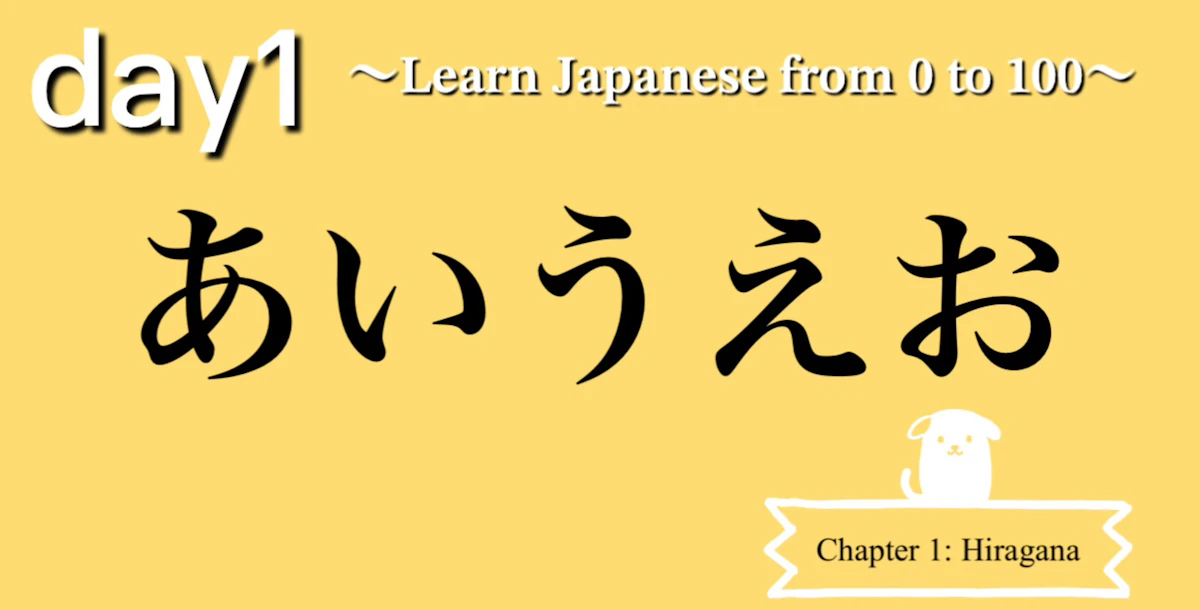
Hiragana is the gateway to Japanese. Before you can read a menu, follow a conversation, or make sense of any grammar point, you need hiragana — all 46 characters of it. This guide gives you everything in one place: a complete reference chart, a memory hook for every row, the sounds that catch beginners off guard, real sentence examples, and a quiz to test your progress.
Bookmark this page. You will return to it.
What Is Hiragana?
Hiragana (平仮名, ひらがな) is one of Japan's three scripts and the one every learner masters first. Unlike kanji (Chinese-derived logographs that carry meaning), hiragana is a phonetic syllabary — each character represents a sound, not a concept. There are 46 base characters, and together they can write any Japanese word.
You will find hiragana everywhere: grammar particles, verb endings, native Japanese vocabulary, and furigana (the tiny reading guides printed above difficult kanji in textbooks and children's books).
Cultural note: Hiragana evolved during the Heian period (794–1185 CE) from simplified cursive forms of Chinese characters. They were originally called onnade (女手, "women's hand") because Heian court ladies used them to write poetry and diaries while men were expected to use formal Chinese. Some of the greatest works of early Japanese literature — including The Tale of Genji — were written in hiragana by women. The script has carried Japanese voices for over a thousand years.
The Complete Hiragana Chart
The 46 hiragana characters are arranged in a traditional grid called the gojūon (五十音, "fifty sounds"), organized by vowel column and consonant row. Learn this order and you will always be able to find any character.
Hiragana | Romaji | Sound |
|---|---|---|
あ | a | "ah" (as in father) |
い | i | "ee" (as in feet) |
う | u | "oo" (short, barely rounded) |
え | e | "eh" (as in get) |
お | o | "oh" (as in boat) |
か | ka | "kah" |
き | ki | "kee" |
く | ku | "koo" |
け | ke | "keh" |
こ | ko | "koh" |
さ | sa | "sah" |
し | shi | "shee" |
す | su | "soo" |
せ | se | "seh" |
そ | so | "soh" |
た | ta | "tah" |
ち | chi | "chee" |
つ | tsu | "tsoo" |
て | te | "teh" |
と | to | "toh" |
な | na | "nah" |
に | ni | "nee" |
ぬ | nu | "noo" |
ね | ne | "neh" |
の | no | "noh" |
は | ha | "hah" |
ひ | hi | "hee" |
ふ | fu | "foo" (soft; between "f" and "h") |
へ | he | "heh" |
ほ | ho | "hoh" |
ま | ma | "mah" |
み | mi | "mee" |
む | mu | "moo" |
め | me | "meh" |
も | mo | "moh" |
や | ya | "yah" |
ゆ | yu | "yoo" |
よ | yo | "yoh" |
ら | ra | "rah" (flapped R — not English R or L) |
り | ri | "ree" (flapped R) |
る | ru | "roo" (flapped R) |
れ | re | "reh" (flapped R) |
ろ | ro | "roh" (flapped R) |
わ | wa | "wah" |
を | wo | "oh" (used only as the object particle) |
ん | n | "n" (standalone nasal consonant) |
Voiced variations: Each row also has a dakuten (voiced) counterpart — か becomes が (ga), さ becomes ざ (za), た becomes だ (da), and so on — adding around 20 more sounds. You will pick these up naturally as you read more; the 46 above are your foundation.
How to Pronounce Each Sound
Japanese vowels are pure and consistent — they never shift depending on surrounding consonants, the way English vowels do. Nail the five vowels (a, i, u, e, o) and every row clicks into place.
The five vowels: - あ (a) — open and relaxed, like the "a" in father, not cat. - い (i) — a bright "ee," lips spread like a smile. - う (u) — short and barely rounded. English speakers tend to over-round this into a "woo" shape; keep your lips flatter and the sound shorter. - え (e) — a clean "eh," like get. - お (o) — a round "oh," like boat.
Four sounds that trip up beginners:
- し (shi) — not "si." Always "shee," no exceptions.
- ち (chi) — not "ti." Always "chee."
- つ (tsu) — the "ts" cluster starts the syllable. You already say it in tsunami — apply the same shape.
- ふ (fu) — softer than English "f." Blow air over your lower lip without pressing it hard to your upper teeth. Some describe it as halfway between "f" and "h."
The R sound: ら り る れ ろ use a tongue-flap that is neither the English "r" nor "l." It is very close to the "d" in the American English word ladder, or the "r" in Spanish pero. The best way to learn it is to hear a native speaker, then mimic the tongue position exactly.
ん (n): The only hiragana with no vowel attached. It adds a full rhythmic beat when it appears inside a word — にほん (Nihon, "Japan") has three beats, not two. Before bilabial sounds like p, b, or m, ん naturally sounds more like "m" (さんぽ, sanpo, "a walk," often sounds like sampo).
Particle pronunciation shifts: Three hiragana have special pronunciations when used as grammatical particles. は (normally "ha") becomes "wa" as the topic particle. を (normally "wo") sounds like "o" as the object particle. へ (normally "he") sounds like "e" as the direction particle. These quirks will make sense in context as you start reading sentences.
Mnemonics: A Memory Hook for Every Row
Shape-based mnemonics link a character's appearance to a sound-alike image. The associations below are approximations — your job is to find the one that sticks for you, then discard the scaffold once the character is automatic.
あ row (vowels): あ has the energy of a bold capital A — picture an acroat doing a split. い is two strokes side by side, like two eels swimming in parallel. う shows pursed lips, that small hook the shape your mouth makes saying "oo." え looks like someone throwing up their arms: "eh?!" お is round and open, like an "oh" mouth.
か row: か looks like a karate chop — two strokes slicing down and across. き has tooth-like strokes on the right: a key with its bit. く is a beak parting to cry "coo" — a cuckoo bird. け has a sturdy upright frame like a kettle handle. こ is two parallel bars: a tiny comb. Take a closer look at the shapes and stroke order in the かきくけこ character guide.
さ row: さ crosses and trails like a sashimi fish swimming sideways. し is a shimmering fishhook hanging in water. す spirals like a suction cup. せ has a cross on a horizontal base — a seat at a desk. そ curves like a slithering sorpent.
た row: た is a dancer's triumphant pose — ta-dah! ち loops like a chicken bending to peck. つ sweeps into a wide curl — a tsunami wave rolling in. て is a simple hook: a tea cup handle. と has a vertical drop and small curl at the base: a tornado touching down.
な row: な has looping strokes like stretchy nacho cheese. に looks like the number "2" with a bar — and the Japanese number two, 二, is pronounced ni! ぬ spirals like nuddles (noodles) twisting in a bowl. ね looks exactly like a cat curled up asleep — and ねこ (neko) means cat! の is a single open loop: a smooth "no" sign. The なにぬねの character guide breaks this row down further.
は row: は has three strokes thrown outward — someone rocking back with a ha laugh. ひ curves up into a small arc, like a hill in silhouette. ふ fans out in four directions, like wind blowing snow from Fuji-san (Mt. Fuji). へ is the simplest stroke in all of hiragana — a single mountain peak. ほ is like は with one extra stroke: the jolly "ho-ho-ho" of Santa.
ま row: ま has a sweeping tail like a magnetic fishing hook dropping into the sea. み flows in two graceful curves — the musical note mi (do-re-mi). む has rounded, heavy corners like a bull's face, and bulls say "moo!" め looks exactly like an eye — and め means eye (me) in Japanese. も is a fish with two hooks, catching more.
や row: や throws its arms wide: "yay!" ゆ has a hooked tail like a yukata robe swaying in the breeze. よ reaches out like arms held open in a yoga pose.
ら row: ら sits like a rabbit with its ears pointing right. り sways like two tall reeds in the wind. る loops into a tight coil — a rug being rolled up. れ unwinds like a reel of thread. ろ curves into a gentle road bend. The らりるれろ pronunciation and writing guide gives this row a deeper treatment when you are ready.
わ row + ん: わ sweeps out like a wave on the ocean. を appears almost exclusively as the direct-object particle and sounds the same as お. ん is a loose squiggle — nothing but "n," the lone consonant of hiragana.
Hiragana in Real Sentences
The fastest way to cement characters is to see them working inside real language. Read each sentence aloud and look up any character you forget.
- あめが ふっています。 Ame ga futte imasu. It is raining.
- まいにち にほんごを べんきょうしています。 Mainichi nihongo o benkyō shite imasu. I study Japanese every day.
- なまえは なんですか? Namae wa nan desu ka? What is your name?
- うみへ いきたいです。 Umi e ikitai desu. I want to go to the sea.
- にほんごが すきです。 Nihongo ga suki desu. I like Japanese.
Notice that in sentence 3, は (the topic particle) is written as ha but read as wa. In sentence 4, へ (the direction particle) is written as he but read as e. You will meet these particle shifts constantly — treat them as vocabulary to memorize rather than exceptions to worry about.
Common Mistakes Learners Make
Learners at this stage tend to share the same handful of errors. Recognizing them now saves weeks of unlearning later.
Confusing あ and お. The shapes are distinct when examined carefully — あ is a three-stroke cross-and-tail, お is a two-stroke circle-and-hook — but early handwriting often blurs them. Slow down and write each stroke separately until the difference is muscle memory.
Writing い with one stroke. い has two distinct strokes, each with its own angle. Connecting them in a single flowing line is a common shorthand that is easy to form and hard to break. Write them deliberately, stroke by stroke, from the start.
Over-rounding う. Learners shaped by English "oo" sounds push their lips forward and extend the vowel. Japanese う is shorter and less rounded — keep the lips relaxed and the sound brief.
Mixing up ぬ, め, and ね. These three characters share looping structures and trip up nearly every beginner. The shortcut: め has a shape that resembles an eye (and means eye in Japanese), ね looks like a sleeping cat, and ぬ is the odd one out — it has two visible loops where め and ね each have one.
Skipping the beat on ん. ん is a full syllable in terms of timing, even though it carries no vowel. In にほん (Nihon, "Japan"), ん takes a full beat — the word has three rhythmic units, not two. Rushing through ん makes speech sound unnatural immediately.
Mispronouncing は as a topic particle. Reading は as "ha" inside a sentence (e.g., わたしはがくせいです) is one of the most reliable signals of a very new learner. The particle pronunciation is always "wa" — no exceptions.
Quiz: Test Your Hiragana Recognition
Cover the answers below, then read each item and write the romaji from memory.
Round 1 — Single characters: 1. う = ? 2. け = ? 3. の = ? 4. ほ = ? 5. る = ?
Round 2 — Words: 6. いえ = ? 7. ねこ = ? 8. みず = ? 9. つき = ? 10. しお = ?
Answers: 1. u — 2. ke — 3. no — 4. ho — 5. ru 6. ie (house) — 7. neko (cat) — 8. mizu (water) — 9. tsuki (moon) — 10. shio (salt)
If you missed any, return to that character's row in the Mnemonics section, write the character ten times while saying the sound aloud, then revisit the quiz. Active recall beats passive reading every time.
Reading hiragana from a page is one skill; pronouncing it clearly in front of someone is another. Start a Free Trial lesson over LINE and read these words aloud with a native Japanese teacher — they will catch pronunciation habits that no written guide can hear.
FAQ
How long does it take to learn hiragana?
Most dedicated learners can recognize all 46 characters within one to two weeks of daily practice. Reaching reading fluency — where you no longer have to pause and think — typically takes another two to four weeks of consistent exposure through real Japanese text. Regular reading practice accelerates this far more than isolated drilling.
Do I need to memorize stroke order?
Yes, for two practical reasons. Correct stroke order produces characters that look consistent and natural, which matters whenever you write by hand. More importantly, understanding stroke order helps you recognize handwritten and cursive Japanese, where printed forms can look quite different. Apps and worksheets that show animated strokes are worth using alongside this guide.
Should I learn hiragana before katakana?
Yes. Hiragana appears in far more beginner contexts — grammar particles, verb endings, and native Japanese vocabulary are all written in hiragana. Katakana (used mainly for foreign loanwords and emphasis) is the next step, and learners pick it up noticeably faster once hiragana is solid, because both syllabaries share the same 46-sound grid.
What comes after hiragana?
Katakana is the immediate next script — same 46 sounds, different shapes, different usage contexts. Once both are solid, most learners begin basic vocabulary, introductory grammar, and their first kanji. You will also encounter dakuten (voiced variants like が and ざ) and youon combination characters (like きゃ, にゅ, and しょ) — all built from the 46 characters you learned here.
Continue learning: - Next lesson → Put today's vowels to work and tackle the かきくけこ row — ka, ki, ku, ke, ko
This article is Lesson 1 of the Kind Japanese 100-day beginner curriculum.

