
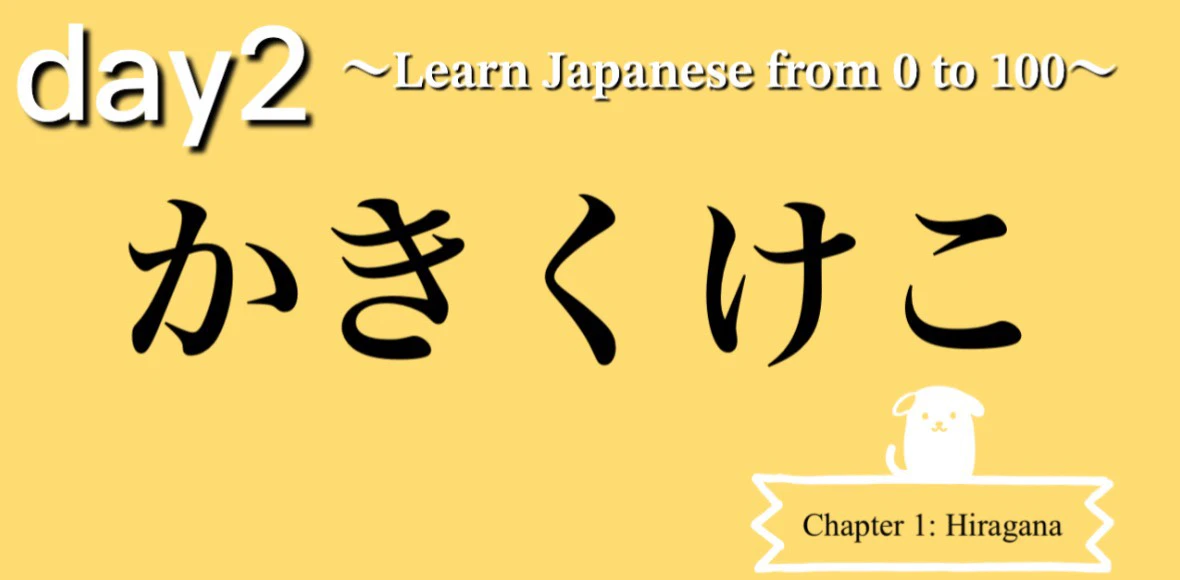
You already know あいうえお. Now add the five characters that open more Japanese words than any other consonant row: か き く け こ — the K-row. By the end of this lesson you'll read them, write them in correct stroke order, say them naturally, and have ten high-frequency vocabulary words ready to use.
If you're joining mid-sequence, start with the あいうえお vowel guide first — those five vowel sounds underpin every character in this lesson.
The Five K-Row Characters (かきくけこ)
Every character in the K-row pairs the consonant k with one of the five Japanese vowels in their fixed order: a, i, u, e, o. This pattern repeats across every consonant row in the hiragana chart, so the structure you learn here accelerates every row that follows.
Hiragana | Romaji | Pronunciation guide | Strokes |
|---|---|---|---|
か | ka | "kah" — open vowel, like "car" without the r | 3 |
き | ki | "kee" — clean and crisp, like the word "key" | 4 |
く | ku | "koo" — light and short; barely rounded | 1 |
け | ke | "keh" — tight vowel, like the start of "kept" | 3 |
こ | ko | "koh" — like the start of "coat," clipped short | 2 |
Pronunciation tip: Japanese syllables carry equal weight and equal duration — resist the English habit of stressing one syllable and swallowing another. Each of these five should sound like a single, even beat.
The k in Japanese is also slightly softer than in English. English speakers add a puff of air before vowels (feel the air from "cat" on your palm); Japanese k is closer to the k in "scat" — far less breath. Practise that difference and your K-row will sound immediately more natural.
Stroke Order: How to Write Each Character
Here are the stroke counts and directions for all five characters. Online you'll find animated hiragana stroke-order guides that show each stroke in motion — watching the animation even once clarifies what the text descriptions below can only approximate.
Cultural note: Stroke order is taught in Japanese primary school from the very first year, and the habit becomes automatic. Learners who build the right order early write faster and more legibly, and recognise characters more quickly when reading.
か (ka) — 3 strokes 1. Short horizontal stroke going left to right 2. A longer stroke starting from above, crossing stroke 1, then curving right and sweeping down 3. A short diagonal stroke from upper right to lower left, below stroke 2
き (ki) — 4 strokes 1. Short horizontal stroke at the upper left 2. A longer horizontal stroke below stroke 1 3. A stroke passing downward through both, ending with a slight rightward hook 4. A curved stroke on the right side, completing the lower portion of the character
く (ku) — 1 stroke One fluid curved stroke: start at the upper left, arc to the right, return to the lower left. く is the simplest character in this entire row. Keep it compact — a wide く looks unbalanced.
け (ke) — 3 strokes 1. Vertical stroke going straight down 2. A horizontal stroke branching from the upper area of stroke 1, going right then curving downward 3. A short curved stroke on the right side completing the lower section
こ (ko) — 2 strokes 1. A short horizontal stroke at the top 2. A longer horizontal stroke below, extending further right and curving gently downward at the end
Practice habit: Write each character slowly 5–10 times per session. Correct form now beats correcting ingrained bad habits later.
Mnemonics: One Memory Hook Per Character
A vivid mental image converts a random shape into something your brain already knows. Pair each image with the sound and say it aloud as you visualise — that multi-sensory loop cements the connection far faster than copying alone.
- か (ka): The two crossing strokes look like a KArate chop — imagine a martial artist striking with arms outstretched. Whenever you see か, picture that cross.
- き (ki): The stacked horizontal strokes resemble the notched teeth of an old-fashioned KInd of key (picture a house key turned sideways — three serrated bars along the blade).
- く (ku): That single curved arc looks like a CUckoo bird's open beak, calling "ku-ku!" — one simple arc, open to the right.
- け (ke): Imagine a KEttle standing upright: the vertical stroke is the body, the horizontal branch is the spout pointing to the right.
- こ (ko): Two horizontal bars, like the side rails of a child's COt. Simple, parallel, complete — don't add a third line.
If a different image sticks better for you, use it. The best mnemonic is the one you actually remember.
Essential Vocabulary and Example Sentences
High-Frequency Words to Learn Today
These ten words are JLPT N5 level — you'll encounter them in textbooks, conversation practice, and listening exercises from your very first month. Notice that several are written entirely in hiragana you already know.
Japanese | Romaji | Meaning |
|---|---|---|
かばん | kaban | bag / briefcase |
かさ | kasa | umbrella |
きって | kitte | postage stamp |
きく | kiku | to listen; to ask |
くつ | kutsu | shoes |
くに | kuni | country |
けいたい | keitai | mobile phone |
こえ | koe | voice |
こども | kodomo | child |
ここ | koko | here / this place |
Sentences in Context
Don't worry about the grammar particles yet — these sentences are for reading practice. Focus on spotting and sounding out the かきくけこ characters.
- これはかさですか? Kore wa kasa desu ka? Is this an umbrella?
- くつはかばんのなかにあります。 Kutsu wa kaban no naka ni arimasu. The shoes are in the bag.
- こどもがここにいます。 Kodomo ga koko ni imasu. The children are here.
- きってをかいました。 Kitte wo kaimashita. I bought a postage stamp.
- けいたいはここにあります。 Keitai wa koko ni arimasu. My phone is right here.
Read each sentence aloud at least twice. Use the romaji as a support if needed, then try reading the hiragana directly.
Common Mistakes Learners Make
These errors come up consistently when learners first tackle this row. Knowing them in advance saves you weeks of unlearning.
Confusing き and け in handwriting. Both have a vertical element and multiple horizontal strokes, so beginners mix them up at speed. The key difference: き has four strokes including a curved element at the lower right; け has three strokes with one clear horizontal branch. Write them side by side until the difference is automatic.
Over-aspirating the K sound. English speakers naturally add a puff of air before vowels — say "keep" close to your palm and you feel it. Japanese k is unaspirated, closer to the k in "ski" or "school." Practise with your hand near your mouth: you should feel almost no air.
Making く too wide. Because く is a single stroke, learners tend to draw it big and sweeping. Keep it compact — roughly the same height and width as your other kana. An oversized く looks out of proportion on the page.
Merging strokes 3 and 4 of き into one. Learners sometimes connect the third and fourth strokes into a single motion, which muddles the character. In careful handwriting, treat them as two distinct strokes to keep き legible and well-proportioned.
Adding a third stroke to こ. こ has only two strokes and looks deceptively simple — so simple that beginners sometimes add a third line thinking it looks incomplete. It is not incomplete. Two strokes is the whole character.
Practice Drills
Work through these in order: first combine the K-row with the vowels you know, then read real words, then test recall.
Combination Reading Table
Every K-row character can pair with the five vowels from Lesson 1. Read each combination aloud — you'll recognise some real Japanese words:
Base | + あ (a) | + い (i) | + う (u) | + え (e) | + お (o) |
|---|---|---|---|---|---|
か | かあ (kā) | かい (kai) | かう (kau) | かえ (kae) | かお (kao) |
き | きあ (kia) | きい (kī) | きう (kiu) | きえ (kie) | きお (kio) |
く | くあ (kua) | くい (kui) | くう (kū) | くえ (kue) | くお (kuo) |
Real words in that table: かい (shellfish / meeting), かう (to buy), かお (face), くう (to eat — informal). You're reading real Japanese already.
Word Reading Drill
Read these words without looking at the romaji. Check yourself after:
- こえ → koe (voice)
- かさ → kasa (umbrella)
- くつ → kutsu (shoes)
- ここ → koko (here)
- こども → kodomo (child)
- かばん → kaban (bag)
- きって → kitte (postage stamp)
Mini Quiz
What sound does each character make?
- く = ?
- け = ?
- か = ?
- こ = ?
- き = ?
Answers: 1. ku 2. ke 3. ka 4. ko 5. ki
FAQ
How many strokes does か have?
か has 3 strokes: a short horizontal line, a longer stroke that crosses it and sweeps downward, then a short diagonal at the bottom right. Writing strokes in the correct order from the start builds muscle memory that makes your handwriting look natural and helps you distinguish similar characters faster when reading.
What is the difference between く and け?
く is a single curved arc that makes the sound ku; け has three strokes and makes the sound ke. On the page they look quite different — く is a simple open curve, け has a clear vertical line with a horizontal branch. Write them side by side a few times and the contrast becomes immediately obvious.
Is the u in く always pronounced?
The u is phonemically present but can become devoiced (whispered) in natural speech, especially between unvoiced consonants. In くつ (kutsu, shoes), the u often becomes nearly inaudible to English ears. For now, pronounce it lightly — you'll absorb the natural patterns through listening practice as you advance.
How does the K-row connect to the rest of hiragana?
Every consonant row follows the same a-i-u-e-o pattern — you only swap the consonant. Once this K-row is solid, each new row builds faster on the last. The N-row hiragana guide (なにぬねの) and the R-row hiragana guide (らりるれろ) follow exactly the same structure, so you'll notice your pace picking up as the chart fills in.
Reading hiragana silently is a start — saying it naturally is the real goal. Practise your K-row pronunciation with a native Japanese teacher in a live one-on-one session: start your Free Trial lesson on LINE and get immediate feedback on the sounds that are trickiest for English speakers.
Continue learning
← The あいうえお vowel guide — the five core vowels every hiragana character is built on
→ The さしすせそ S-row guide — five more characters, including the "shi" sound that surprises every English speaker
This article is Lesson 2 of the Kind Japanese 100-day beginner curriculum, covering the K-row hiragana: か き く け こ (ka ki ku ke ko).

