
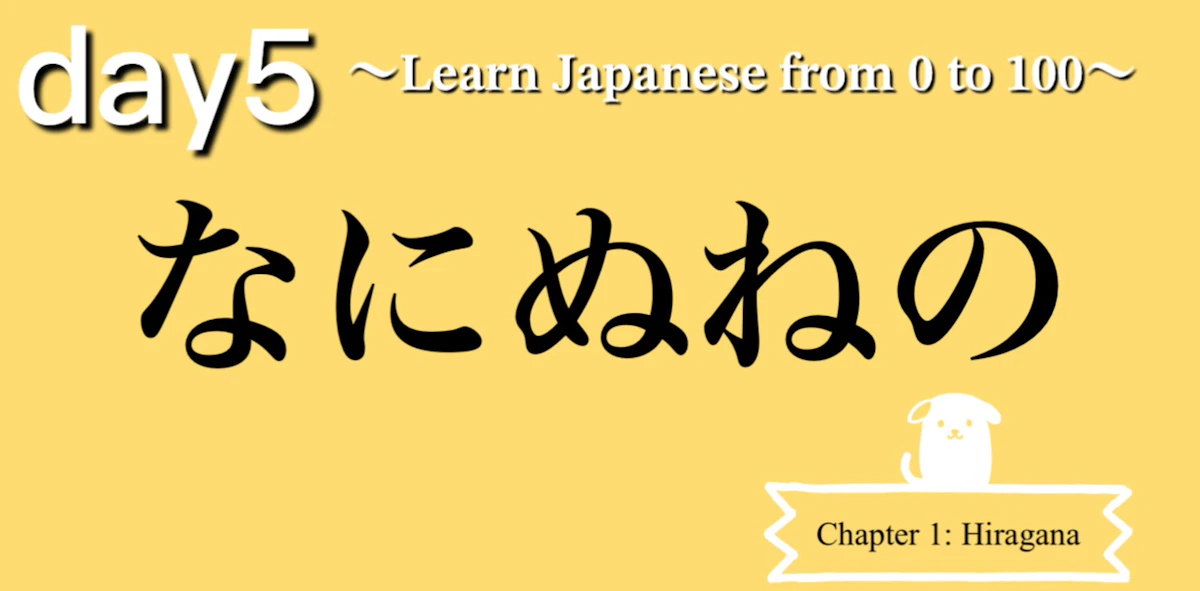
The Na-row — な, に, ぬ, ね, の — is your fifth set of hiragana characters, and it is one of the most rewarding to learn. These five sounds appear constantly in everyday Japanese speech, and の in particular is one of the most frequently used particles in the entire language. Once you can read and write this row, you will spot it everywhere — in menus, song titles, and conversation from day one.
This guide gives you pronunciation, stroke order, a visual mnemonic for every character, twelve vocabulary words to practise with, and a short quiz to lock it all in.
The Five Na-Row Characters
Each character pairs the same "n" consonant with one of the five Japanese vowels: a, i, u, e, o. The pronunciation is completely consistent — there are no irregular sounds in this row.
Hiragana | Romaji | Pronunciation guide |
|---|---|---|
な | na | "nah" — relaxed, like shrugging off a question |
に | ni | "nee" — short and clean, not drawn out |
ぬ | nu | "noo" — a quick, soft sound |
ね | ne | "neh" — rhymes with "bet" |
の | no | "noh" — sounds just like the English word "no" |
All five vowel sounds are the same ones you first encountered in the hiragana vowels あいうえお. If any vowel sound is fuzzy, that is a good page to revisit before drilling this row.
Stroke Order: How to Write Each Character
Learning correct stroke order from the start prevents habits that are surprisingly hard to break later. Work through each character slowly.
な (na) — 4 strokes 1. Short horizontal stroke, left to right 2. Vertical stroke crossing the first, going down and slightly right 3. Curved stroke sweeping down and to the left from the intersection 4. Small separate hook stroke on the lower right, curling upward — do not skip this one
に (ni) — 3 strokes 1. Short horizontal stroke 2. Second short horizontal stroke below the first, parallel to it 3. Longer vertical stroke on the right that curves and flares outward at the bottom
ぬ (nu) — 2 strokes 1. Curved stroke sweeping down and to the left 2. A second stroke beginning to the right of the first, forming a distinctive knotted loop in the lower portion
ね (ne) — 2 strokes 1. Vertical stroke on the left side 2. A longer stroke on the right that curves downward, forms a closed loop, then curls outward and upward
の (no) — 1 stroke Draw a single fluid spiral: start at the upper right, sweep left and downward, then curl back to the right. The entire character is one continuous motion.
Memory Tricks: One Mnemonic per Character
One strong image per character beats drilling a stroke ten times with no mental hook. Here is a picture-based mnemonic for each Na-row character.
な (na) → Imagine someone crossing their arms and saying "Nah!" The two crossed strokes in the centre of な look exactly like crossed arms, and the curved stroke trailing off is the dismissive wave that follows.
に (ni) → Think of two knees. The two horizontal strokes are two kneecaps, and the vertical line below them is the leg. Ni sounds like "knee" — this association sticks immediately for most learners.
ぬ (nu) → Picture a bowl of noodles. The looping, swirling second stroke of ぬ looks like noodles curling in a bowl. Nu → noodles. Every time you see ぬ, imagine steam rising from the bowl.
ね (ne) → Think of a cat with a curly tail. The loop sweeping to the right of ね is the cat's tail curling upward. Conveniently, neko (ねこ) is the Japanese word for cat, and ね is the opening character of that word.
の (no) → A single circular stroke that looks like a spinning coin or a rolled-up "no-entry" sign. The English meaning "no" makes this one doubly easy to anchor — even though の does not actually mean "no" in Japanese.
Na-Row Vocabulary Reference
Work through this table by covering the romaji and English columns, reading the hiragana aloud, then checking your answer. These twelve words all feature Na-row characters prominently and cover everyday vocabulary.
Hiragana | Romaji | English |
|---|---|---|
なつ | natsu | summer |
なまえ | namae | name |
なか | naka | inside, middle |
なに | nani | what |
にく | niku | meat |
にほん | Nihon | Japan |
にわ | niwa | garden |
ぬの | nuno | cloth, fabric |
ぬるい | nurui | lukewarm |
ねこ | neko | cat |
ねつ | netsu | fever, heat |
のみもの | nomimono | drink, beverage |
Notice how many of these words come up in ordinary daily life: ordering drinks, talking about pets, describing weather, introducing yourself. The Na-row is not abstract vocabulary — it is the vocabulary of conversation.
の: The Particle That Connects Everything
Of all five Na-row characters, の deserves special attention because it does double duty: it is a hiragana character and one of the most important grammar particles in Japanese.
の as a linking particle works like "of" or "'s" in English. It sits between two nouns so that the first describes, belongs to, or modifies the second.
わたしのなまえ — watashi no namae — "my name" (literally: "I of name") にほんのなつ — Nihon no natsu — "Japan's summer" / "summer in Japan"
Cultural note: の is so ubiquitous in Japanese that learners often spot it in shop signs, food menus, and song titles long before they have finished learning all 46 hiragana. Recognising it in the wild is one of the first small, satisfying victories of learning to read Japanese.
Here are five example sentences using Na-row vocabulary in context:
- なまえはなに? Namae wa nani? What is your name?
- ねこがにわにいる。 Neko ga niwa ni iru. There is a cat in the garden.
- にほんのなつはあつい。 Nihon no natsu wa atsui. Summer in Japan is hot.
- のみものはなに? Nomimono wa nani? What would you like to drink?
- ねこのなまえはなに? Neko no namae wa nani? What is the cat's name?
Common Mistakes Teachers See Most Often
Mixing up な (na) and た (ta) The resemblance is real — both characters have a horizontal stroke crossed by a vertical one, and both have a curved lower section. The difference is in the lower right: な has a small, separate hook stroke that stands apart from the curve, while た curves upward from the same body without a separate element. Slow down and isolate that bottom-right corner before moving on.
Confusing ぬ (nu) with め (me) Both characters have a prominent swirling loop, and learners regularly swap them in reading practice. The key distinction: ぬ begins with a clearly separate curved stroke on the left before the loop forms, and its loop opens to the right. め is more compact, with its components sitting closer together and a different opening angle. Writing both side by side, ten times alternating, until the difference feels automatic is the most reliable fix.
Confusing ね (ne) with れ (re) These two are nearly identical at a glance — it is one of the most common mix-ups in the entire hiragana set. The difference lies in the final stroke: ね's loop closes and curls back into a tight upward hook, while れ extends into a longer, more open final stroke that sweeps outward. Learners often find that studying the ら-row hiragana later in the curriculum naturally resolves the confusion, but knowing these two look similar means the comparison will not catch you by surprise.
Pronouncing に (ni) too forcefully English speakers tend to push the initial consonant based on how "knee" feels in English. In Japanese, に is softer — the "n" is lighter, and the vowel is clipped. Aim for a gentle, forward sound rather than stressing the consonant.
Practice Quiz
Part 1: Reading Write the romaji reading for each character:
- ぬ = ?
- の = ?
- ね = ?
Part 2: Vocabulary Match each hiragana word to its English meaning:
- なまえ → (a) cat (b) name (c) drink
- ねこ → (a) garden (b) meat (c) cat
- のみもの → (a) drink (b) summer (c) cloth
Part 3: Write from memory Without looking at this page, write each character once in the correct stroke order: な、に、ぬ、ね、の
Answers Part 1: 1. nu 2. no 3. ne Part 2: なまえ → (b) name | ねこ → (c) cat | のみもの → (a) drink
FAQ
How do I write な correctly, step by step?
な is written in four strokes: a short horizontal line, a vertical line crossing it, a curved stroke sweeping down and to the left, and a small separate hook on the lower right. That fourth stroke is what beginners most often skip — it sits slightly apart from the curve and is essential to the character's distinctive shape.
What does の mean in Japanese?
の (no) is a possessive and linking particle. It connects two nouns so the first describes or belongs to the second, similar to "of" or "'s" in English. For example, にわのねこ (niwa no neko) means "the cat in the garden." It is one of the most frequently appearing words in the entire language.
How is ぬ different from め?
Both have a swirling loop, but ぬ begins with a distinct curved stroke on the left before the loop forms, and the loop opens toward the right. め is more compact, with its two components sitting closer together and the opening facing a different direction. Writing both side by side repeatedly is the fastest way to feel — not just see — the difference.
Do all Na-row characters use the same "n" sound?
Yes. The "n" consonant stays the same across な, に, ぬ, ね, and の — only the following vowel changes (a, i, u, e, o). This consistency makes the Na-row one of the most predictable rows to learn, with no irregular pronunciations to memorise alongside the shapes.
Want to test your pronunciation of な, に, ぬ, ね, and の with a real teacher? One-on-one practice over LINE lets you read these characters aloud and get instant feedback on your sounds — something no worksheet can give you. Start your Free Trial with Kind Japanese and put these characters to work in a real conversation.
Continue learning
- Previous lesson: The さ-row hiragana — sa shi su se so
- Next lesson: The ま-row hiragana — ma mi mu me mo
For a useful comparison of character shapes, it is also worth revisiting how the Ka-row was introduced: the か-row hiragana (ka ki ku ke ko) shares several structural patterns with the Na-row and makes a helpful side-by-side study companion.
This article is Lesson 5 of the Kind Japanese 100-day beginner curriculum.

