
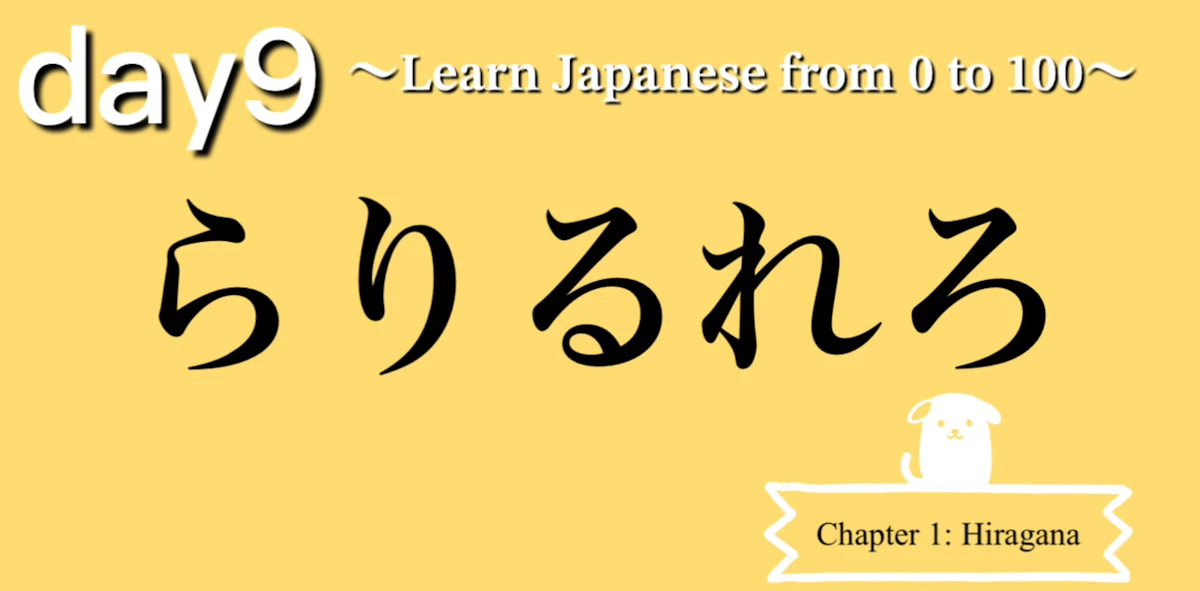
The Five R-Row Characters at a Glance
The R-row — ら行 (ra-gyō) — is the ninth group of hiragana. Five syllables, all built on the same consonant: the Japanese alveolar tap. Here is your instant reference:
- ら — ra — 2 strokes
- り — ri — 2 strokes
- る — ru — 1 stroke
- れ — re — 2 strokes
- ろ — ro — 1 stroke
Each character pairs the R consonant with one of the five Japanese vowels (a, i, u, e, o) — the same vowel-pairing pattern you saw with the hiragana vowels あいうえお and the K-row characters かきくけこ. Nail the tap sound once, and all five characters come naturally.
How to Pronounce the Japanese R: The Alveolar Tap
The Japanese R is not the English R and not the English L — it is a distinct sound called the alveolar tap, and getting it right is the single most important step before you start practising the shapes.
What actually happens in your mouth: The tip of your tongue briefly taps the alveolar ridge — the bumpy ridge just behind your upper front teeth — and immediately pulls away. There is no curl, no sustained contact, and no lip rounding. The whole movement takes a fraction of a second.
You almost certainly already make this sound in English. Say the word "butter" in a relaxed American accent. That quick flapped sound in the middle — the soft double-T between the two vowels — is your tongue doing an alveolar tap. The Japanese R is exactly that movement, placed at the beginning of a syllable instead. The word "water," said casually, gives you the same flap: that middle sound is your ら.
Three-way comparison:
- English "R" — the tongue curls back (retroflex) and never touches the roof of the mouth. Heavy and tense. ("red," "run")
- Japanese "R" — the tongue tip taps the alveolar ridge once, lightly, and releases immediately. (ら, り, る, れ, ろ)
- English "L" — the tongue presses against the alveolar ridge and stays there while air flows around the sides. ("led," "lake")
Japanese R is faster than English L and far lighter than English R. Practise saying "butter" slowly, isolate that middle tap, then shift it to the front of the vowel "ah" — you get ら (ra). Move it in front of "ee" and you get り (ri). The same tap carries all five syllables.
Keep your vowels clean. Japanese vowels are short and pure — no glide, no diphthong. Open wide for a, spread your lips for i, keep them relaxed and barely parted for u, hold your mouth halfway open for e, and lightly round for o. Each syllable ends cleanly; resist the English habit of letting the vowel drift (so that ro becomes "roh-oo" and re becomes "reh-ee").
Pronunciation is the hardest part of the R-row, and the one place where live feedback makes the biggest difference. Start your Free Trial with a native Japanese teacher on LINE and get your ら-row pronunciation corrected in real time before bad habits take hold.
Stroke Order for らりるれろ
Writing with correct stroke order is not a formality — it builds muscle memory and makes your handwriting look natural to Japanese readers. Read each description carefully, pick up a pencil, and go slowly.
ら (ra) — 2 strokes Stroke 1: A short, slightly curved horizontal line going to the right. Stroke 2: Begin above and to the left, sweep right, then curve downward and loop around into a rightward tail that extends away from the body of the character.
り (ri) — 2 strokes Two roughly vertical strokes side by side. Stroke 1: A short stroke with a slight hook curving to the right at the bottom. Stroke 2: Longer, starting a touch higher than stroke 1, curving down and sweeping to the left at the base.
る (ru) — 1 stroke Begin at the upper right, curve left and downward, then loop back to the right to form a small closed circle. End by curling gently to the left — that outward tail is what gives る its distinctive shape.
れ (re) — 2 strokes Stroke 1: A straight vertical line going downward. Stroke 2: Branch to the right from near the top of stroke 1, curve down past the vertical line, loop to the right forming a rounded section, then extend the tail further right with a slight upward lift.
ろ (ro) — 1 stroke Start and move exactly as you would for る, but after the loop the stroke closes inward instead of extending left. Think of る with its tail tucked back in — that is ろ.
Practice tip: Write each character ten times slowly before you work on speed. Slow, deliberate strokes build the correct motor pathway; speed follows naturally with daily repetition.
Mnemonics: A Visual Hook for Each Character
A strong mental image lets you recall a shape in half a second. Make each image vivid and slightly ridiculous — your brain retains strange pictures far better than abstract line descriptions.
- ら (ra) — A rabbit sitting up with rounded ears curving to one side. Two strokes, two ear-curves. Every time you see ら, picture the rabbit.
- り (ri) — Two reeds standing in still water — one short, one tall. Ri-reed. The two vertical strokes are the two blades of grass.
- る (ru) — A running track seen from above: one endless loop you circle around and around. Ru-round.
- れ (re) — Someone reaching forward to pick something up from the floor: the vertical line is the body, the looping stroke is the arm extending out and ending in a lifted hand.
- ろ (ro) — A road that doubles back on itself — a roundabout that loops inward with no clear exit. Closed in, unlike the open-tailed る.
Common Words Using らりるれろ
Twelve high-frequency words built from R-row characters. These appear constantly in everyday Japanese speech and writing — return to this table regularly as your vocabulary grows.
Japanese | Romaji | English Meaning |
|---|---|---|
りんご | ringo | apple |
らく | raku | easy, comfortable |
るす | rusu | being away from home; unanswered call |
れい | rei | zero; example; a bow |
ろく | roku | six |
りょうり | ryōri | cooking, cuisine |
れんしゅう | renshū | practice, drill |
ろうか | rōka | hallway, corridor |
らいねん | rainen | next year |
りゆう | riyū | reason, cause |
れきし | rekishi | history |
るり | ruri | lapis lazuli; deep blue |
Cultural note: りんご (apple) is one of Japan's most celebrated fruits. Aomori Prefecture in the far north produces around 60% of the country's entire apple harvest, and presenting a box of premium Aomori apples is a genuine gesture of care — not a casual snack. You will spot りんご early and often, from school reading exercises to fruit-shop signs.
Example sentences:
- りんごがすきです。
Ringo ga suki desu.
I like apples. - ろくじにおきます。
Roku-ji ni okimasu.
I wake up at six o'clock. - まいにちれんしゅうします。
Mainichi renshū shimasu.
I practise every day. - らいねんにほんにいきます。
Rainen Nihon ni ikimasu.
I will go to Japan next year. - りょうりがじょうずですね。
Ryōri ga jōzu desu ne.
You're quite good at cooking, aren't you?
(Some sentences include hiragana characters from upcoming lessons — treat them as a preview of what you'll learn soon.)
Common Mistakes Learners Make
1. Substituting the English retroflex R. The most widespread error. Learners hear ら and produce the heavy English "r" of "run" — a tense, curled sound that sounds wrong to Japanese ears. Remind yourself: tap the ridge and release immediately, like the middle consonant in "butter." Nothing more.
2. Holding the tongue on the ridge (producing an L). The mirror mistake — overcorrecting away from English R and landing on English L. Japanese R must flick; the tongue cannot linger. Learners whose native language includes a tap consonant (Spanish r, Korean ㄹ, Italian r between vowels) often find the Japanese R comes more naturally than they expect.
3. Confusing る and ろ in writing. Both are single-stroke loops and look strikingly similar until you train your eye. The difference: る has a tail that extends outward to the left; ろ closes inward without that tail. Write them side by side twenty times until the difference becomes automatic.
4. Adding a vowel glide. English speakers instinctively drift: ro becomes "roh-oo," re becomes "reh-ee." Japanese vowels are pure and short — cut each one cleanly at its peak.
5. Stretching り (ri) into a long vowel. Japanese り is a short, crisp flick. The English "ree" in "reed" is long and drawn out by comparison. If you tend to sing the vowel, pull it back and make it quick.
Practice: Drills and Mini Quiz
Reading drill — read each line aloud three times, keeping the tap light and each vowel short and clean:
ら り る れ ろ
りんご ろく らく れい るす
らいねん りょうり れんしゅう ろうか
Writing drill — close this page, pick three characters at random, write each ten times from memory, then check your stroke order.
Mini quiz — what is the romaji reading for each character?
- り = ?
- ろ = ?
- ら = ?
- れ = ?
Answers: 1. ri 2. ro 3. ra 4. re
Bonus challenge: Which of these characters is written with a single stroke — る or り?
Answer: る is a single stroke. り uses two.
FAQ
Is the Japanese R closer to R or L?
Neither exactly. It is an alveolar tap — the same flick your tongue makes in the casual American English "butter" or "water." It is faster than English L, which holds the tongue in place, and far lighter than English R, which never touches the palate at all. Isolate the tap first, then attach each vowel: ra, ri, ru, re, ro.
Do I need to learn stroke order if I only plan to type Japanese?
For typing, stroke order is irrelevant — you press phonetic keys and the character appears. But stroke order matters for handwriting, and for recognising characters in handwritten menus, personal messages, and informal signs, which appear constantly in daily Japanese life. Learning it correctly once costs only a few minutes per row.
What is the difference between る and ろ when writing?
Both are single-stroke loops, but る has a tail that extends outward to the left at the end, while ろ closes inward without that extending tail. A quick mental shortcut: る is "open," ろ is "closed." Writing them alternately in columns is the fastest way to lock in the difference.
Will I need to learn these sounds again for katakana?
Yes — katakana has its own R-row: ラ (ra)、リ (ri)、ル (ru)、レ (re)、ロ (ro). The pronunciation is completely identical; only the visual shapes differ. Once you're confident with the hiragana versions here, the katakana RA RI RU RE RO guide (ラリルレロ) will feel much faster to learn.
Continue Learning
This article is Lesson 9 of the Kind Japanese 100-day beginner curriculum.

